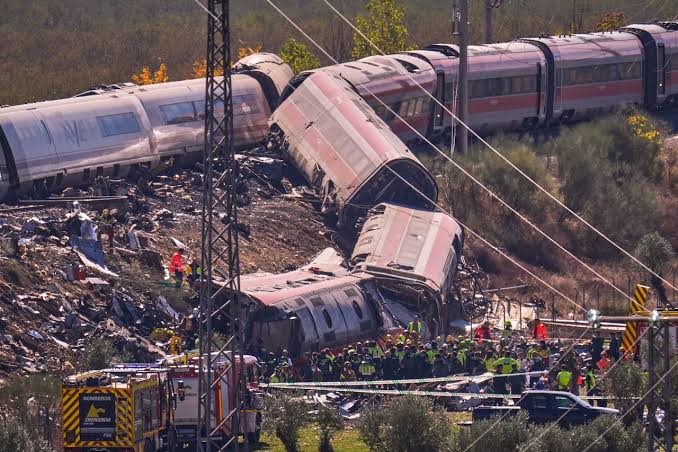
At least 68 people were killed and more than 100 injured on Wednesday, 28 October, when two high-speed trains collided near Urda in Toledo province, south of Madrid, according to the Castilla-La Mancha regional government as reported by Euronews. The trains, run by Renfe and Iryo on the Madrid–Seville line, came together at about 8:53 am on a straight stretch of track with good visibility. Renfe said the two rear carriages of the Iryo train derailed. Prime Minister Pedro Sánchez, who said he was “shocked”, has declared three days of national mourning, and infrastructure operator Adif has suspended high-speed services in both directions between Madrid and Andalusia. European Commission president Ursula von der Leyen said “Europe mourns”.
The government’s account points to a failure of procedure rather than the drivers. Transport Minister Óscar Puente called a decision by the central control centre in Madrid “inexplicable” and said it is the focus of the investigation. According to Euronews, a safety system known as LZB failed on a 63-kilometre stretch at about 8:30 am because of a computer fault, and automatically stopped about six trains. At 8:36 am the control centre authorised the Renfe AVE train to resume normal running even though a red signal was still active. After about 25 kilometres the AVE hit the stationary Iryo train. Puente said the AVE should have run under a reduced-speed procedure known as “marcha a la vista” and that it may have reached 200 km/h, although the speed is still being checked. Sánchez said the government would respond firmly if failures in the safety systems were confirmed.
The counterargument is that this is the second deadly high-speed rail crash in nine months. In January, a collision between two trains near Adamuz killed 46 people, and the Partido Popular has questioned the government’s management of the network, and Vox filed a criminal complaint for homicide against Puente. The reports also leave questions open, since the figures differ. One Euronews article says 58 people are being treated in hospital, another refers to more than 100 injured, and a sidebar headline cites a toll of 74, so the figures should be treated as provisional. Officials have also said the crash was caused by human error after a computer failure, which raises the question of why a single decision could override a red signal.
The politics are immediate. Sánchez called an early general election for next month, and Euronews says the main parties suspended their pre-campaign events after the crash, except Vox. Before the crash, a poll in El Mundo on 26 October put the Partido Popular at 30.6% and the Socialists at 26.1%, with Vox on 19.9%, while the CIS poll placed the Socialists well ahead. Health Minister Mónica García called it a “high-impact accident”, and French President Emmanuel Macron expressed France’s solidarity, so the investigation will be watched well beyond Spain.
For now, Spain is counting its dead and waiting for answers about one order given in a control room. The findings will decide whether the blame lies with a single decision or with the way the network is run.