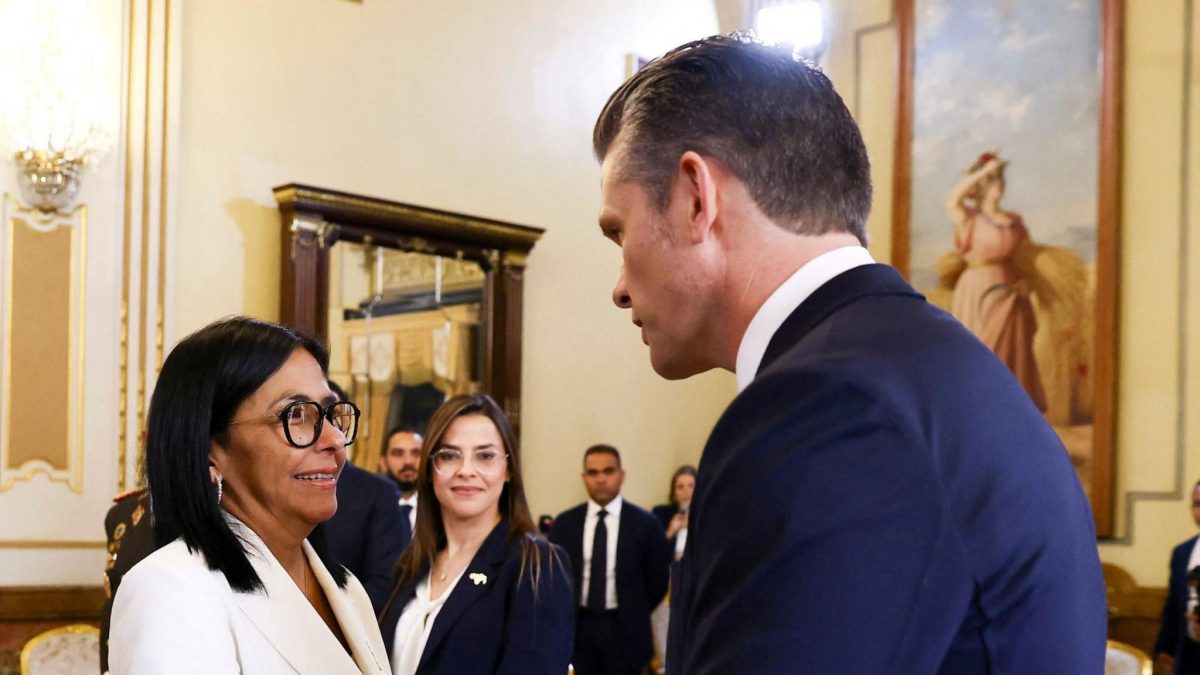
A year ago, the idea of a United States Secretary of Defense standing in Caracas and shaking hands with a Venezuelan government would have sounded like fiction. This week it was real. On Wednesday, Pete Hegseth signed a military cooperation agreement with Venezuela’s interim government, less than a year after US forces seized the country’s leader, Nicolás Maduro, in a raid on the capital.
The deal is short on public detail and long on symbolism, and it says a lot about how quickly the map of the Americas has been redrawn.
What happened
According to the BBC, Venezuela’s interim government, led by Delcy Rodríguez, Maduro’s former vice-president, signed the military cooperation agreement with Hegseth on Wednesday. The deal was signed by Hegseth and Venezuela’s defense minister. Few details have been released.
Hegseth said Venezuela had “gone from our most aggressive regional threat to a compliant security partner” in less than twelve months. Rodríguez, for her part, said the deal would help confront “common threats.”
In remarks at the US embassy in Caracas, Hegseth said he was “the first United States Secretary of War this century to set foot in Venezuela” and added that, just a year earlier, his presence “would have been deemed impossible, almost unimaginable.” He described the agreement as a “new chapter for the United States, for Venezuela, for the Venezuelan military and for the Western Hemisphere through the Americas Counter Cartel Coalition.”
What we know, and do not know, about the contents
Here is the honest part. No details of the deal have been published. In her own speech, Rodríguez mentioned the training of Venezuela’s armed forces, improving its “operational equipment,” and access to new technology “to confront shared threats.”
That is as specific as it gets. Hegseth was more direct about who he considers the threat, addressing “the narco-terrorists who abuse this [Venezuela] as a safe haven” and warning: “we will hunt you down, we will find you, and we will kill you.”
So the agreement is framed as a counter-cartel partnership. Beyond that framing, the public has to wait for documents that have not appeared.
How we got here
The history helps explain why this moment is so striking. The BBC reports that military cooperation between the two countries was terminated in 2005 by Hugo Chávez, who alleged that US military personnel sent to train Venezuelan counterparts had made disparaging remarks about his government. He also accused the US military office at Fuerte Tiuna, Venezuela’s largest military complex, of being “an organ of the CIA… conspiring against the government.”
Relations worsened under Maduro, who succeeded Chávez after the latter’s death from cancer. They reached rock bottom late last year, when the US doubled its reward for information leading to Maduro’s capture to $50 million (£38 million). Then, on January 3, US forces seized him in a military raid. Maduro and his wife, Cilia Flores, are now in custody in New York on charges of drug trafficking and conspiracy to commit torture, which they deny.
That is the background to Wednesday’s handshake: a two-decade freeze, a dramatic raid and a new interim government willing to work with the country that carried it out.
A message from the podium
Hegseth used the occasion to recall Maduro’s defiance. He said that “exactly one year ago today,” Maduro had stood on a stage “not too far from here” and yelled mockingly, “Come and get me!” and added, “Well, we answered that call.” He also quoted Maduro’s words, “No war, yes peace,” saying the result of the raid had been as Maduro predicted.
It was a victory lap, and an unmistakable signal to others in the region. But victory laps are not strategy, and the harder questions come after the cheering stops.
The Colombian side trip
From Venezuela, Hegseth traveled on to neighboring Colombia, whose president, Abelardo de la Espriella, is a close ally of the Trump administration. Colombia is already part of the US-led Americas Counter Cartel Coalition, and in August Hegseth floated the possibility of joint US-Colombian military operations against armed groups.
On Wednesday, de la Espriella denied on X a New York Times report that he had rejected joint operations, stressing that any decision would be taken while respecting Colombia’s constitution, laws and sovereignty. Hegseth reposted the message, calling the partnership “stronger than ever before.”
Back home in Colombia, the issue is politically charged. Al Jazeera reported on Friday that thousands protested Colombia’s tax plans amid a row over the US military role. That is a reminder that cooperation with Washington is not universally popular, even among a government’s own citizens.
Why this deal raises questions
Without details, observers are left to ask the kind of questions any thoughtful reader would.
What exactly will US personnel do inside Venezuela, and where? Training and equipment can mean many things.
Who oversees the deal? Venezuela’s government is an interim one, and the BBC’s reporting makes clear that the arrangements are new and untested.
How will the arrangement sit with Venezuelans themselves? The BBC has previously reported that a separate US oil deal puzzled analysts and angered many Venezuelans, which suggests public opinion may not be uniformly supportive of closer ties.
And what does “compliant” mean? Hegseth’s own word choice, describing Venezuela as a “compliant security partner,” will be read very differently in Caracas than in Washington.
The wider shift
Zoom out, and the story is part of a larger realignment. The Americas Counter Cartel Coalition, as Hegseth describes it, is becoming the framework for US security engagement in the hemisphere. It now includes Colombia and, with this agreement, a Venezuela that has changed dramatically in under a year.
For some Latin Americans, that is reassuring: a coordinated approach to drug trafficking and armed groups that have destabilized communities. For others, it evokes a long history of US intervention that many in the region have not forgotten. Both reactions have deep roots, and any serious assessment has to hold them together.
The people at the center
It is worth remembering who is not in the photographs. Millions of Venezuelans have lived through economic collapse, migration and political upheaval over the past decade. Their daily concerns, such as prices, power cuts, safety and the chance to rebuild, rarely rank high in the language of military agreements.
If the deal brings security and stability, many would welcome it. If it deepens dependence without delivering improvements in ordinary life, the goodwill will not last. Interim governments, by definition, are meant to lead toward something. What that something is remains the central question hanging over Venezuela.
What to watch
Whether the text of the agreement is made public, and what it says about US personnel and operations.
How Venezuelan political and military figures, and the public, react.
Whether similar deals are signed with other countries in the region.
How the Colombian debate over joint operations develops after the protests.
For now, what we have is a signature, a speech and a big change in tone. The substance, as so often in diplomacy, is still to come.