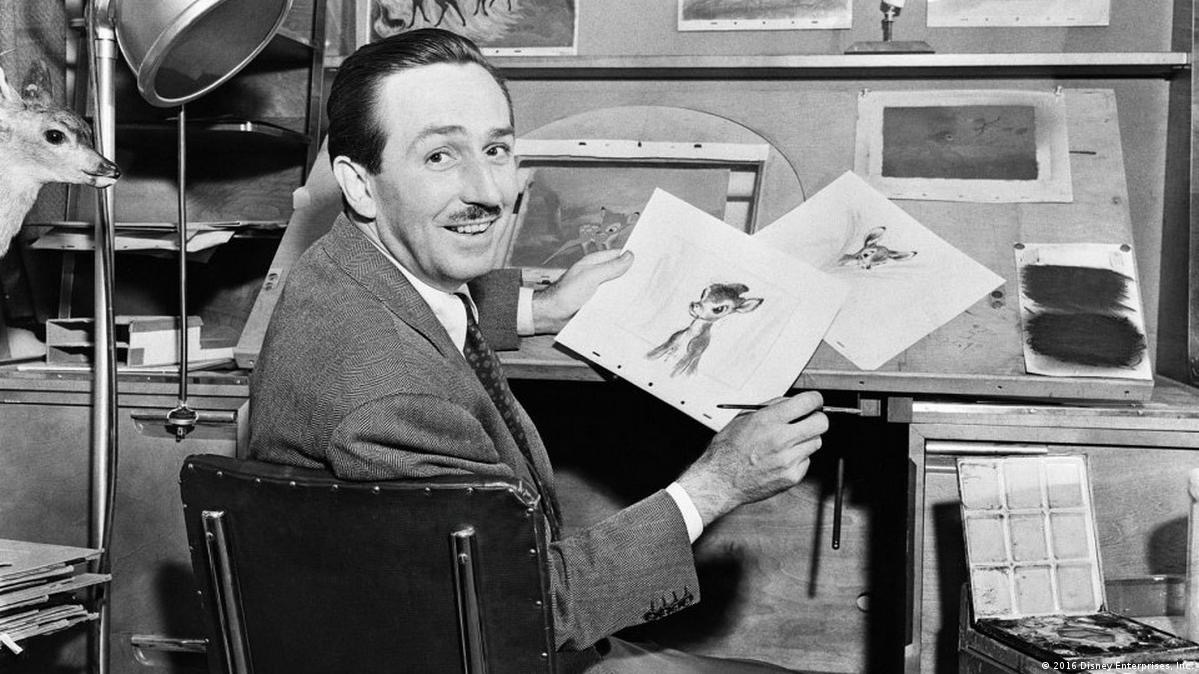
Walter Elias Disney (5 December 1901 – 15 December 1966) was an American animator, film producer, voice actor and entrepreneur. He was a pioneer of the American animation industry, co-founded the studio that became the Walt Disney Company, and holds the record for the most Academy Awards won by an individual, 22, and the most nominations, 59. He opened Disneyland in 1955.
Walt Disney at a Glance
| Full name | Walter Elias Disney |
| Born | 5 December 1901, Chicago, Illinois, United States |
| Died | 15 December 1966, aged 65 |
| Profession | Animator, film producer and entrepreneur |
| Company | Disney Brothers Studio (1923), now the Walt Disney Company, with his brother Roy |
| Key creations | Mickey Mouse (1928); Snow White and the Seven Dwarfs (1937); Disneyland (1955) |
| Academy Awards | 22 won and 59 nominated, both records |
| Spouse | Lillian Bounds (married July 1925) |
| Children | Diane (born 1933) and Sharon (adopted 1936) |
Early Life
Walt Disney was born in the Hermosa neighbourhood of Chicago, the fourth son of Elias Disney and Flora Disney. The family moved to Kansas City, Missouri, in 1911, and he and his brother Roy delivered newspapers every morning before school. He developed an early interest in drawing, took art classes, and at 18 took a job as a commercial illustrator, where he befriended the artist Ub Iwerks. His Laugh-O-Gram Studio in Kansas City went bankrupt in 1923, and he moved to Hollywood in July that year at the age of 21.
The Disney Studio and Mickey Mouse
Disney and his brother Roy formed the Disney Brothers Studio in 1923. After losing control of the character Oswald the Lucky Rabbit, Disney and Iwerks developed Mickey Mouse, whose name Disney's wife Lillian suggested in place of "Mortimer". Mickey first appeared in May 1928 and made his breakthrough with Steamboat Willie, the first post-produced sound cartoon. Disney voiced Mickey until 1947. The Silly Symphonies series followed, and Flowers and Trees won the first Academy Award for Best Short Subject (Cartoon) in 1932.
Feature Films
The studio spent four years making Snow White and the Seven Dwarfs (1937), the first of a series of animated features that included Pinocchio and Fantasia (both 1940), Dumbo (1941) and Bambi (1942). After the war the studio made Cinderella (1950), Sleeping Beauty (1959) and the live-action Mary Poppins (1964), which received five Academy Awards. In 1940 Disney and his brother started the company's first public stock offering and made heavy salary cuts, and his sometimes high-handed manner with staff contributed to an animators' strike in 1941.
Disneyland and Television
In the 1950s Disney moved into television with Walt Disney's Disneyland and The Mickey Mouse Club, to help fund his theme park. He opened Disneyland in Anaheim, California, in July 1955. He also helped plan the 1960 Winter Olympics and provided four exhibits for the 1964 New York World's Fair, including It's a Small World. In 1965 he began planning a second park, Disney World, whose centre was to be a new type of city, the Experimental Prototype Community of Tomorrow, known as EPCOT.
Death
Disney was a heavy smoker for most of his life. He was diagnosed with lung cancer in early November 1966, and he died on 15 December 1966 before either the park or EPCOT was finished. His brother Roy postponed his retirement to take control of the company and changed the project from a town into an attraction that opened in 1971.
Awards
Disney received 59 Academy Award nominations, including 22 wins, both records. He also received two Special Achievement Golden Globe Awards, the Cecil B. DeMille Award, and an Emmy for Best Producer for the Disneyland television series. He was inducted into the Hollywood Walk of Fame in 1960.
Personal Life and Character
Disney married the ink artist Lillian Bounds in Lewiston, Idaho, in July 1925, and they had two daughters, Diane and Sharon, who was adopted. Biographers describe him as shy and insecure in private but warm and outgoing in public. He became more politically conservative as he grew older. Accusations that he was racist or antisemitic have been contradicted by many who knew him, while critics have pointed to episodes such as giving the filmmaker Leni Riefenstahl a tour of his studio in 1938. A 1993 New York Times report said he had acted as an FBI informant about communist activity in Hollywood, although FBI officials have said that the "Special Agent in Charge Contact" title given to him in 1954 was largely honorary.
Legacy
Disney is widely considered one of the most influential cultural figures of the 20th century, and his company has become one of the world's largest media and entertainment groups. Historians have given different assessments of him, from a promoter of homely patriotic values to a symbol of American cultural influence abroad. This biography draws on [Wikipedia](https://en.wikipedia.org/wiki/Walt_Disney).