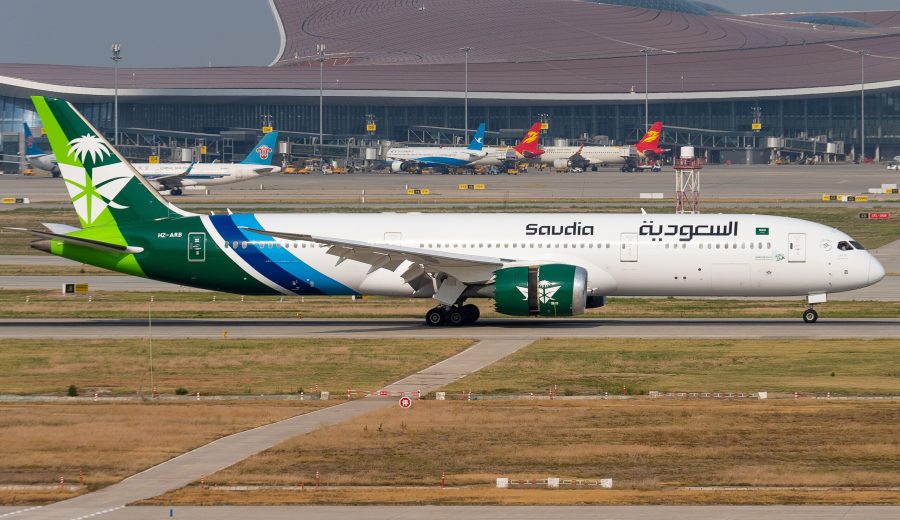
Riyadh’s main airport has reopened after Houthi attacks killed three people, among them a pilot for the national airline Saudia. It is the latest in a week of strikes on Saudi airports, as fighting in Yemen intensifies.
Saudi Arabia has reopened King Khalid International Airport in Riyadh following attacks by Yemen’s Houthis that killed three people and injured several others, Al Jazeera reported.
The General Authority of Civil Aviation (GACA) said on Friday, October 9, that the attacks the previous day had hit airport facilities and an aircraft belonging to the state carrier, Saudia.
Operations have resumed and air traffic has returned to normal, the authority said.
A Pilot Among the Dead
Saudia said one of its pilots was killed and an aircraft was damaged.
“It is with profound sadness that Saudia announces the passing of Captain Hamoud Ali Alkalthami,” the airline said in a statement.
GACA said the strikes caused injuries ranging from minor to severe, as well as material damage.
What the Houthis Said
A Houthi military spokesperson said on Thursday that the group had launched a ballistic missile at the airport, claiming it had hit its target, caused damage and disrupted air traffic.
The Houthis have warned airlines to avoid Saudi airspace. They say any aircraft operating there is a target, except over the holy cities of Mecca and Medina.
A Week of Attacks on Airports
- Attacks earlier in the week killed three civilians and injured 36 at Abha and King Khalid airports, GACA said on Wednesday
- At least three people were wounded in attacks on Jazan and Najran airports, near the Yemeni border
- On Thursday, the Saudi-led coalition said it had intercepted two ballistic missiles heading towards Riyadh and one heading towards the city of Khamis Mushait
The tactic is not new. On September 18, coalition forces said they had intercepted a suspected Houthi ballistic missile fired towards King Khalid airport.
The War Behind the Attacks
The strikes come as forces of Yemen’s internationally recognised government, which is backed by Riyadh, press a counteroffensive against the Houthis.
That push began after the Iran-aligned group seized a broad stretch of territory last month along the Bab al-Mandeb strait, which connects the Red Sea to the Gulf of Aden. Government forces claimed gains around that coastline this week, but heavy fighting continues.
The Coalition’s Response
The Saudi-led coalition said on Friday that it had destroyed three rocket launch platforms used by the Houthis.
Spokesman Colonel Turki al-Maliki said all Houthi attacks on civilians and civilian facilities “will be met with resolve”.
Earlier in the week, the coalition said it had carried out 97 “precise targeting operations” against Houthi reinforcements.
Other Countries Drawn In
Pakistan and Türkiye have agreed to deploy troops under a mutual defence pact signed with Saudi Arabia earlier this year.
A spokesman for Pakistan’s foreign ministry said on Friday that the country now has a “substantial number of forces as well as resources” in Riyadh. He said Pakistani personnel would not cross the border to attack the Houthis but were acting “in the defence of the territory”.
Image: A Saudia aircraft, photographed at Beijing Daxing airport in 2025 (file photo, not the aircraft involved). Photo by N509FZ via Wikimedia Commons, CC BY-SA 4.0.