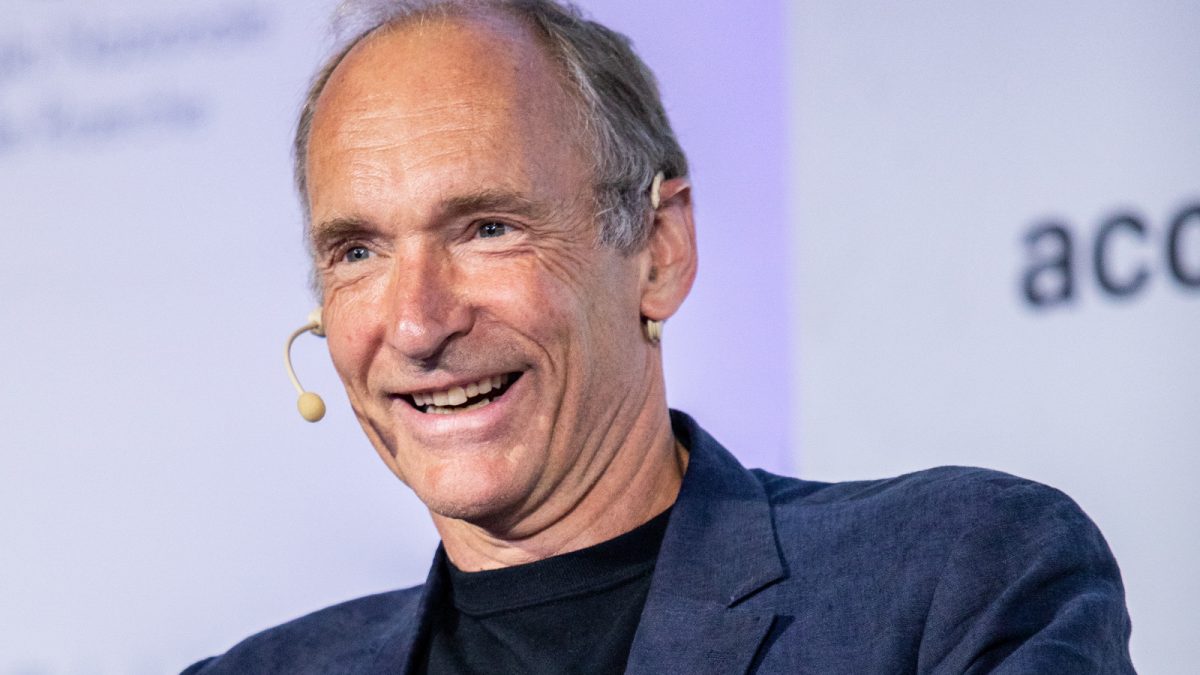
Sir Timothy John Berners-Lee (born 8 June 1955), known as TimBL, is an English computer scientist best known as the inventor of the World Wide Web, HTML, the URL system and HTTP. He proposed the Web at CERN in March 1989, founded the World Wide Web Consortium, and made his idea available free of patents and royalties. This biography follows his life and career up to November 2026.
Tim Berners-Lee at a Glance
| Full name | Sir Timothy John Berners-Lee |
| Born | 8 June 1955, London, England |
| Age | 71 (as of November 2026) |
| Profession | Computer scientist |
| Education | The Queen's College, Oxford (first in physics, 1976) |
| Known for | Inventing the World Wide Web, HTML, URLs and HTTP |
| Organisations | W3C (founder); World Wide Web Foundation; Open Data Institute; Inrupt |
| Honours | Knighted (2004); Order of Merit (2007); Queen Elizabeth Prize for Engineering (2013); Turing Award (2016) |
| Spouse | Rosemary Leith (married 2014) |
Early Life and Education
Tim Berners-Lee was born in London to the mathematicians and computer scientists Mary Lee Berners-Lee and Conway Berners-Lee, who had both worked on the Ferranti Mark 1, the first commercially built computer. He has three younger siblings. He attended Sheen Mount Primary School and Emanuel School from 1969 to 1973, and as a child he was a keen trainspotter who learned about electronics from tinkering with a model railway. At The Queen's College, Oxford, he took a first in physics in 1976, and he built a computer out of an old television set.
Career Before the Web
After graduating, Berners-Lee worked as an engineer at Plessey in Poole, Dorset, and in 1978 joined D. G. Nash, where he helped create typesetting software. From June to December 1980 he worked as an independent contractor at CERN in Geneva, where he proposed a hypertext project to help researchers share and update information and built a prototype called ENQUIRE. He then returned to the UK, where he ran the technical side of Image Computer Systems in Bournemouth for three years.
Inventing the World Wide Web
In 1989 CERN was the largest Internet node in Europe, and Berners-Lee saw an opportunity to join hypertext with the Internet. He proposed an information management system in March 1989, and his manager Mike Sendall called the proposal "vague, but exciting". Robert Cailliau, who had independently proposed a hypertext project at CERN, joined him. Berners-Lee devised and implemented the first Web browser and Web server, and the first successful communication between an HTTP client and server over the Internet took place in 1989. The first website, which described the project itself, was published in 1990, and sources give different dates for when it became publicly available.
In 1994 he founded the World Wide Web Consortium (W3C) at the Massachusetts Institute of Technology to set standards for the Web. He made the Web available free, with no patent and no royalties due. In 2009 he launched the World Wide Web Foundation with Rosemary Leith, and in 2012 he co-founded the Open Data Institute. In 2018 he announced the start-up Inrupt to build on Solid, a project that aims to give users more control over their personal data, and in November 2019 he launched the Contract for the Web to urge governments, companies and citizens to commit to principles against misuse of the Web.
Honours
Queen Elizabeth II knighted him in 2004 and appointed him to the Order of Merit in 2007. He received the inaugural Queen Elizabeth Prize for Engineering in 2013 and the Association for Computing Machinery's 2016 Turing Award, presented in 2017, for inventing the Web, the first Web browser and the fundamental protocols and algorithms that allowed the Web to scale. Time named him among the 100 most important people of the 20th century. In June 2021 the Web's source code was auctioned by Sotheby's as a non-fungible token, selling for $5,434,500.
Personal Life
Berners-Lee has married three times. He married Jane Northcote in 1976, married the American computer programmer Nancy Carlson in 1990 and had two children with her before they divorced in 2011, and in 2014 he married Rosemary Leith at the Chapel Royal, St James's Palace. He is a professorial research fellow at the University of Oxford and a professor emeritus at MIT.
Legacy
Berners-Lee's decision to give the Web away freely allowed it to grow into the platform used by billions of people. He has since become one of its loudest critics, warning of misuse of personal data and campaigning for a more open, decentralised Web. This biography draws on [Wikipedia](https://en.wikipedia.org/wiki/Tim_Berners-Lee) and [CERN's report on his Turing Award](https://home.cern/news/news/computing/sir-tim-berners-lee-receives-am-turing-award).