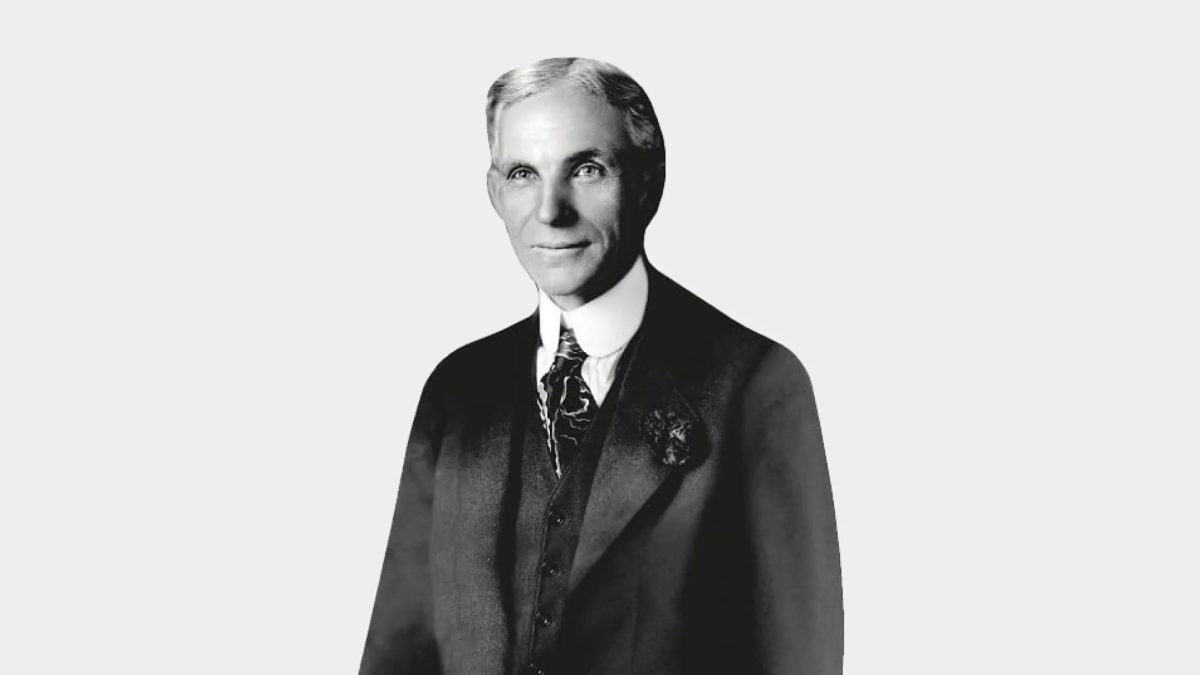
Henry Ford (30 July 1863 – 7 April 1947) was an American industrialist who founded the Ford Motor Company in 1903. He is credited as a pioneer in making cars affordable for middle-class Americans through the system known as Fordism. He is also remembered for the antisemitic material he published in the 1920s. This biography follows his life and career using standard references.
Henry Ford at a Glance
| Full name | Henry Ford |
| Born | 30 July 1863, Greenfield Township, Michigan, United States |
| Died | 7 April 1947, Dearborn, Michigan, aged 83 |
| Profession | Industrialist and business magnate |
| Company | Ford Motor Company (incorporated 16 June 1903) |
| Key products | Model T (introduced 1 October 1908); Model A (1927) |
| Innovations | Moving assembly line (1913); five-dollar day (1914); five-day work week (1926) |
| Spouse | Clara Jane Bryant (married 11 April 1888) |
| Child | Edsel Ford (1893 to 1943) |
Early Life
Henry Ford was born on a farm in Greenfield Township, Michigan, now part of Dearborn, to William Ford, who was born in County Cork, Ireland, and Mary Ford, who was born in Michigan to Belgian immigrants. He finished eighth grade at a one-room school and never attended high school. At 15 he took apart a watch his father had given him, and at 16 he left home to find work in Detroit. In 1882 he returned to Dearborn to work on the family farm, where he became adept at operating a steam engine. He married Clara Jane Bryant on 11 April 1888 and supported himself by farming and running a sawmill. In 1891 he became an engineer with the Edison Illuminating Company of Detroit.
The First Cars and the Ford Motor Company
In 1896 Ford completed a self-propelled vehicle that he named the Ford Quadricycle, and he later started a second car and eventually built three in his home workshop. In the same year he was introduced to Thomas Edison at a meeting of Edison executives. After earlier business failures, including the Detroit Automobile Company and the Henry Ford Company, Ford & Malcomson was reincorporated as the Ford Motor Company on 16 June 1903 with $28,000 in capital.
The Model T and the Assembly Line
The Model T was introduced on 1 October 1908 at a price of $825, and the price fell each year. In 1913 Ford introduced moving assembly belts into his plants, which allowed an enormous increase in production. Sales passed 250,000 in 1914, and by 1916, with the basic touring car down to $360, sales reached 472,000. By 1918 half of all cars in the United States were Model Ts. In 1914 Ford offered a $5 daily wage, which more than doubled the rate for most of his workers and was widely reported around the world. In 1926 he announced a five-day, 40-hour working week. By 1926 flagging sales of the Model T convinced him to make a new model, and the Model A was introduced in December 1927 and produced through 1931, with a total output of more than four million.
Labour Disputes
Ford resisted unions. He promoted Harry Bennett to head the company's Service Department, which used intimidation tactics to quash union organising, and on 7 March 1932, during the Great Depression, unemployed Detroit auto workers staged the Ford Hunger March. Ford Motor Company was the last Detroit automaker to recognise the United Auto Workers, and a sit-down strike by the union in April 1941 closed the River Rouge Plant.
Antisemitism
In 1918 Ford bought the newspaper The Dearborn Independent, and in 1920 it began publishing a series of articles that promoted conspiracy theories about Jewish people, drawing on the fabricated text The Protocols of the Elders of Zion. The articles were collected in the book The International Jew, which was also published in Germany. Adolf Hitler wrote favourably about Ford and said in 1931 that he regarded him as an inspiration, and Heinrich Himmler called him a valuable fighter in a 1924 letter. Historians describe Ford's role in spreading antisemitism as a significant part of his legacy.
War, Later Career and Death
Ford was known for pacifism in the first years of the First World War, although his company became a major supplier of weapons during the war. He promoted the League of Nations, and opposed the United States' entry into the Second World War and served for a time on the board of the America First Committee. After his son Edsel died in 1943, Ford resumed control of the company but was too frail to make decisions. He turned it over to his grandson Henry Ford II in 1945, and he died in 1947, leaving most of his wealth to the Ford Foundation and control of the company to his family.
Legacy
Ford changed how goods are made and who can afford them, and the Model T and the assembly line transformed transport and industry across the world. His record also includes his hostility to unions and his publication of antisemitic material, and any account of his influence has to include both. This biography draws on [Wikipedia](https://en.wikipedia.org/wiki/Henry_Ford).