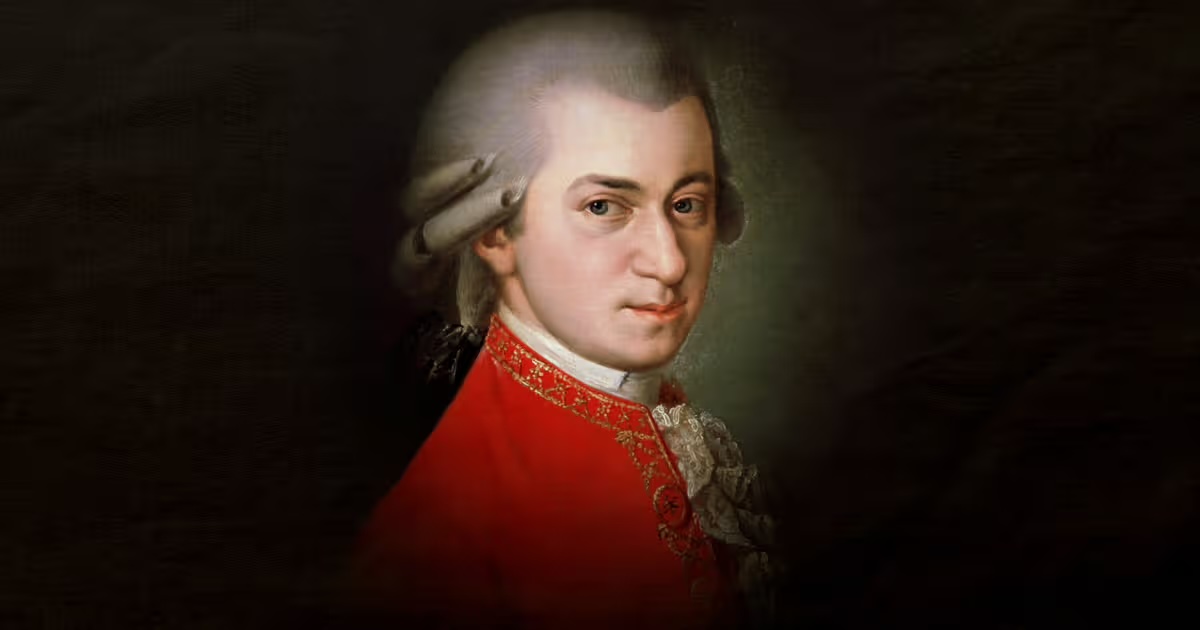
Wolfgang Amadeus Mozart (27 January 1756 to 5 December 1791) was a Classical composer and musician who completed more than 800 works in his life, including outstanding examples of most of the genres of his time: symphonies, concertos, chamber music, opera and choral music. He is regarded as one of the greatest composers in the history of Western music. A child prodigy from Salzburg, he spent the last decade of his life in Vienna, and he died there at the age of 35, leaving his Requiem largely unfinished. This biography follows his life and music.
Wolfgang Amadeus Mozart at a Glance
| Full name | Wolfgang Amadeus Mozart (baptised Joannes Chrysostomus Wolfgangus Theophilus Mozart) |
| Born | 27 January 1756, Salzburg, Archbishopric of Salzburg (now Austria) |
| Died | 5 December 1791, Vienna (aged 35) |
| Profession | Composer and musician |
| Output | More than 800 works |
| Best-known works | The Marriage of Figaro, Don Giovanni, The Magic Flute, Jupiter Symphony, Requiem |
| Father | Leopold Mozart, a composer and violin teacher |
| Sister | Maria Anna "Nannerl" Mozart |
Childhood in Salzburg
Mozart was born at Getreidegasse 9 in Salzburg to Leopold Mozart and Anna Maria, nee Pertl. He was the youngest of seven children, five of whom died in infancy, and his elder sister was Maria Anna, nicknamed Nannerl. His father was a minor composer and an experienced teacher who had been appointed fourth violinist in the musical establishment of the Prince-Archbishop of Salzburg in 1743 and who became the orchestra's deputy Kapellmeister in 1763. In the year of his son's birth, Leopold published a successful violin textbook. When Nannerl was seven she began keyboard lessons with her father while her three-year-old brother looked on, and by the age of five Wolfgang was already composing little pieces, which he played to his father, who wrote them down. Leopold was their only teacher, and he dubbed Wolfgang "the miracle whom God allowed to be born in Salzburg".
The Travelling Prodigy
Mozart and Nannerl performed as child prodigies in several European journeys. They began with an exhibition in 1762 at the court of the Elector Maximilian III of Bavaria in Munich, and at the imperial courts in Vienna and Prague. A long concert tour of three and a half years followed, taking the family to Munich, Mannheim, Paris, London, The Hague, Amsterdam and Zurich. In London in 1764 and 1765 he met Johann Christian Bach, a significant influence, and at the age of eight he wrote his first symphony, most of which was probably transcribed by Leopold. The journeys were challenging, and the family endured long illnesses: both children caught smallpox in Vienna in 1767. Between December 1769 and March 1771 Leopold and Wolfgang toured Italy, where Wolfgang was accepted as a member of the Accademia Filarmonica in Bologna, and in Milan he wrote the opera Mitridate, re di Ponto (1770), which was performed with success. A famous story says that in Rome he heard Allegri's Miserere twice in the Sistine Chapel and wrote it out from memory, though the details of the account are disputed.
The Break With Salzburg
At 17 Mozart was a musician at the Salzburg court but grew restless. A fruitless journey in search of employment between 1777 and 1779 took him to Mannheim, Paris and Munich and back to Salzburg, and during this time he wrote his five violin concertos, the Sinfonia Concertante, various masses and the opera Idomeneo, which premiered with considerable success in Munich in January 1781. In March 1781 he was summoned to Vienna, where his employer, Archbishop Colloredo, was attending the celebrations for the accession of Joseph II. The quarrel between the composer and the archbishop came to a head in May, when Mozart tried to resign and was refused. When permission was granted the following month, it was in a grossly insulting way, and Mozart was dismissed, in his own account, "with a kick in the arse" delivered by the archbishop's steward, Count Arco. The quarrel was complicated by the fact that his father sided against him, but Mozart decided to settle in Vienna as a freelance performer and composer, a step that the scholar Maynard Solomon described as "revolutionary".
Vienna and Marriage
His Vienna career began well. On 24 December 1781 he played in a competition before the emperor against Muzio Clementi, and he soon "had established himself as the finest keyboard player in Vienna". His opera Die Entfuhrung aus dem Serail premiered on 16 July 1782 and achieved considerable success, spreading throughout German-speaking Europe and establishing his reputation as a composer. Near the height of his quarrels with Colloredo, he moved in with the Weber family, and he later married Constanze Weber. Throughout his Vienna years he composed more than a dozen piano concertos, many considered masterpieces, and he stayed in the city for the rest of his life, achieving fame and some financial success but no long-term security.
The Last Great Works
In his final years he wrote many of his best-known works, including his last three symphonies, culminating in the Jupiter, the serenade Eine kleine Nachtmusik, the Clarinet Concerto, the Piano Concerto No. 27 and the operas Le nozze di Figaro (The Marriage of Figaro), Don Giovanni, Cosi fan tutte and Die Zauberflote (The Magic Flute). The Requiem was largely unfinished at the time of his death at the age of 35. His Great Mass in C minor and the "Haydn" Quartets date from his early years in Vienna.
Sources and Letters
Modern scholars rely on about 1,500 pages of family letters, often vivid and entertaining, written mostly when travel separated Mozart from his family, as well as early biographies written with input from Nannerl and Constanze, old documents and the composer's surviving manuscripts, including his personal catalogue. A source once widely used but now judged untruthful is the publisher Friedrich Rochlitz, who sought to increase posthumous sales of Mozart's works by publishing false, vivid stories about him.
Death
Mozart died in Vienna on 5 December 1791, aged 35, while working on the Requiem.
Legacy
Mozart's music, with its clarity, melodic gift and dramatic insight, has remained at the centre of the concert and opera repertoire for more than two centuries. He wrote in almost every genre of his time and raised each of them to a new level, and his piano concertos and late operas are considered some of the greatest achievements in Western music. The picture of a child prodigy who became a mature master and died young has made him one of the best-known figures in the history of culture.