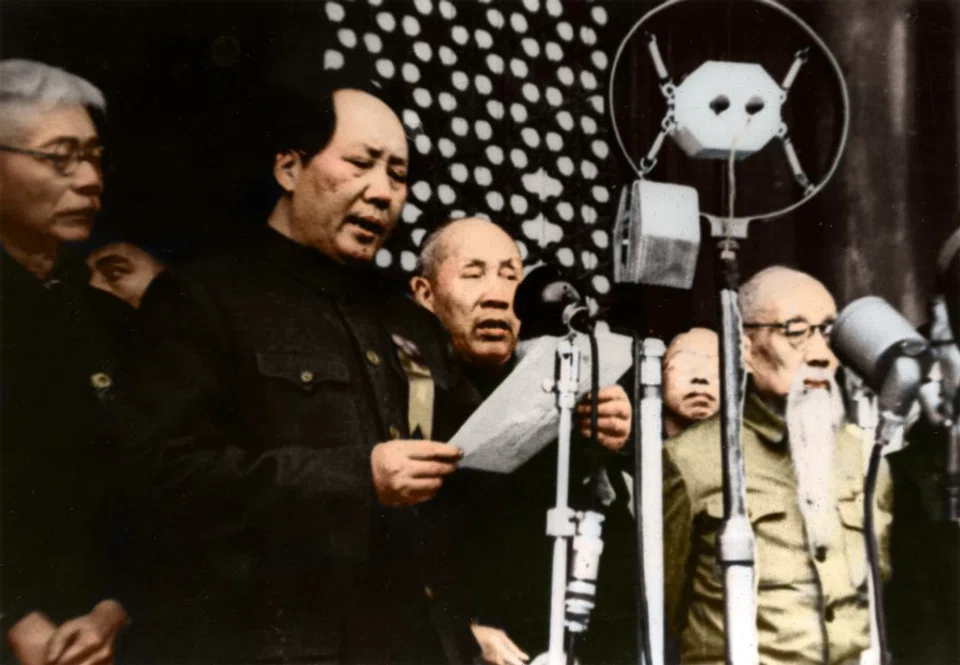
The People's Republic of China was proclaimed by Mao Zedong, chairman of the Chinese Communist Party, on 1 October 1949 in Tiananmen Square in Beijing. The new state under the Communist Party, formally called the Central People's Government, was proclaimed by Mao at a ceremony that marked the foundation of contemporary China. The Republic of China had retreated to the island of Taiwan by December 1949.
An Earlier Attempt: The Chinese Soviet Republic
The Communist Party had previously proclaimed the establishment of the Chinese Soviet Republic within the discontinuous territories of China that it controlled, on 7 November 1931, in Ruijin. That republic lasted seven years until it was abolished in 1937.
The Chinese Civil War
The Chinese Civil War was fought between the Kuomintang-led Nationalist government of the Republic of China and the Communist Party, intermittently between 1927 and 1949. The war is generally divided into two phases with an interlude. From August 1927 to 1937, the First United Front collapsed during the Northern Expedition and the Nationalists controlled most of China. The Chinese Soviet Republic government moved north to Yan'an during the Long March until its dissolution. From 1937 to 1945 hostilities were put on hold, and the Second United Front fought the Japanese invasion of China with eventual help from the Allies of the Second World War. The civil war resumed with the Japanese defeat, and the Communists gained the upper hand in the final phase of the war, from 1945 to 1949, generally referred to as the Chinese Communist Revolution. Major combat ended in 1949 with the Communists in control of most of mainland China and the Kuomintang retreating offshore, reducing its territory to Taiwan, a former Japanese colony received in 1945, Hainan and their surrounding islands.
Choosing the Name
Mao initially suggested continuing the Republic of China under new leadership, but the overseas Chinese entrepreneur and activist Tan Kah Kee strongly objected to the use of the old name, urging a clean break with the former regime. After discussions the committee agreed to a suggestion by Zhang Xiruo for "People's Republic of China". On 21 September 1949 Mao announced the establishment of the People's Republic of China in a speech at the first plenary session of the Chinese People's Political Consultative Conference. This was followed by a mass celebration in Tiananmen Square on 1 October, at which the proclamation was made publicly by Mao at the Tiananmen Gate, and the date became the new country's first National Day.
The Declaration
At exactly 15:00 Beijing time on 1 October 1949, Mao announced to the nation from the top of the Tiananmen Gate: "Fellow countrymen, the Central People's Government of the People's Republic of China was established today!" After the national anthem had been played, he proclaimed the founding of the People's Republic of China that day. In the proclamation he declared that the people throughout China had been plunged into bitter suffering since the Kuomintang government "betrayed the fatherland, colluded with imperialists, and launched the counter-revolutionary war", and that the People's Liberation Army, backed by the whole nation, had fought to defend the territorial sovereignty of the homeland and to overthrow the rule of the Nationalist government. He said that the People's War of Liberation had been basically won and that the majority of the people in the country had been liberated.
The Government Announced
In his proclamation Mao explained that the first session of the Chinese People's Political Consultative Conference, made up of delegates of all the democratic parties and people's organisations, the People's Liberation Army, the various regions and nationalities and the overseas Chinese, had enacted the organic law of the Central People's Government, elected Mao as its chairman, elected Zhu De, Liu Shaoqi, Song Qingling, Li Jishen, Zhang Lan and Gao Gang as vice chairmen and chosen a council to form the Central People's Government Council. The conference proclaimed the founding of the People's Republic of China and decided on Beijing as the capital. The Central People's Government Council took office that day in the capital and decided to adopt the Common Program of the conference as the policy of the government, and to appoint Zhou Enlai as premier of the Government Administration Council and concurrently minister of foreign affairs.
The Ceremony
"March of the Volunteers" was played as the new national anthem, and the new national flag, the Five-starred Red Flag, was officially unveiled and hoisted for the first time during the celebrations, as a 21-gun salute was fired in the distance. The first public military parade of the People's Liberation Army took place after the raising of the national flag, with the playing of the national anthem.
Celebrations and the First Parade
The first National Day military parade took place right after the proclamation. It was commanded by Nie Rongzhen, the commander of the Northern China Military Region, and inspected by Zhu De, the commander-in-chief of the People's Liberation Army, and it involved around 16,000 PLA officers and personnel. The parade had been approved in June 1949 and was the first large-scale and modern Chinese military parade, since the country had never held a public review of troops under previous governments. Liu Bocheng proposed that the parade directors be organised in the Soviet format, having personally witnessed a military parade on Red Square in Moscow.
Recognition and Aftermath
The Central People's Government Council also decided to declare to the governments of all other countries that it was the sole legal government representing all the people of the People's Republic of China, and that it was willing to establish diplomatic relations with any foreign government prepared to observe the principles of equality, mutual benefit and mutual respect for territorial integrity and sovereignty. On 2 October 1949 the Soviet Union recognised the PRC, becoming the first country to do so, followed by other communist states, including Bulgaria, Romania, Hungary, North Korea, Czechoslovakia, Poland, Mongolia, East Germany, Albania and North Vietnam, while many Western countries, including the United States, initially continued to recognise the Republic of China on Taiwan as the legitimate government of China. The Communist Party has remained the sole ruling party since 1 October 1949. The PRC claims Taiwan as its 23rd province in its constitution, while the Republic of China on Taiwan and the PRC on the mainland both officially claim to be the legitimate government of all China, and no armistice or peace treaty has ever been signed over the Chinese Civil War. After the proclamation the PRC moved quickly to consolidate its power and began nationalising industries.
Why It Matters
The proclamation of 1949 brought to an end more than two decades of civil war and created a state that has since become one of the largest economies in the world, and one of the most influential powers. It also created lasting questions about the status of Taiwan, where the Republic of China government continued to exist, and it reshaped the balance of the Cold War in Asia. For the Chinese Communist Party the day remains the central date of the national story, celebrated each year as National Day.