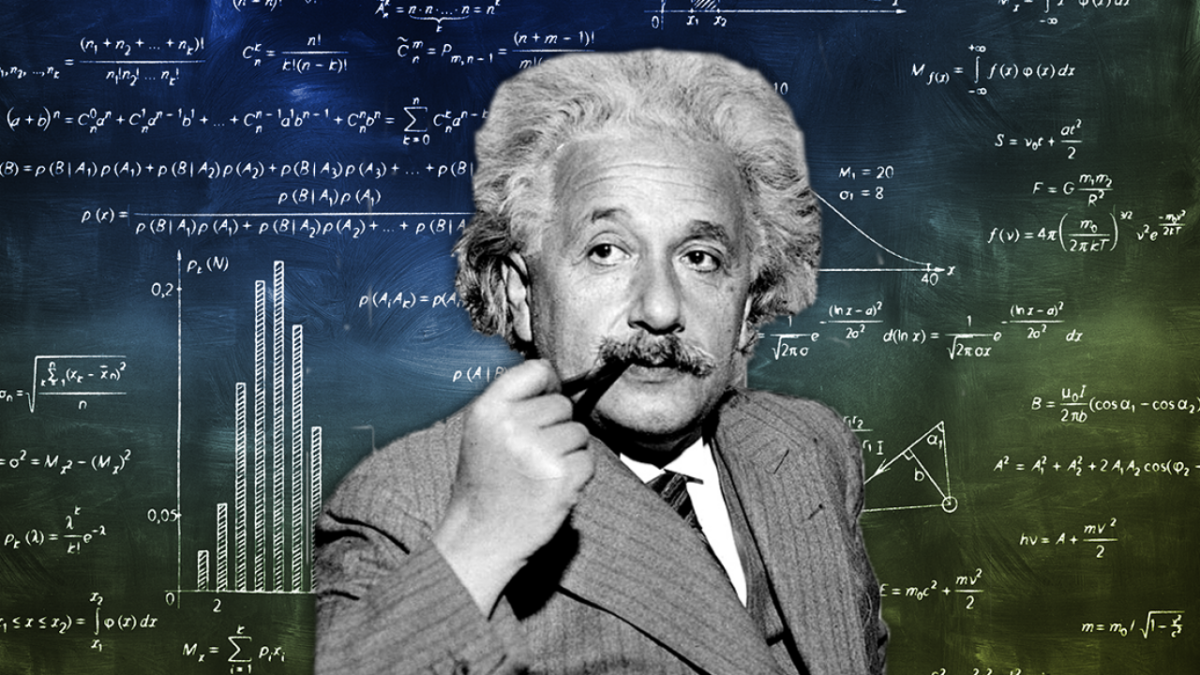
Albert Einstein (14 March 1879 to 18 April 1955) was a German-born theoretical physicist who developed the theory of relativity and is widely regarded as one of the greatest scientists of all time. He received the 1921 Nobel Prize in Physics for his discovery of the law of the photoelectric effect. His mass-energy equation, E = mc², is among the best-known formulas in the world. This biography follows his life from his birth in Ulm to his death in Princeton.
Albert Einstein at a Glance
| Full name | Albert Einstein |
| Born | 14 March 1879, Ulm, Kingdom of Württemberg, German Empire |
| Died | 18 April 1955, Princeton, New Jersey, United States (aged 76) |
| Profession | Theoretical physicist |
| Education | ETH Zurich (graduated 1900); University of Zurich (doctorate, 1905) |
| Nobel Prize | Physics, 1921 (awarded in 1922) |
| Known for | Special and general relativity, the photoelectric effect, E = mc² |
| Spouses | Mileva Marić (married 1903, divorced 1919); Elsa Löwenthal (married 1919) |
| Children | Lieserl, Hans Albert and Eduard |
Early Life and Education
Einstein was born in Ulm to Hermann Einstein, a salesman and engineer, and Pauline Koch, and he had a younger sister, Maja. The family moved to Munich, where he attended the Luitpold Gymnasium, and in late 1894 he left to join his family in Italy. In 1895 he failed the general part of the entrance examination for the Swiss federal polytechnic school in Zurich, finished secondary school at Aarau in 1896 and then enrolled at the polytechnic, graduating in 1900. He gave up his German citizenship in 1896 and became a Swiss citizen in 1901.
The Patent Office and 1905
Unable to find a university post, Einstein worked as an assistant examiner at the Swiss Patent Office in Bern, and his position became permanent in 1903. In 1905, while working there, he published four papers that changed physics. They covered the photoelectric effect, Brownian motion, special relativity and the equivalence of mass and energy, and the year is often called his "miracle year". He received his doctorate from the University of Zurich that year.
General Relativity
After professorships in Zurich and Prague, Einstein moved to Berlin and in 1915 completed the general theory of relativity, which describes gravity as the curvature of space and time. Its most famous early test was an expedition led by Arthur Eddington to observe the total solar eclipse of 29 May 1919, and the results, presented to the Royal Society on 6 November 1919, matched Einstein's prediction of how much starlight bends near the Sun. The announcement made him world famous.
Nobel Prize
Einstein received the 1921 Nobel Prize in Physics, awarded in 1922, "for his services to Theoretical Physics, and especially for his discovery of the law of the photoelectric effect." The Nobel committee chose to cite his work on the photoelectric effect rather than relativity, which some committee members were reluctant to endorse at the time.
Life in the United States
Einstein was visiting the United States in 1933 when Adolf Hitler came to power in Germany, and he decided not to return. He became a resident scholar at the Institute for Advanced Study in Princeton, where he worked until his death, and he became a United States citizen in 1940. On the eve of the Second World War he endorsed a letter to President Franklin D. Roosevelt warning that Germany might develop atomic weapons. In 1952, after the death of Chaim Weizmann, Israel's prime minister David Ben-Gurion offered him the presidency of Israel, and he declined.
Personal Life
Einstein married Mileva Marić in January 1903 and they had a daughter, Lieserl, born in early 1902 before the marriage, whose fate is uncertain, and two sons, Hans Albert and Eduard. They divorced on 14 February 1919, and he then married his cousin Elsa Löwenthal, who died in December 1936. He died at Princeton on 18 April 1955 after an aortic aneurysm, having refused emergency surgery.
Legacy
Einstein was named Time Person of the Century in 1999. General relativity is the basis of modern cosmology and of technologies such as satellite navigation, and his explanation of the photoelectric effect helped to found quantum theory. His name remains a byword for scientific genius.