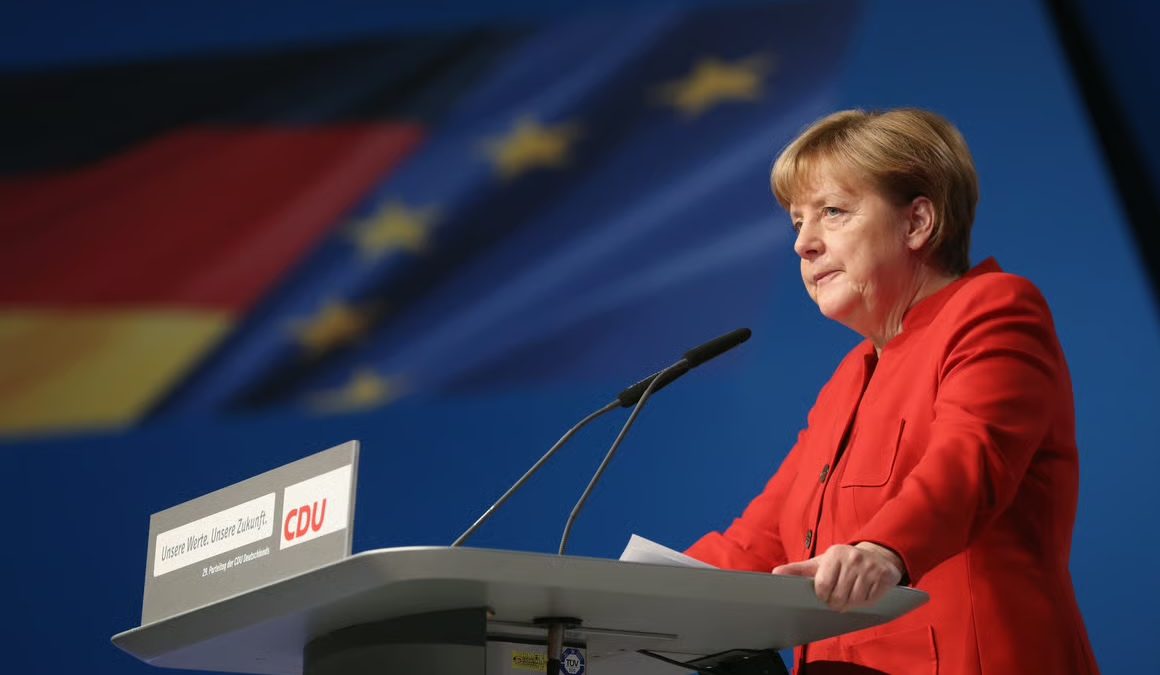
Angela Merkel is a German politician who served as Chancellor of Germany from 22 November 2005 to 8 December 2021, leading four governments over sixteen years. A trained physicist who grew up in East Germany, she led the Christian Democratic Union (CDU) from 2000 to 2018 and guided Germany and the European Union through the 2008 financial crisis, the euro area crisis, the 2015 migrant crisis and the COVID-19 pandemic.
Angela Merkel at a Glance
| Full name | Angela Dorothea Merkel (born Kasner) |
|---|---|
| Born | 17 July 1954, Hamburg, West Germany |
| Profession | Politician; former physicist |
| Education | Physics, Karl Marx University, Leipzig (1973-78); doctorate in quantum chemistry (1986) |
| Party | Christian Democratic Union (CDU) |
| Chancellor of Germany | 22 November 2005 – 8 December 2021 |
| CDU leader | 10 April 2000 – 7 December 2018 |
| Memoir | Freedom: Memories 1954-2021 (26 November 2024) |
Early Life and Education
Angela Kasner was born in Hamburg, in what was then West Germany. Her family moved to East Germany when she was an infant, and she grew up in Templin, about 90 km north of East Berlin. Her father, Horst Kasner, was a pastor and her mother, Herlind, a teacher. She has a brother, Marcus, and a sister, Irene.
She studied physics at Karl Marx University in Leipzig from 1973 to 1978, then worked at the Academy of Sciences in Berlin-Adlershof from 1978 to 1990, earning a doctorate in quantum chemistry in 1986.
Entry into Politics
Merkel joined the Democratic Awakening movement in late 1989, about a month after the fall of the Berlin Wall, and became deputy spokesperson for the last pre-unification East German government under Lothar de Maizière. Democratic Awakening merged into the East German CDU in April 1990, and she was elected to the Bundestag that year for Mecklenburg-Vorpommern.
Career Journey
- Minister for Women and Youth: 18 January 1991 – 17 November 1994.
- Minister for the Environment, Nature Conservation and Nuclear Safety: 17 November 1994 – 26 October 1998.
- CDU General Secretary: 7 November 1998 – 10 April 2000.
- CDU leader: 10 April 2000 – 7 December 2018.
- Leader of the Opposition: 22 September 2002 – 22 November 2005.
The Chancellorship, 2005-2021
Merkel governed in a grand coalition of the CDU/CSU and the Social Democrats from 2005 to 2009, in a coalition with the Free Democrats from 2009 to 2013, and in grand coalitions again from 2013 to 2017 and from 2018 to 2021. She stepped down as party leader in 2018 and did not seek a fifth term in the 2021 federal election.
Her tenure was defined by crises. The page records the 2008 financial crisis, the euro area crisis, the 2015 European migrant crisis and COVID-19 as the major ones. In the 2015 migrant crisis she coined the phrase “Wir schaffen das” (“We can do this”). Germany also moved away from nuclear power under her Energiewende programme, with the last German nuclear plants shutting down in April 2023.
Honours and Recognition
- Time Person of the Year in December 2015, on a cover calling her the “Chancellor of the Free World”.
- Nansen Refugee Award from the UN High Commissioner for Refugees in 2022, citing her “courage and compassion” during the migrant crisis.
Memoir and Life After Office
Merkel’s 736-page memoir, Freedom (Freiheit), written with her longtime adviser Beate Baumann, was released on 26 November 2024 as Freedom: Memories 1954-2021 and published in 30 languages.
Personal Life
Merkel married Ulrich Merkel in 1977 (divorced 1982) and Joachim Sauer in 1998. She was raised in the Lutheran tradition.
Conclusion
Angela Merkel moved from a physics laboratory in East Berlin to the head of Europe’s largest economy, holding office through four coalitions and several of the most serious crises of the century so far. Assessments of her record, particularly on migration and energy, remain debated, and readers should consult independent histories alongside her own memoir.