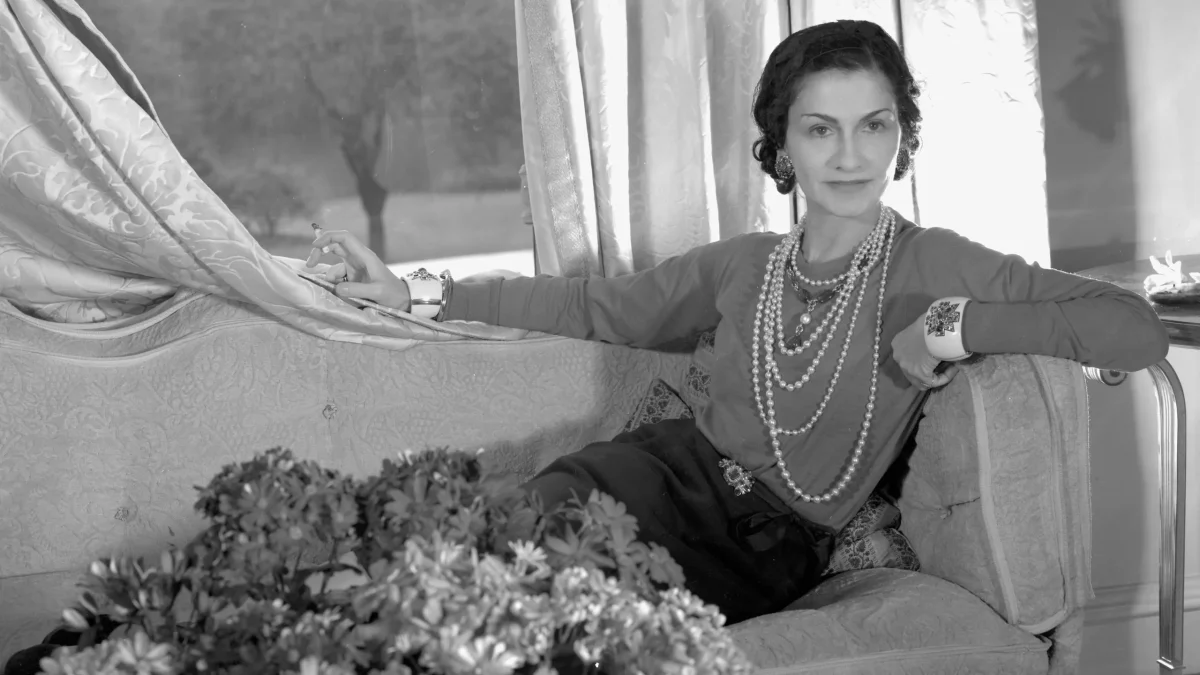
Coco Chanel (Gabrielle Bonheur Chanel, 19 August 1883 to 10 January 1971) was a French fashion designer and businesswoman who founded the house of Chanel. She helped to establish modern women's fashion, with designs such as the little black dress and the Chanel suit, and she launched the perfume Chanel No. 5 in 1921. Her life also includes a controversial record during the German occupation of France. This biography follows her life and career.
Coco Chanel at a Glance
| Full name | Gabrielle Bonheur Chanel |
| Born | 19 August 1883, Saumur, France |
| Died | 10 January 1971, Paris, France (aged 87) |
| Profession | Fashion designer and businesswoman |
| Company | House of Chanel |
| Best-known creations | Chanel No. 5 (1921), the Chanel suit, the little black dress, the 2.55 handbag (February 1955) |
| Business partners | The Wertheimer brothers (Les Parfums Chanel, 1924) |
Early Life
Gabrielle Chanel was born in Saumur and learned to sew at the Aubazine orphanage. She later worked as a seamstress and sang in a cabaret in Moulins, where she acquired the nickname "Coco". Her early backers included Étienne Balsan and Arthur "Boy" Capel, and Capel helped to finance her first shops.
The Rise of the House of Chanel
Chanel became a licensed milliner in 1910 and opened a boutique at 21 rue Cambon in Paris. She opened a shop in Deauville in 1913 and one in Biarritz in 1915, and by 1919 she had a couture house at 31 rue Cambon. Her designs were simpler and more comfortable than the fashions of the time. The Chanel suit was introduced in 1923, and American Vogue published her little black dress in 1926.
Chanel No. 5
Chanel No. 5, created with the perfumer Ernest Beaux, was launched in 1921. In 1924 the Wertheimer brothers, the owners of the Galeries Lafayette department store, financed the production of the perfume and founded Les Parfums Chanel in return for most of the profits. The Wertheimer family has kept ownership of the company ever since.
The War Years
Chanel closed her couture house in 1939 when the Second World War began, which cost about 4,000 employees their jobs. She lived at the Ritz Hotel in Paris during the German occupation and had a relationship with the German diplomat and Abwehr officer Hans Günther von Dincklage. Declassified French documents list her as an agent with the code name "Westminster", reference F-7124, although historians disagree about whether her actions amounted to deliberate espionage or opportunistic collaboration. In 1943 she took part in a plan known as Operation Modellhut, in which she was to act as a go-between with Winston Churchill. She was interrogated after the war but was not charged as a collaborator, and she moved to Switzerland in 1945.
The Comeback
Chanel returned to Paris in 1954 to revive her fashion house, with funding from Pierre Wertheimer. She introduced the quilted 2.55 handbag in February 1955, and her suits became fashionable again. She died in her apartment at the Ritz Hotel on 10 January 1971, aged 87.
Legacy
Chanel is credited with freeing women's clothing from corsets and with building one of the best-known brands in the world. Her record during the war is still debated, and any account of her life has to include both her influence on fashion and the controversy about her relationship with the occupiers of France.