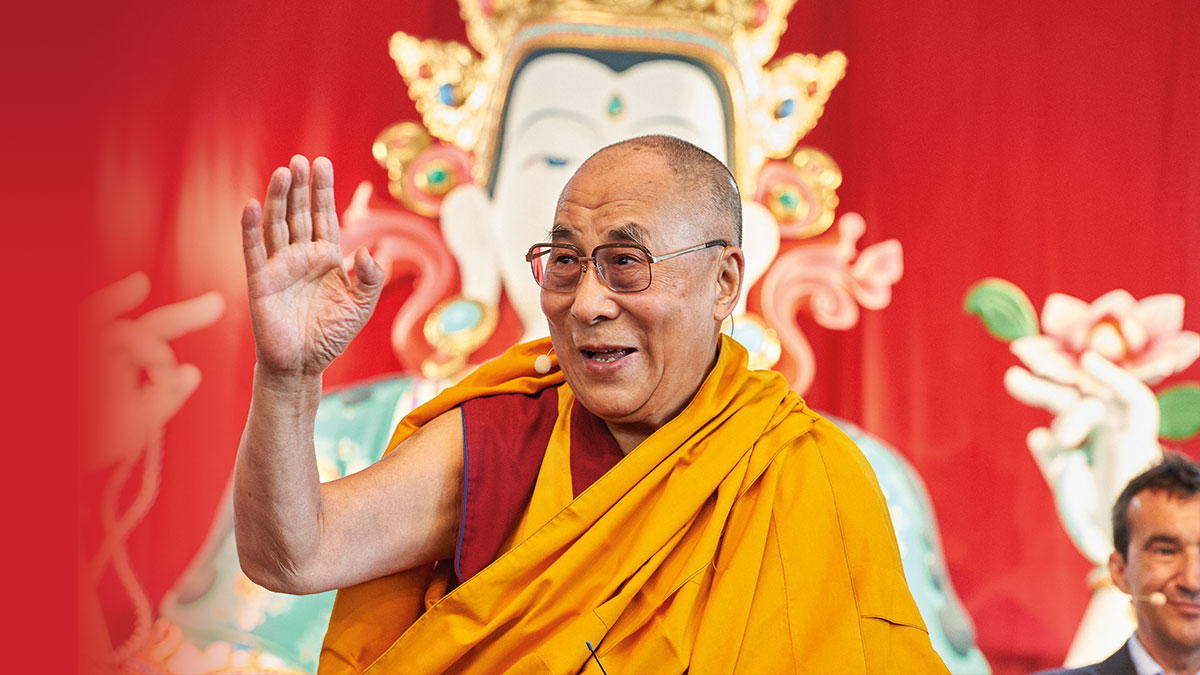
Tenzin Gyatso (born Lhamo Thondup, 6 July 1935) is the 14th Dalai Lama, the spiritual leader of Tibetan Buddhism and for decades the head of the Tibetan government in exile. He was recognised as the reincarnation of the 13th Dalai Lama as a young child and fled Tibet to India in 1959. He received the Nobel Peace Prize in 1989. In July 2025, shortly before his 90th birthday, he said that the institution of the Dalai Lama will continue. This biography follows his life up to November 2026.
The Dalai Lama at a Glance
| Full name | Tenzin Gyatso (born Lhamo Thondup) |
| Born | 6 July 1935, Taktser, Amdo, Tibet |
| Age | 91 (as of November 2026) |
| Role | 14th Dalai Lama; spiritual leader of Tibetan Buddhism |
| Enthroned | 22 February 1940 |
| Political power | Assumed on 17 November 1950, aged 15; retired from political leadership in 2011 |
| Exile | India, since 1959; government in exile in Dharamshala |
| Nobel Peace Prize | 1989 |
Early Life and Recognition
Lhamo Thondup was born in the village of Taktser in the Amdo region of Tibet. He was selected as the reincarnation of the 13th Dalai Lama in 1937 and formally recognised in 1939, and he left for Lhasa on 21 July 1939 and arrived there on 8 October. He was enthroned on 22 February 1940.
Political Leadership and Flight
On 17 November 1950, at the age of 15, he assumed full political power in Tibet. In 1959 tensions between Tibetans and the Chinese government led him to flee to India, where he crossed the border on 30 March 1959. He reached Tezpur in Assam on 18 April, and a Tibetan government in exile was established at Mussoorie on 29 April 1959. It moved to Dharamshala in May 1960.
The Middle Way and the Nobel Prize
On 15 June 1988 the Dalai Lama presented a proposal in Strasbourg, known as the Middle Way, which seeks autonomy for Tibet within China instead of full independence. He received the Nobel Peace Prize in 1989 for his non-violent struggle for the liberation of Tibet. He has taught widely on compassion and ethics.
Stepping Back from Politics
In 2011 the Dalai Lama retired as head of the Tibetan government in exile, and he kept only his role as a religious leader. Since 2018 he has taught on a reduced schedule and has limited his travel to within India. He celebrated his 70th birthday on 6 July 2005 and his 90th on 6 July 2025.
The Succession Question
On 2 July 2025 he issued a statement affirming that the institution of the Dalai Lama will continue. He said that the Gaden Phodrang Trust, the office that works for him, has the sole authority to recognise his reincarnation. The statement recalled a pledge that he made in 2011 to decide at the age of 90 whether the institution should continue. Beijing responded that the succession must follow Chinese law as well as religious rituals and historical conventions, so the question of who will choose the next Dalai Lama remains disputed.
Legacy
The Dalai Lama is one of the most recognised religious figures in the world and a symbol of non-violent resistance. His exile has kept the Tibetan cause in international view for more than 60 years, and his succession will have consequences for Tibetans, for India and for China.