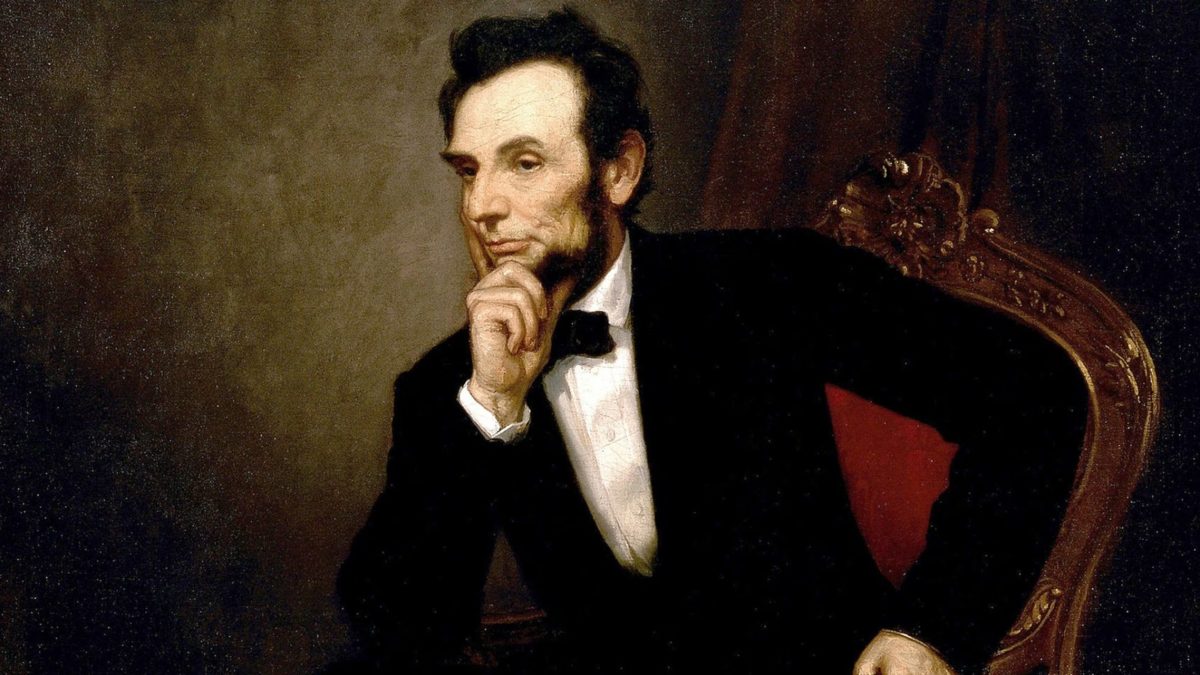
Abraham Lincoln (12 February 1809 – 15 April 1865) was the 16th president of the United States, from 1861 until his assassination in 1865. He led the country through the American Civil War, defeated the Confederacy and played a major role in the abolition of slavery. He is consistently ranked among the greatest American presidents in popular and scholarly polls.
Abraham Lincoln at a Glance
| Full name | Abraham Lincoln |
| Born | 12 February 1809, near Hodgenville, Kentucky, United States |
| Died | 15 April 1865, Washington, D.C., aged 56 |
| Profession | Lawyer and politician |
| President | 16th president of the United States (1861 to 1865) |
| Party | Whig; later Republican |
| Earlier offices | Illinois legislator (four terms); US Representative (1847 to 1849) |
| Spouse | Mary Todd Lincoln (married 4 November 1842) |
| Children | Robert, Edward, William and Thomas |
Early Life
Abraham Lincoln was born in a one-room log cabin in Kentucky and raised on Sinking Spring Farm and Knob Creek Farm near Hodgenville. He was the second child of Thomas Lincoln and Nancy Hanks Lincoln. In 1816 the family moved to Indiana, where land titles were more secure, and in 1831 his father moved them to a new homestead in Illinois. Lincoln was largely self-educated, with formal schooling only from itinerant teachers, and in 1831 he began working at a general store in New Salem, Illinois, where he lived for six years.
Lawyer and Legislator
Lincoln served four terms in the Illinois House of Representatives for Sangamon County, and he championed the construction of the Illinois and Michigan Canal. He was admitted to the Illinois bar on 9 September 1836, moved to Springfield and practised law, handling "virtually every kind of business that could come before a prairie lawyer". He served in the US House of Representatives from 1847 to 1849. He married Mary Todd on 4 November 1842, and they had four sons, of whom only the eldest, Robert, lived to adulthood. Edward died in 1850, William ("Willie") died at the White House in 1862, and Thomas ("Tad") died in 1871.
Republican Leader and the 1860 Election
Lincoln was angered by the Kansas–Nebraska Act of 1854, which opened the territories to slavery, and he became a leader of the new Republican Party. He reached a national audience through his 1858 Senate campaign debates against Stephen A. Douglas, and he lost the Senate race, although Republican candidates won more of the popular vote. His February 1860 speech at Cooper Union in New York raised his standing further. On 6 November 1860 he was elected the first Republican president, entirely on support from the North and West, and no ballots were cast for him in ten of the 15 Southern slave states.
The Civil War Presidency
After his election a majority of the slave states began to secede. A month after he took office, Confederate forces attacked Fort Sumter on 12 and 13 April 1861, which started the Civil War. Lincoln closely supervised the Union's strategy, including the selection of generals and a naval blockade of Southern ports. He suspended the writ of habeas corpus in April 1861, an action that Chief Justice Roger Taney said in Ex parte Merryman only Congress could take. On 1 January 1863 he issued the Emancipation Proclamation, which declared the slaves in states "in rebellion" to be free. On 19 November 1863 he delivered the Gettysburg Address, one of the most famous speeches in American history, and he promoted the Thirteenth Amendment, which abolished slavery in 1865. He was re-elected in 1864 and sought to heal the nation through Reconstruction.
Assassination
On 14 April 1865, five days after the Confederate surrender at Appomattox, Lincoln was shot by the actor and Confederate sympathiser John Wilkes Booth at Ford's Theatre in Washington, D.C. He died at 7:22 a.m. on 15 April, and he was the first US president to be assassinated.
Legacy
Lincoln is remembered as a martyr and a national hero for preserving the Union and ending slavery. Historians also debate his wartime use of executive power and his views on race and Reconstruction. This biography draws on [Wikipedia](https://en.wikipedia.org/wiki/Abraham_Lincoln).