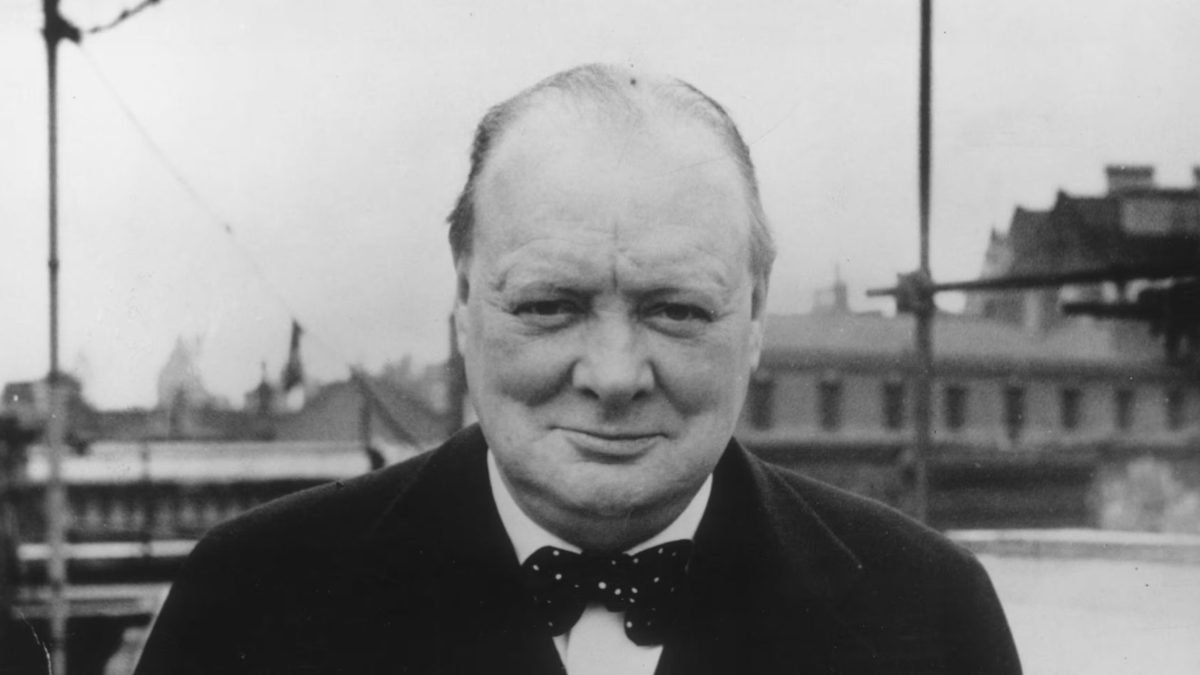
Sir Winston Leonard Spencer Churchill (30 November 1874 – 24 January 1965) was a British statesman, soldier and writer who was Prime Minister of the United Kingdom from 1940 to 1945, during the Second World War, and again from 1951 to 1955. He was a member of Parliament for about 62 years between 1900 and 1964, and he won the Nobel Prize in Literature in 1953.
Winston Churchill at a Glance
| Full name | Winston Leonard Spencer Churchill |
| Born | 30 November 1874, Blenheim Palace, Oxfordshire, England |
| Died | 24 January 1965, London, aged 90 |
| Profession | Statesman, army officer, historian and writer |
| Prime minister | 1940 to 1945 and 1951 to 1955 |
| Parties | Conservative (leader 1940 to 1955); Liberal (1904 to 1924) |
| Nobel Prize | Literature, 1953 |
| Spouse | Clementine Hozier (married 12 September 1908) |
| Children | Five, including Diana, Randolph, Sarah, Marigold and Mary |
Early Life
Winston Churchill was born at Blenheim Palace in Oxfordshire, into the aristocratic Spencer family, as the son of Lord Randolph Churchill and the American-born Jennie Jerome, which gave him mixed English and American parentage. His father was a descendant of John Churchill, 1st Duke of Marlborough. He began boarding school at St George's in Ascot at the age of seven, and was not academic at first. He joined the British Army in 1895 and saw action in British India, the Mahdist War and the Second Boer War, gaining fame as a war correspondent and writing books about his campaigns.
Early Political Career
Churchill was elected a Conservative MP for Oldham in October 1900, at the age of 25. He defected to the Liberals in 1904 because he opposed protectionism, and in H. H. Asquith's government he served as President of the Board of Trade and Home Secretary, where he championed prison reform and workers' social security. He married Clementine Hozier on 12 September 1908. As First Lord of the Admiralty at the start of the First World War, he oversaw the naval attack on the Dardanelles, a prelude to the Gallipoli campaign, and he was demoted after it failed. He resigned in November 1915 and served for six months with the Royal Scots Fusiliers on the Western Front. Later he was Minister of Munitions, Secretary of State for War and for Air, and Colonial Secretary, and from 1924 to 1929 he was Chancellor of the Exchequer, where his return of sterling to the gold standard in 1925 is criticised for depressing the economy.
Wilderness Years and the Second World War
In the 1930s Churchill was out of government in the "wilderness years", when he led calls for rearmament against Nazi Germany. He returned as First Lord of the Admiralty at the outbreak of war and became prime minister in May 1940, succeeding Neville Chamberlain and forming a national government. As the British Expeditionary Force retreated to Dunkirk, the evacuation of 338,226 Allied servicemen ended on 4 June 1940, and Churchill told Parliament "we shall fight on the beaches". He rallied the country during the Battle of Britain and the Blitz. In August 1941 he met Franklin Roosevelt in Newfoundland and they issued the Atlantic Charter, and he attended the Allied conferences at Cairo, Yalta and Potsdam. His wartime record is also debated, including the Bengal famine of 1943. After the Conservatives lost the July 1945 general election he became Leader of the Opposition.
Later Career
In 1946, on a trip to the United States, Churchill gave his "Iron Curtain" speech in Fulton, Missouri, about the Soviet Union and the Eastern Bloc. The Conservatives won the October 1951 election and he became prime minister again. He suffered a serious stroke in June 1953, which was kept secret. He resigned as prime minister on 5 April 1955 in declining health and remained an MP until 1964. He was awarded the Nobel Prize in Literature in 1953.
Personal Life and Death
Churchill and Clementine had five children. Their daughter Marigold died of sepsis in 1921, and he was haunted by her death for the rest of his life. He bought Chartwell in Kent in 1922, which became the family home. He painted as a hobby. He died on 24 January 1965 and was given a state funeral.
Legacy
Churchill is widely regarded as one of Britain's greatest leaders for his role in the war, while his record on empire, the Dardanelles and the Bengal famine continues to be debated. Memorials include the National Churchill Museum in Fulton, Missouri. This biography draws on [Wikipedia](https://en.wikipedia.org/wiki/Winston_Churchill).