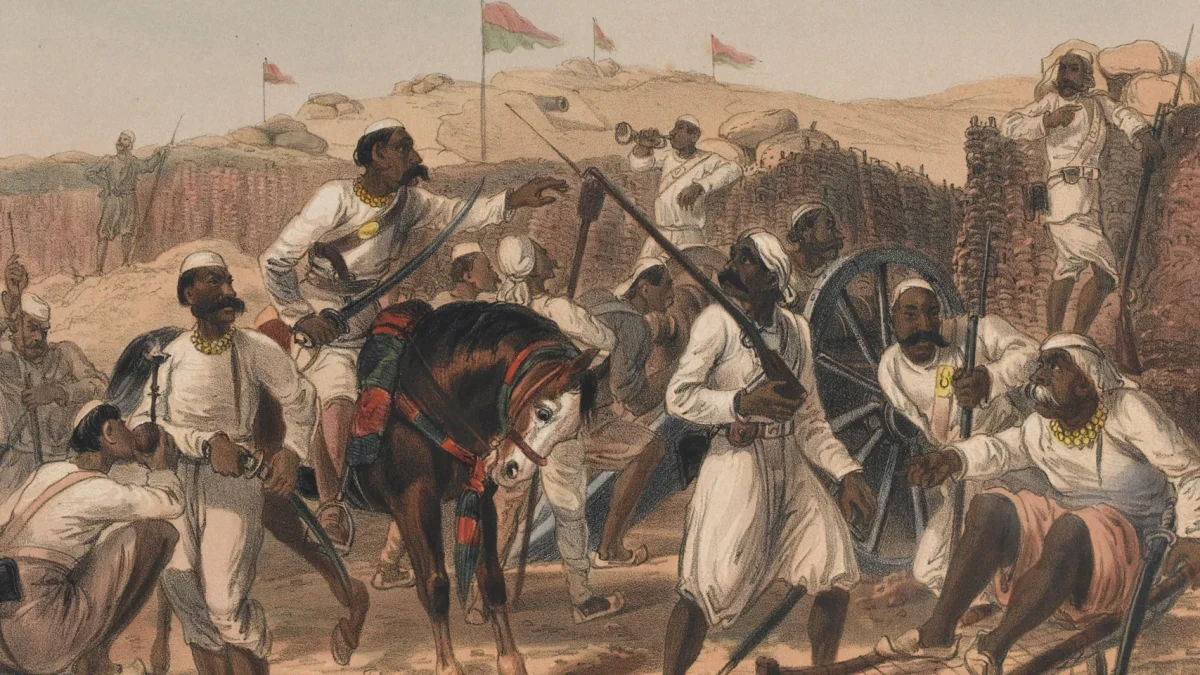
The Indian Rebellion of 1857 was a major uprising in India in 1857 and 1858 against the rule of the British East India Company, which functioned as a sovereign power on behalf of the British Crown. The rebellion began on 10 May 1857 as a mutiny of sepoys of the Company's garrison in Meerut, a town 40 miles (64 km) north-east of Delhi. It then erupted into other mutinies and civilian rebellions, chiefly in the upper Gangetic plain and central India, though incidents of revolt also occurred farther north and east. The rebellion posed a military threat to British power in that region and was contained only with the rebels' defeat at Gwalior on 20 June 1858. On 1 November 1858 the British granted amnesty to all rebels not involved in murder, although they did not declare hostilities to have formally ended until 8 July 1859.
A Contested Name
The name of the revolt is contested. It is variously described as the Sepoy Mutiny, the Indian Mutiny, the Great Rebellion, the Revolt of 1857, the Indian Insurrection and the First War of Independence.
Causes
The rebellion was fed by resentments born of diverse perceptions, including invasive British-style social reforms, harsh land taxes, the summary treatment of some rich landowners and princes, and scepticism about British claims that their rule offered material improvement to the Indian economy. Many Indians rose against the British, but many also fought for the British, and the majority remained seemingly compliant with British rule. Violence, which sometimes betrayed exceptional cruelty, was inflicted on both sides: on British officers and civilians, including women and children, by the rebels, and on the rebels and their supporters, sometimes entire villages, by British reprisals. The cities of Delhi and Lucknow were laid waste in the fighting and the British retaliation.
The Spread of the Revolt
After the outbreak at Meerut the rebels quickly reached Delhi, whose 81-year-old Mughal ruler, Bahadur Shah Zafar, was declared the Emperor of Hindustan. Soon the rebels had captured large tracts of the North-Western Provinces and Awadh. The East India Company's response came rapidly. With the help of reinforcements Kanpur was retaken by mid-July 1857 and Delhi by the end of September, but it then took the remainder of 1857 and the better part of 1858 to suppress the rebellion in Jhansi, Lucknow and especially the Awadh countryside.
Who Stayed Out
Other regions of Company-controlled India, the Bengal, Bombay and Madras Presidencies, remained largely calm. In the Punjab, the Sikh princes crucially helped the British by providing both soldiers and support. The large princely states of Hyderabad, Mysore, Travancore and Kashmir, as well as the smaller ones of Rajputana, did not join the rebellion and served the British, in the words of Governor-General Lord Canning, as "breakwaters in a storm". In some regions, most notably Awadh, the rebellion took on the attributes of a patriotic revolt against British oppression, but the rebel leaders proclaimed no articles of faith that foreshadowed a new political system.
The End of Company Rule
The rebellion nevertheless proved to be an important watershed in Indian and British imperial history. It led to the dissolution of the East India Company and forced the British to reorganise the army, the financial system and the administration in India through the Government of India Act 1858. India was thereafter administered directly by the British government in the new British Raj. On 1 November 1858 Queen Victoria issued a proclamation to Indians which, though it lacked the authority of a constitutional provision, promised rights similar to those of other British subjects. In the following decades, when admission to those rights was not always forthcoming, Indians pointedly referred to the Queen's proclamation in growing avowals of a new nationalism.
The Sepoys
In 1772, when Warren Hastings was appointed the first Governor-General at Fort William, one of his first undertakings was the rapid expansion of the Company's army. Because the sepoys from Bengal, many of whom had fought against the Company at Plassey and Buxar, were now suspect in British eyes, Hastings recruited farther west from the high-caste rural Rajputs and Bhumihars of Awadh and Bihar, a practice that continued for the next 75 years. To forestall social friction the Company adapted its military practices to the requirements of religious ritual: soldiers dined in separate facilities, overseas service, which was considered polluting to caste, was not required of them, and the army came officially to recognise Hindu festivals. But this encouragement of high-caste ritual status left the government vulnerable to protest, even mutiny, whenever the sepoys detected an infringement of their prerogatives. After the annexation of Awadh by the Company in 1856 many sepoys were disquieted by the loss of their perquisites as landed gentry in the Awadh courts and by the prospect of increased land revenue payments. Other historians stress that by 1857 some Indian soldiers, interpreting the presence of missionaries as a sign of official intent, were convinced that the Company was masterminding mass conversions of Hindus and Muslims to Christianity, and that changes in the terms of service, such as being expected to serve in less familiar regions like Burma without the "foreign service" payment, created resentment. Rumours about the greased cartridges for the Enfield rifle spread quickly through the ranks.
Background: The Company in India
Although the British East India Company had established a presence in India as far back as 1612, its victory at the Battle of Plassey in 1757 marked the beginning of its firm foothold in eastern India. The victory was consolidated in 1764 at the Battle of Buxar, when the Company army defeated the Mughal emperor Shah Alam II, who then granted the Company the right to collect revenue, known as the Diwani, in the provinces of Bengal, Bihar and Odisha.
Why It Matters
The rebellion of 1857 is one of the defining events in the history of modern India and of the British Empire. It ended the rule of a trading company over a subcontinent and brought in direct Crown rule, and it left a legacy of memory, controversy and debate over how it should be named and understood. For many Indians it is remembered as an early moment of resistance to colonial rule, while others stress its complexity and the divisions it exposed. Both views agree that it changed the political relationship between Britain and India for the next ninety years.