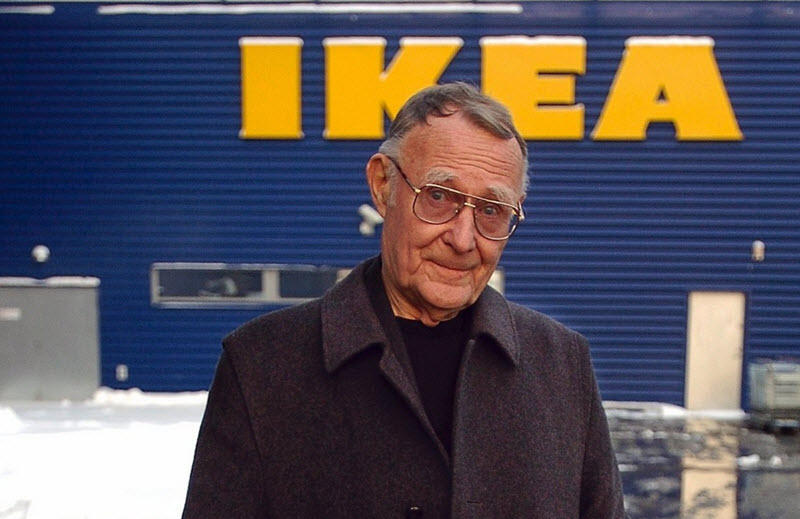
Ingvar Kamprad (Feodor Ingvar Kamprad, 30 March 1926 to 27 January 2018) was a Swedish businessman who founded IKEA in 1943, at the age of 17, and turned it into a multinational retail company that became the world's largest furniture seller in 2008. He was known for a frugal lifestyle that contrasted with the scale of the company he built, and for a youthful involvement with pro-fascist groups that he later called the greatest mistake of his life. He died in 2018 at the age of 91. This biography follows his life and his business.
Ingvar Kamprad at a Glance
| Full name | Feodor Ingvar Kamprad |
| Born | 30 March 1926, Pjatteryd (now part of Almhult Municipality), Smaland, Sweden |
| Died | 27 January 2018, Smaland, Sweden (aged 91) |
| Profession | Businessman and founder of IKEA |
| Company | IKEA, founded in 1943 |
| Books | A Testament of a Furniture Dealer (1976); Leading by Design: The IKEA Story, with Bertil Torekull |
| Spouses | Kerstin Wadling (divorced 1961) and Margaretha Kamprad-Stennert (died 2011) |
| Children | Annika (adopted) and sons Peter, Jonas and Mathias |
Early Life in Smaland
Kamprad was born in Pjatteryd, in the Swedish province of Smaland, to Feodor Kamprad and Berta Linnea Matilda Nilsson. His father was born in the German Empire and came to Sweden as a baby with his parents. His grandparents had bought a timber estate near Agunnaryd, and from the age of six Kamprad lived on the family farm, Elmtaryd, with his parents, sister and grandmother. The farm, with 449 hectares of land, was the largest in the area.
From Matches to a Company
Kamprad's business career began early. He started selling matches at the age of five, and at seven he began cycling further afield to sell to neighbours. He discovered that he could buy matches in bulk cheaply in Stockholm, sell them individually at a low price and still make a profit. From matches he expanded to fish, Christmas tree decorations, seeds and later ballpoint pens and pencils. When he was 17, his father gave him a cash reward for doing well in his studies, and in 1943 he founded IKEA at his uncle Ernst's kitchen table.
The Name IKEA
The name IKEA is an acronym. It is made up of Kamprad's initials, I and K, together with the first letters of Elmtaryd, the family farm where he was born, and of Agunnaryd, the nearby village where he grew up. He attended the Handelsinstitut in Gothenburg from 1943 to 1945, and in 1948 he added furniture to the products he sold. At the beginning the business was mostly mail order.
Frugality and Business Philosophy
Kamprad developed a reputation for extreme thrift. According to a 2006 interview, he drove a 1993 Volvo 240, flew economy class and encouraged IKEA employees to use both sides of a sheet of paper. He reportedly recycled tea bags and was known to take salt and pepper packets from restaurants, and he visited IKEA stores for a "cheap meal". In his 1976 manifesto, A Testament of a Furniture Dealer, he wrote: "It is not only for cost reasons that we avoid the luxury hotels. We don't need flashy cars, impressive titles, uniforms or other status symbols. We rely on our strength and our will!" IKEA's attention to cost control and product development allowed it to lower its prices by an average of 2 to 3 per cent over the decade to 2010, while it continued to expand around the world.
Wealth and the Foundation Structure
Estimates of Kamprad's wealth varied greatly because of the way IKEA is owned. In June 2015 he was listed as the eighth wealthiest person in the world by the Bloomberg Billionaires Index, with an estimated net worth of 58.7 billion US dollars, while Forbes reported his net worth in March 2015 as 3.5 billion. In March 2010 Forbes estimated his fortune at 23 billion US dollars, which made him the eleventh richest person in the world. A year later he fell to 162nd after his lawyers produced documents showing that the foundation he established in Liechtenstein owns IKEA, and that its bylaws bar him and his family from benefiting from its funds. The Dutch-registered Stichting INGKA Foundation, named after Kamprad, owns INGKA Holding, the parent company of all IKEA stores. In June 2013, at the age of 87, he resigned from the board of Inter IKEA Holding and was replaced as chairman by his youngest son, Mathias, a step he described as part of a generation shift that had been under way for some years.
Fascist Involvement in His Youth
In 1994 the personal letters of the Swedish fascist Per Engdahl were made public, and they revealed that Kamprad had joined Engdahl's pro-fascist New Swedish Movement in 1942, at the age of 16, and remained active until as late as September 1945. In a 1994 letter to IKEA employees he called his membership the "greatest mistake of my life", and he explained that he had been influenced by his father and grandmother. A 2011 book by the journalist Elisabeth Asbrink argued that he had deeper ties to Nazi organisations than previously known, and the Swedish security police had taken note of his activities in 1943.
Family and Personal Life
Kamprad and his first wife, Kerstin Wadling, adopted a daughter, Annika, in 1958, and they divorced in 1961. In the 1960s he married Margaretha Kamprad-Stennert, whom he met when she was 20, and they had three sons: Peter, Jonas and Mathias. He lived with his family in Epalinges, in the Swiss canton of Vaud, from 1976 to 2014, and moved back to Smaland in March 2014. He acknowledged that he became an alcoholic while working with furniture manufacturers in Poland, and said in 2004 that he had it under control.
Death and Legacy
Kamprad died in his sleep of pneumonia at his home in Smaland on 27 January 2018, at the age of 91. According to his will, half of his estate would go to projects in Norrland, the sparsely populated northern half of Sweden, and the other half to his four children. His sons hold leadership roles at IKEA. Kamprad is remembered as one of the most successful retailers in history, who built a company focused on cost control and low prices, and also as a figure whose early associations and unusual lifestyle make him a complex subject for biographers.