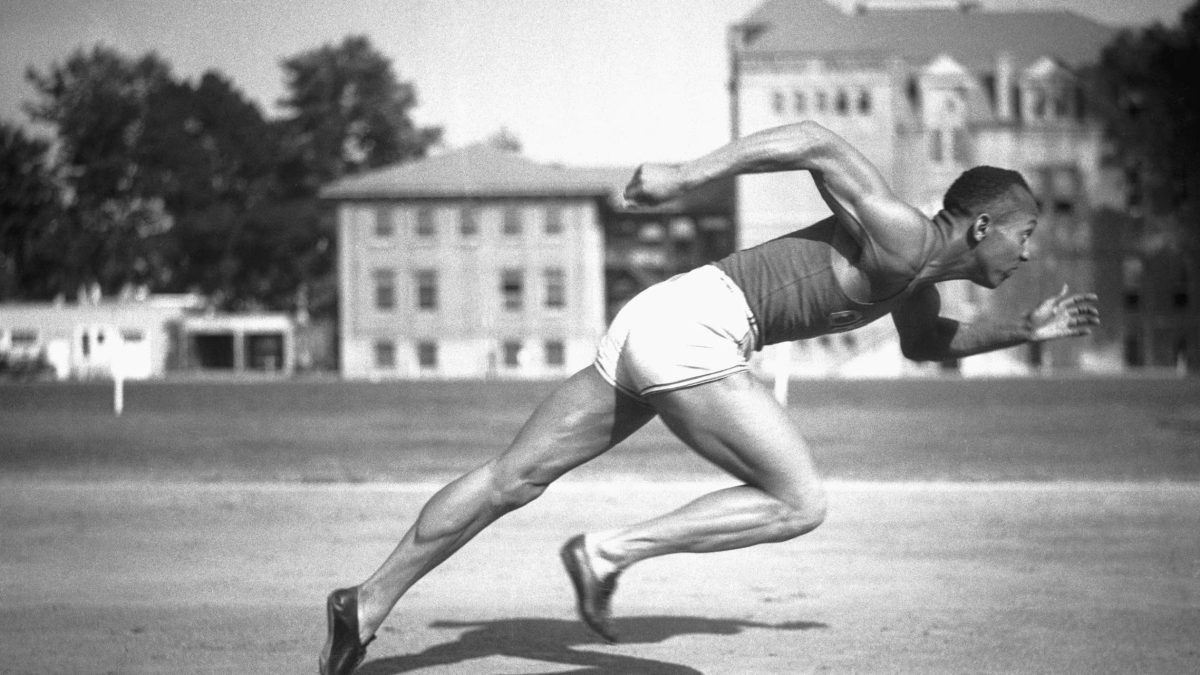
Jesse Owens (James Cleveland Owens, 12 September 1913 to 31 March 1980) was an American track and field athlete who made history at the 1936 Olympic Games in Berlin by winning four gold medals. He is widely regarded as one of the greatest athletes in track and field history. A year earlier, in 45 minutes at the 1935 Big Ten Championships, he had set world records in a feat that has never been equalled. He died in 1980 at the age of 66. This biography follows his life and career.
Jesse Owens at a Glance
| Birth name | James Cleveland Owens |
| Born | 12 September 1913, Oakville, Alabama, United States |
| Died | 31 March 1980, Tucson, Arizona (aged 66) |
| Profession | Track and field athlete |
| Events | 100 metres, 200 metres, long jump, 4 x 100 metres relay |
| 1936 Olympics | Four gold medals in Berlin |
| Nickname | The Buckeye Bullet |
| Spouse | Minnie Ruth Solomon (married 1935 until his death) |
Early Life
Owens was originally known as J. C. He was the youngest of ten children, three girls and seven boys, born to Henry Cleveland Owens, a sharecropper, and Mary Emma Fitzgerald in Oakville, Alabama, and he was the grandson of a slave. At the age of nine he and his family moved to Cleveland, Ohio, in search of better opportunities, part of the Great Migration in which millions of African Americans left the segregated rural South for the industrial North. When his new teacher asked his name for her roll book, he said "J. C.", but because of his strong Southern accent she thought he had said "Jesse", and the name stuck. In his younger years he delivered groceries, loaded freight cars and worked in a shoe repair shop, and he developed a passion for running. He always credited his success to Charles Riley, his track coach at Fairmount Junior High School, who allowed him to practise before school because Owens worked after class.
High School Records and Family
At East Technical High School in Cleveland he gained national attention. He equalled the world record of 9.4 seconds in the 100-yard dash, broke the national high school record in the 220-yard dash with 20.7 seconds and long-jumped 24 feet 9.5 inches at the 1933 National High School Championship in Chicago. His 100-yard dash record stood as the national high school record until 1967, and his 220-yard dash mark remained the national record for 20 years. He met Minnie Ruth Solomon at Fairmount Junior High School when he was 15 and she was 13. Their first daughter, Gloria, was born in 1932, and they married on 5 July 1935 and had two more daughters, Marlene in 1937 and Beverly in 1940. They remained married until his death.
Ohio State University
Owens entered Ohio State University in 1933 and, under the coach Larry Snyder, won a record eight individual NCAA championships, four each in 1935 and 1936. He did so despite living off campus with other African American athletes, and when he travelled with the team he was restricted to carry-out orders or "blacks-only" restaurants and hotels. He did not receive a scholarship and worked part-time jobs to pay for school. In 1936 he was undefeated, winning all 42 events he entered, and he struggled as a student, being placed on academic probation in 1936 and 1940.
The Greatest 45 Minutes in Sport
On 25 May 1935, at the Big Ten Championships at Ferry Field in Ann Arbor, Michigan, Owens battled through a lower back injury and in 45 minutes, between 3:15 and 4 p.m., set five world records and tied a sixth. He equalled the world record in the 100-yard dash with 9.4 seconds and set world records in the long jump, with 26 feet 8.25 inches, a mark that lasted for 25 years, in the 220-yard sprint, with 20.3 seconds, and in the 220-yard low hurdles, with 22.6 seconds. The performance was called "the greatest 45 minutes ever in sport".
The 1936 Berlin Olympics
At the 1936 Summer Olympics in Berlin, Owens won four gold medals, in the 100 metres, the long jump, the 200 metres and the 4 x 100 metre relay, setting Olympic records in each of his individual events. He was the most successful athlete at the Games and, as a Black American man, was credited by ESPN with "single-handedly crushing Hitler's myth of Aryan supremacy". He won the 100 metres on 3 August with a time of 10.3 seconds, beating his teammate and college friend Ralph Metcalfe by one tenth of a second, and he won the long jump the next day. He initially credited his long-jump success to technical advice from the German competitor Luz Long, whom he defeated, but later admitted that this was not true, as the two did not meet until after the competition. He won the 200 metres on 5 August and the relay on 9 August. He also signed what was the first sponsorship for a male African American athlete, with the Dassler shoe company.
Later Life
Owens dropped out of Ohio State in 1941 without earning a degree. After the Olympics, Avery Brundage organised a European exhibition tour to profit the AAU and the USOC, and Owens, exhausted but pressured to compete, ran multiple races across Europe with little rest or support. He later struggled to earn a living, eventually filed for bankruptcy and was convicted of tax evasion in 1966. President Dwight D. Eisenhower enlisted him as a goodwill ambassador in 1955 and sent him to India, the Philippines and Malaya to promote physical exercise and American freedom. In a 1950 Associated Press poll he was voted the greatest track and field athlete of the first half of the century.
Death and Legacy
From December 1979 he was hospitalised on and off with an extremely aggressive and drug-resistant type of lung cancer, and he died of the disease in Tucson, Arizona, on 31 March 1980, at the age of 66, with his wife and other family members at his bedside. In 1999 he made the six-man short-list for the BBC's Sports Personality of the Century, and that year ESPN ranked him the sixth-greatest North American athlete of the twentieth century and the highest-ranked in his sport. The Jesse Owens Award is USA Track and Field's accolade for the year's best track and field athlete.