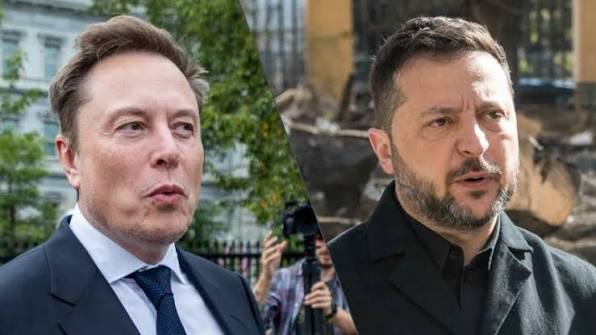
Ukraine's president, Volodymyr Zelensky, has called on the United States and Elon Musk's company to lift restrictions on a military satellite internet system that he says is hampering the country's ability to stop Russian attacks, just as he disclosed that American negotiators had floated the idea of Ukraine withdrawing from the eastern Donbas region in exchange for NATO membership. The two developments, announced within 48 hours of each other, show the pressure Kyiv is under on two fronts: on the battlefield, where the technology that protects its skies has become a point of friction with its most important ally, and at the negotiating table, where the shape of a possible peace deal remains deeply contested. "We are counting on these restrictions being lifted. The protection of lives and Ukraine's energy infrastructure ahead of winter directly depends on this," Mr Zelensky said, adding that "it is important to be on the right side of history".
The satellite dispute concerns Starshield, a military-grade service developed by Mr Musk's Starlink and provided to Ukraine by the US government. Ukraine uses the normal Starlink service for communications on the battlefield, while Starshield is used for the interception of drones in Ukrainian airspace. According to the BBC, the issue of speed restrictions was first identified in October and led to conflicting accounts from Mr Musk and President Donald Trump. Mr Musk said the US government was responsible because Starshield was controlled by Washington, while Mr Trump denied responsibility and said he had told the billionaire to "put it back". The service appeared to return to normal after a week, but Ukraine then said the restrictions were still being applied. On Sunday Mr Zelensky said Ukraine was struggling to intercept Russian jet-powered drones targeting electricity substations because restrictions on the operating speed of Starshield terminals along the front line and in the occupied territories were still in place.
The practical effect, he argued, is stark. "Our interceptor drones lose connection with their operators at a speed of 161km/h (100mph) and simply cannot catch up with Russian jet-powered 'shaheds'," he posted, referring to the drones that follow an Iranian design. On Friday he had said that speed limits of around 100mph had been enforced on the network since Monday, but only in Russian-occupied areas and not across the whole of Ukraine. He also saw a political dimension, according to the New York Times as quoted by the BBC: "It already has political implications. If you impose restrictions there, you are already partially recognising the temporary occupied territories as not ours." In other words, Kyiv reads a geographic limit on a satellite service as a quiet statement about where Ukraine's borders lie, which is why a technical question has turned into a diplomatic one.
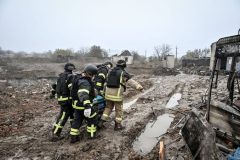
The argument for lifting the limits is therefore simple and urgent. The past week, Mr Zelensky said, saw Russian attacks that included more than 2,300 drones, 1,590 glide bombs and 15 missiles and cruise missiles, according to DW, and he called the strikes "brutal" and "difficult to counter". Ukraine is also short of US-made Patriot interceptors used against Russian missiles, a gap that Russia has exploited to intensify its strikes. Overnight into Sunday, Russia hit energy infrastructure in Zaporizhzhia and the Sumy, Odesa, Zhytomyr and Kirovohrad regions and struck railway infrastructure in the Dnipro, Kharkiv and Zaporizhzhia regions, Ukraine said. Two people were killed in an attack on an infrastructure facility in Chernihiv region, and a Russian strike on the port city of Chornomorsk injured six people and damaged energy infrastructure, local authorities said. With winter approaching, every substation that fails is a household without heat, which is why Mr Zelensky has tied the satellite speed limits directly to the protection of civilian lives.
The other side of the argument is less about technology than about control. Starshield is not a commercial product that Ukraine buys on its own terms; it is a military-grade service operated by a private company and provided through the US government, which means that Washington can in principle change how it works. The BBC notes that the connection problems coincided with a tense stand-off between Mr Zelensky and Mr Trump over Ukrainian strikes on oil infrastructure inside Russia. Mr Trump said the strikes on Russian refineries, which Kyiv says are crucial to stemming the main revenue source for Moscow's war effort, had pushed global prices higher. Ukraine, for its part, carried out strikes on a petrochemical plant and an oil refinery in the central Russian city of Nizhnekamsk in Tatarstan on the night of 15 November, saying the two enterprises "feed the Russian war with raw materials and fuel". The BBC has asked the White House and Starlink for comment, and neither answer was available when it published.
The second development concerns the terms of peace. In remarks released by his office on Saturday, Mr Zelensky said US negotiators had raised a new question. "The Americans raised a question: 'What if Ukraine joins NATO? Would Ukraine withdraw from Donbas?' This was the first time this had been raised," he said. He added that if he received a specific proposal that included security guarantees, no constraints on Ukraine's military and funds to rebuild the country, he would put it to a referendum. The remarks followed a round of diplomacy in which the US envoys Jared Kushner and Steve Witkoff travelled to Dublin on Thursday to meet Mr Zelensky after talks with Russian President Vladimir Putin in Moscow. The US has not confirmed the comments; an American official told the BBC that "many ideas continue to be discussed but any final deal will have to be agreed to by both parties".
Reaction suggests the idea is more of a probe than a plan. Hours after Mr Zelensky's remarks, Mr Kushner appeared keen to dampen down any American offer of NATO membership, urging "confidentiality" in a sensitive process and referring to "private discussions" aimed at exploring new ideas for ending what he called a "horrible war". He said "maximalist" proposals had been reported from the negotiations, along with "strong political rhetoric". The BBC's analysis notes that other NATO members apart from the US are wary of membership for Ukraine, that Kyiv itself is understood to see it as unrealistic, and that the Kremlin has always been fiercely opposed. It is possible, the BBC suggests, that the US envoys were testing Ukraine's red lines on occupied Donbas land, and equally possible that Mr Zelensky made the suggestion public to reopen a discussion that had been considered all but closed. He said the idea was now "back on the agenda" as part of an "extremely difficult conversation" on European security.
Russia's position, meanwhile, has not shifted. Russia launched its full-scale invasion in February 2022 and occupies roughly a fifth of Ukrainian territory, including most of the Donetsk and Luhansk regions that make up the Donbas. It has insisted that it will not agree to a ceasefire until a final peace deal is in place that includes Ukraine ceding the parts of the Donbas that Russian troops have not captured, in addition to Crimea, which Moscow annexed illegally in 2014. Moscow now talks of a "new European security architecture", which the BBC describes as long-standing Russian code for a weaker NATO. Ukraine has rejected limits on the size of its military and neutrality as conditions, arguing that such constraints would hamper its ability to ward off a future invasion. Mr Zelensky has consistently said Ukraine is unwilling to give up sovereign territory, and elections are suspended while Ukraine remains under martial law, although he has said he would be willing to hold them within months of a peace deal.
There is a further complication on the European side of the front. Estonia announced that it will shut its border crossing points with Russia from 1 December after a suspected sabotage attack on a defence company. Eight people were detained over an attempted arson attack on the drone maker Threod Systems, and Estonian authorities say they had been ordered by Russia's GRU military intelligence service to carry it out. "Russia must understand that hostile actions against Estonia come with consequences," Foreign Minister Margus Tsahkna said. Russia has not commented. The episode is a reminder that the war's effects are spreading beyond Ukraine's borders and that drone production, the same industry at stake in the Starshield dispute, has become a target in its own right.
Taken together, the week's events show how many moving parts a settlement would need to align. Ukraine needs a stable, unrestricted air-defence network before the cold sets in, and it needs the United States to be seen as a reliable provider of that network. It also needs any peace proposal to come with security guarantees that go beyond words, which is why the NATO question, however remote, keeps resurfacing. Washington, for its part, is balancing its wish for a quick deal against its relationship with Kyiv and with Moscow. For now, the most concrete test is the one Mr Zelensky has set himself: whether the speed limits on Starshield are lifted before the next wave of Russian drones reaches the substations that keep Ukraine's lights on.