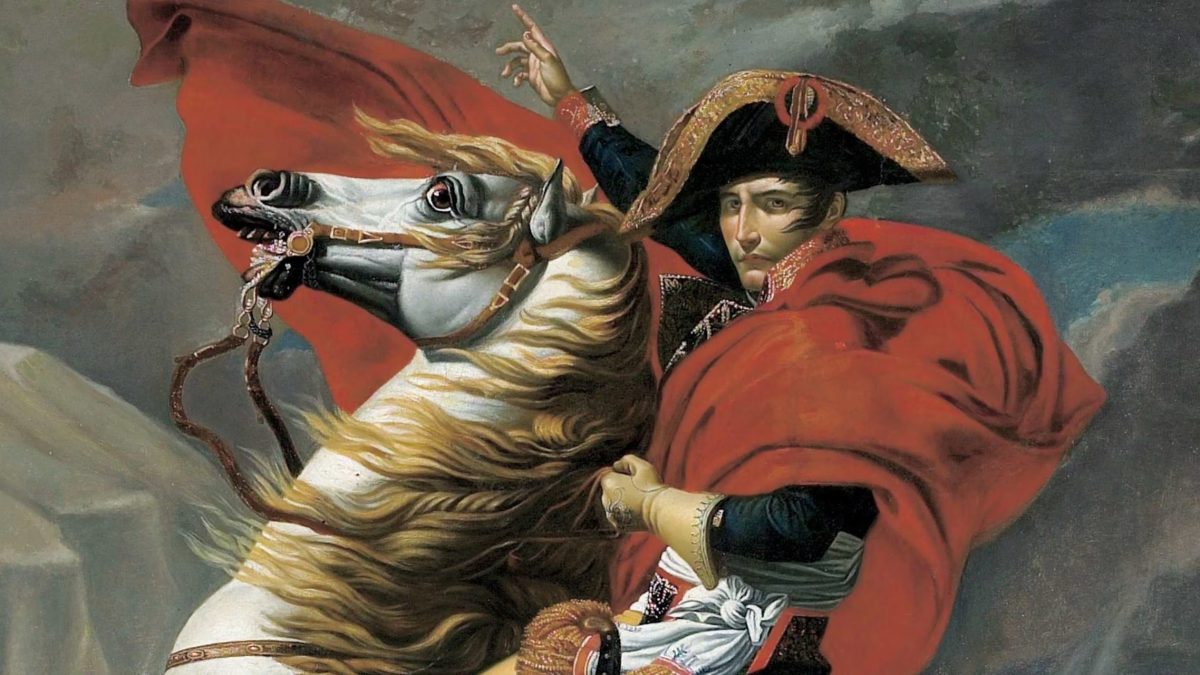
Napoleon Bonaparte (born Napoleone di Buonaparte, 15 August 1769 to 5 May 1821) was Emperor of the French from 18 May 1804 until his first abdication in 1814, with a brief return to power during the Hundred Days in 1815. He rose to prominence as a general in the French Revolution and led military campaigns across Europe and the Middle East. As a statesman he introduced legal and administrative reforms that still influence France and other countries. This biography follows his life.
Napoleon Bonaparte at a Glance
| Full name | Napoleone di Buonaparte (Napoleon Bonaparte) |
| Born | 15 August 1769, Ajaccio, Corsica |
| Died | 5 May 1821, Saint Helena (aged 51) |
| Title | First Consul (1799 to 1804); Emperor of the French (1804 to 1814, and 1815) |
| Best-known victories | Marengo (1800) and Austerlitz (1805) |
| Final defeat | Waterloo, 18 June 1815 |
| Spouses | Joséphine de Beauharnais (married 1796; annulled 1810) and Marie Louise of Austria (married 1810) |
Early Life and Military Training
Napoleon was born on the island of Corsica to a family of Italian origin. In 1779 he moved to mainland France, and in 1785 he was commissioned as an officer in the French Royal Army. He supported the French Revolution after 1789 and promoted its cause in Corsica.
Rise During the Revolution
Napoleon rose quickly through the ranks after winning the siege of Toulon in 1793 and defeating royalist insurgents in Paris on 13 Vendémiaire in 1795. In 1796 he commanded a campaign against the Austrians and their Italian allies in the War of the First Coalition, scored decisive victories and became a national hero. He led an invasion of Egypt and Syria in 1798, which became a springboard for his rise to political power.
First Consul and Emperor
In November 1799 Napoleon carried out the Coup of 18 Brumaire against the French Directory and became First Consul of the Republic. He won the Battle of Marengo in 1800, which secured France's victory in the War of the Second Coalition. In 1803 he sold the territory of Louisiana to the United States. In December 1804 he crowned himself Emperor of the French. His reforms included the Civil Code of 1804, known as the Napoleonic Code, which set out a uniform system of law and influenced legal systems around the world.
Wars Across Europe
The breakdown of the Treaty of Amiens led to the War of the Third Coalition. Napoleon won a decisive victory at Austerlitz in 1805, which led to the dissolution of the Holy Roman Empire. In 1806 he defeated Prussia at Jena-Auerstedt, and in 1807 he defeated the Russians at Friedland. His invasion of the Iberian Peninsula and the installation of his brother Joseph as King of Spain in 1808 provoked the Peninsular War, and in 1809 he beat Austria again at Wagram.
The Russian Campaign and Defeat
In the summer of 1812 Napoleon launched an invasion of Russia. After the Battle of Borodino the Russians abandoned Moscow, and Napoleon occupied it briefly before a catastrophic winter retreat. In 1813 Prussia and Austria joined Russia, and Napoleon was decisively defeated at Leipzig. The coalition invaded France and captured Paris, forcing him to abdicate in April 1814, and he was exiled to the island of Elba.
The Hundred Days and Waterloo
Ten months later Napoleon escaped from Elba with about a thousand men and marched on Paris, reclaiming power. His opponents formed a Seventh Coalition, and on 18 June 1815 he was defeated at the Battle of Waterloo. He was exiled to the remote island of Saint Helena in the South Atlantic.
Exile and Death
Napoleon and 27 followers arrived on Saint Helena, about 1,870 km from the west coast of Africa. His health worsened from mid-1817, and he died on 5 May 1821 aged 51. Most medical opinion points to stomach cancer, although other explanations have been argued over the years. His remains were returned to Paris in 1840 and placed at Les Invalides.
Personal Life
Napoleon had a civil marriage with Joséphine de Beauharnais in 1796. They had no children, and he annulled the marriage so that he could make a strategic marriage into a European royal house. In 1810 he married Marie Louise of Austria, and their son was born in 1811.
Legacy
Napoleon's legal and administrative reforms, including the Napoleonic Code, outlasted his empire, and his campaigns changed the map of Europe. Historians remain divided between those who stress his role in spreading revolutionary reforms and those who emphasise the human cost of his wars.
Conclusion
Napoleon rose from a Corsican family to rule much of Europe and died as a prisoner on a remote island. His laws and his campaigns still shape how the period is understood, and he remains one of history's most studied leaders.