Seven core OPEC+ members agreed on 4 October to leave their November oil output targets unchanged at about 31 million barrels a day, with Brent crude settling at $102.25 a barrel and the Strait of Hormuz still restricting supply.
The seven core members of OPEC+ agreed on Sunday, 4 October 2026, to keep their oil production targets for November unchanged, according to The National, the Moscow Times and other outlets. The group decided to maintain September 2026 required production for November, and the joint quota stays at about 31 million barrels a day, according to The National. Another report gives the figure as 31.01 million barrels a day.
The seven members are Saudi Arabia, Iraq, Kuwait, Oman, Algeria, Russia and Kazakhstan, according to The National. It is the second month in a row that the group has paused increases.
The pause follows a larger programme. The group completed the unwinding of 1.65 million barrels a day of voluntary cuts from 2023 and keeps 2 million barrels a day of cuts from its 2022 agreement in place through the end of the year, according to The National. It has also begun reviewing members’ production capacity as a basis for 2027 quotas, a review that a search summary says will likely happen later in 2026.
Quotas are largely theoretical at present. The National says that most members are producing below their targets because of the regional conflict. A search summary says that the seven core members pumped 25 million barrels a day in August, up 630,000 from July but still roughly five million barrels a day below prewar levels in February.
Prices are well above the level before the war. Brent crude settled at $102.25 a barrel on 4 October, according to The National, and a search summary says it was about $73 before the war began in late February. That is a rise of about 40%, a calculation by Delima News, in line with the roughly 41% rise in the oil price assumption that the IMF used in its forecast, as Delima News has reported.
The cause is the closure of the Strait of Hormuz since late February, which, according to The National, has restricted about a fifth of the world’s crude and liquefied natural gas supplies. The International Energy Agency’s October report, which Delima News covered, forecasts world oil demand falling by 2.6 million barrels a day in 2026.
The group will meet again on 1 November, according to The National, and says it will continue to hold monthly meetings to review the market. A search summary says that OPEC+ is likely to pause its increases for the fourth quarter.
For consumers and businesses the practical significance is that no increase in official targets is coming to lower prices. The pause leaves the price of oil dependent on the shipping situation in the Gulf and on how much oil members can actually produce, which the reports say is below their quotas. The sources reviewed do not give an expected price for November.
The decision means that the group is not adding barrels on paper while it cannot deliver the barrels it already has.
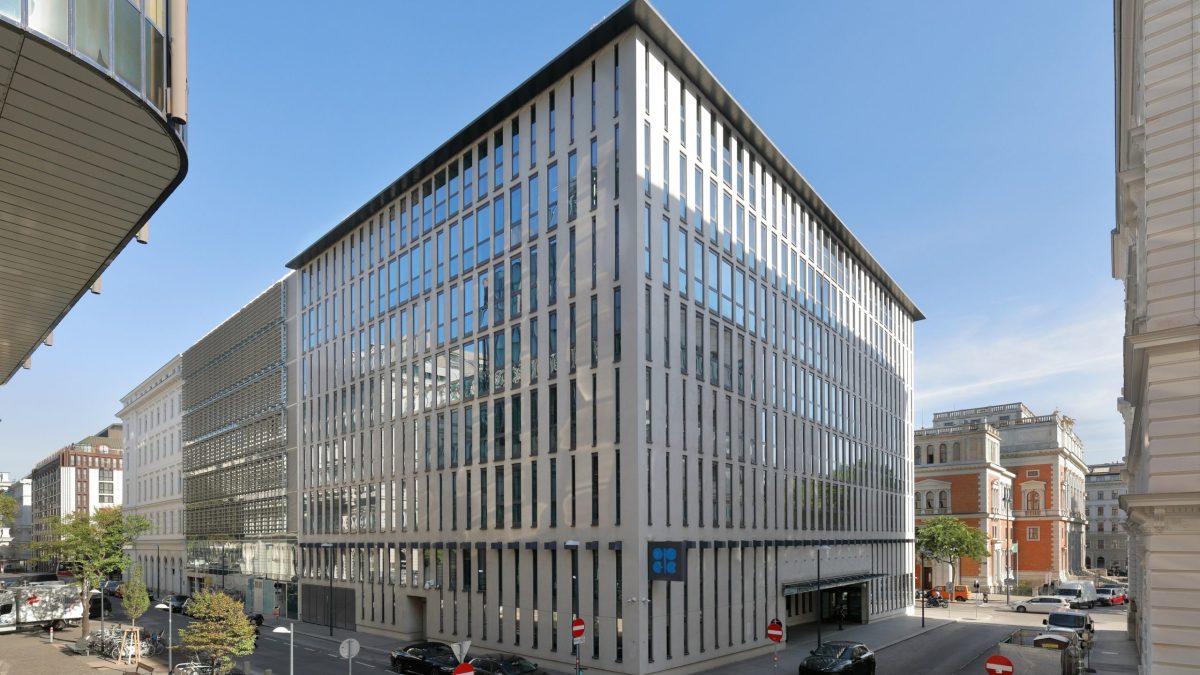
Image: The OPEC headquarters in Vienna (file photo). Photo: C.Stadler/Bwag / Wikimedia Commons (CC BY-SA 4.0)