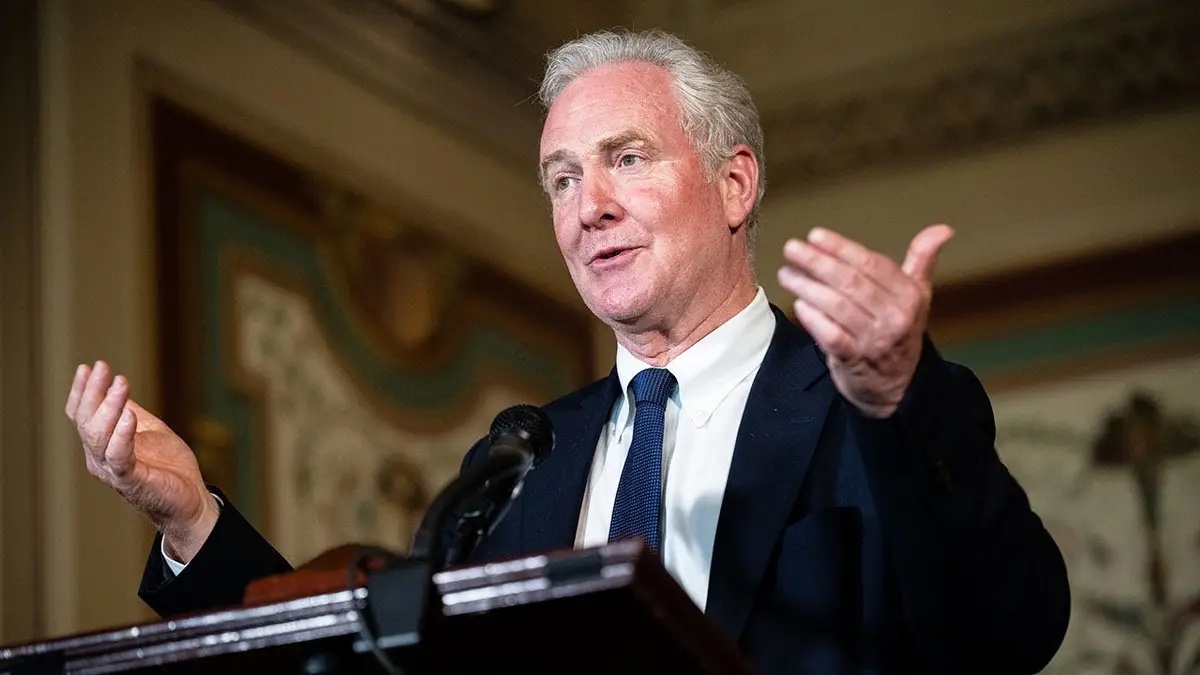
Democrats have won control of Congress, and before they take it, they are arguing about who should lead them. Senator Chris Van Hollen of Maryland announced on Thursday that he will challenge Chuck Schumer for the top Democratic job in the Senate, saying in a post on X that Americans voted for change earlier this month and "to deliver, we need new leadership." Mr Schumer, who has led Senate Democrats since 2017 as both majority and minority leader, responded that he welcomed "any discussion about the future of our caucus," said he was proud of what the party accomplished together in the midterms, and said he had "the votes to continue as Democratic leader." The contest will be settled by a secret ballot behind closed doors in early December, and the winner takes the role on 4 January, when Democrats assume control of both the Senate and the House.
The two men are not far apart in age or ideology as the headlines may suggest. Mr Van Hollen is 67 and Mr Schumer is 75, so NPR's Elena Moore noted that the challenger is only eight years younger than the incumbent, and the two are broadly aligned on the party's major priorities, including lowering costs, ending the war and reversing some of the Trump administration's funding cuts. The difference is how they talk about reforming the party. Mr Van Hollen told a Democratic summit in Colorado that "we should not be preserving our institutions if they are not delivering for the American people," and that the government's mission should be delivering for them "even when that means shaking things up." He also said the country "does not belong to the people who can afford to buy influence," and called for Democrats to "unrig an economy rigged against working people."
The case for the challenge is built on the midterm message. Mr Van Hollen argues that voters rejected the status quo and that the party must reorganise the Senate to answer calls to end political corruption and what he calls a rigged economic system. That language echoes the campaigns of successful Democratic Senate candidates this cycle, including Abdul El-Sayed in Michigan, who ran against the establishment that Mr Schumer has long represented, according to NPR. Mr Van Hollen has taken positions popular with the left in recent years: in 2024 he supported restricting weapons shipments to Israel and criticised the Biden administration's role in the Gaza war, and last year he travelled to El Salvador to meet Kilmar Abrego Garcia, the Maryland man wrongly deported to a prison there. He has also pointed to the influence of special interests and campaign donations from super PACs and pro-Israel lobbying groups such as AIPAC, which has supported Mr Schumer in the past, a topic that exposes a real rift inside the caucus.
Mr Van Hollen is backed by some prominent figures. Independent Senator Bernie Sanders said he believes Mr Van Hollen "will stand up to powerful special interests, take on the billionaire class and fight for working families," and Senator-elect Abdul El-Sayed said the challenger would bring "bold leadership" and lead with "courage and experience." NPR adds that dissatisfaction with Mr Schumer is not confined to progressives: earlier this week, Mr Sanders held a press conference with Senator Elissa Slotkin of Michigan, who is considerably more moderate, and both announced that they would not support Mr Schumer. Part of the unease dates to the start of Mr Trump's second term, when Mr Schumer was criticised in Congress and by voters who argued that he was not fighting hard enough. Those who want change argue that a new majority needs a new face and a new approach.
The case for Mr Schumer rests on experience and on the result. He was first elected to the Senate in 1999, and his supporters credit him with guiding the party to its midterm success. Senator Jacky Rosen of Nevada said he "has the experience and the fight to continue leading our diverse caucus at this crucial moment," and Senator Kirsten Gillibrand predicted that "despite all the grumblings, enormous gratitude for the hard work he has done to get us to this position." Mr Schumer has said he has the votes, and Mr Van Hollen himself acknowledged to MS NOW that he is an "underdog," though he believes the race is "very much in flux." NPR cautions that dissatisfaction with Mr Schumer may not automatically translate into a victory for Mr Van Hollen, who, with nearly a decade in the Senate and more than a decade in the House before that, is himself a veteran of Washington. Critics of the challenge also point out that a leadership fight before the new Congress even begins risks distracting from the agenda voters just endorsed.
The generational and stylistic dimension is hard to avoid, even though both men are in their late sixties or seventies. Mr Schumer has been in the Senate since 1999 and has led his party in the chamber for nearly a decade. Mr Van Hollen has served in the Senate since 2017 after more than a decade in the House, where he held leadership roles. NPR observed that Mr Van Hollen in some ways embodies older-school politics, which makes his claim to be the face of change a question voters and colleagues will test. His answer is that the change he is offering is one of method and priorities rather than biography: a leader who is willing to pick fights over donations and corporate influence, and who places the economic complaints of working people at the centre of the party's message. His opponents will answer that a leader needs to hold a diverse caucus together, from progressives to moderates, and that Mr Schumer has done that through some of the party's hardest moments.
There is also the matter of what the vote will actually measure. A secret ballot among Senate Democrats is a different contest from a primary or a general election, since the electorate is a few dozen colleagues who have worked with both men for years and who weigh personal relationships, committee assignments and political survival alongside ideology. Mr Schumer said he has the votes and Mr Van Hollen said the race is in flux, and both statements may be true at this stage, because few senators have declared publicly. What the challenge has already done is change the conversation: whatever the outcome, Mr Schumer will now have to explain what he intends to do differently as leader of a majority, and the winner will have to hold together a caucus that has just been reminded how divided it is over money in politics, the war and relations with Israel.
Why does it matter? The Senate leader decides the party's floor strategy, negotiates with the White House, shapes committee priorities and sets the tone of opposition and governance for two years. With the Democrats about to control both chambers while Donald Trump remains in the White House, the leader will be responsible for deciding when to cooperate, when to confront, and how to handle fights over spending, nominations and investigations. The contest is also a test of what the party believes the midterms meant: a demand for sharper opposition and structural change, or a vindication of the existing strategy.
The next three weeks will reveal how deep the dissatisfaction runs. Because the vote is by secret ballot, public statements of support may not reflect private intentions, and both camps have time to lobby colleagues before the early December vote. Mr Schumer says he has the numbers; Mr Van Hollen says the race is in flux. Whichever result emerges, the fact that a sitting senator has openly challenged the leader before a majority has even been sworn in suggests that the question Democrats now face is not only who will lead them, but what they intend to do with the power they have just won.