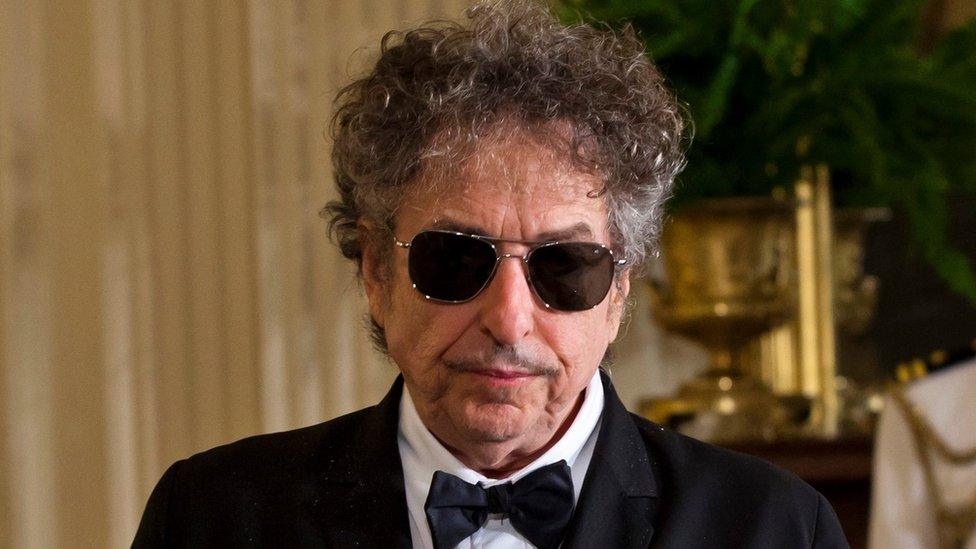
Bob Dylan (Robert Allen Zimmerman, born 24 May 1941) is an American singer-songwriter who has been one of the most influential figures in popular music for more than six decades. He became a voice of the 1960s protest movement with songs such as "Blowin' in the Wind", reinvented rock music with "Like a Rolling Stone", and in 2016 became the first musician to win the Nobel Prize in Literature. He turned 85 in May 2026. This biography follows his life, his music and his place in cultural history.
Bob Dylan at a Glance
| Birth name | Robert Allen Zimmerman |
| Born | 24 May 1941, Duluth, Minnesota, United States |
| Age | 85 (as of November 2026) |
| Profession | Singer-songwriter, musician and author |
| Best known for | "Blowin' in the Wind", "Like a Rolling Stone", Highway 61 Revisited, Blood on the Tracks |
| Major honours | Nobel Prize in Literature (2016), Presidential Medal of Freedom (2012), Pulitzer Prize special citation (2008), Academy Award (2001) |
| Record label | Columbia Records |
| Touring | The "Never Ending Tour", begun in 1988 |
Early Life in Duluth and Hibbing
Dylan was born in Duluth, Minnesota, and spent his childhood in the town of Hibbing, where the family returned when Dylan was six, after his father contracted polio, and where his father and uncles ran a furniture and appliance store. His family belonged to a close-knit Jewish community. As a teenager he listened to the radio and was drawn to blues, country and early rock and roll, and he played in a series of school bands. After a short period at the University of Minnesota in Minneapolis, he began performing folk songs in local coffee houses and started calling himself Bob Dylan. He has said that the name was not taken from the poet Dylan Thomas, but he has also been unwilling to explain its origin in detail.
Greenwich Village and the Folk Revival
In January 1961 Dylan moved to New York, where he performed in the clubs of Greenwich Village and visited the folk singer Woody Guthrie, who was ill in hospital and whom he admired. The critic Robert Shelton wrote an enthusiastic review of one of his performances in The New York Times, and the record producer John Hammond signed him to Columbia Records. His first album, Bob Dylan, was released in March 1962 and consisted mostly of folk and blues covers.
His second album, The Freewheelin' Bob Dylan (1963), contained original songs including "Blowin' in the Wind" and "A Hard Rain's A-Gonna Fall". "Blowin' in the Wind" became an anthem of the civil rights movement, and the singer performed at the March on Washington in August 1963. The album The Times They Are a-Changin' (1964) took the same direction, with the title song becoming a rallying cry for a generation of young people.
Going Electric
By 1965 Dylan was moving away from the folk tradition that had made him famous. His album Bringing It All Back Home placed electric instruments alongside acoustic songs, and in the summer of that year he released "Like a Rolling Stone", a six-minute single that changed the expectations of what popular music could be. It was followed by the album Highway 61 Revisited. When he played an electric set at the Newport Folk Festival in July 1965, some of the audience reacted with hostility, and the episode became one of the best-known events in the history of rock music. His 1966 double album Blonde on Blonde confirmed his shift and is often named among the finest albums ever made.
Accident, Retreat and Return
In July 1966 Dylan was injured in a motorcycle accident near his home in Woodstock, New York, and withdrew from public performance for a number of years. He recorded music with the group later known as The Band, and in the late 1960s he released albums that moved towards country music. He returned to the charts in 1975 with Blood on the Tracks, an album about heartbreak that many critics regard as one of his best. In 1979 he released Slow Train Coming, which followed his conversion to Christianity and surprised many of his admirers.
Family
Dylan married the former model Sara Lownds on 22 November 1965, and the couple had four children, including Jakob Dylan, who became a musician and leads the band The Wallflowers. They divorced in 1977. Dylan later married the singer Carolyn Dennis, with whom he has a daughter, and that marriage, which ended in 1992, was not widely known for many years. He has kept his private life largely out of the public eye.
The Never Ending Tour and Later Albums
In 1988 Dylan began what became known as the Never Ending Tour, in which he has played hundreds of concerts around the world, usually dozens of dates each year. His later albums include Time Out of Mind (1997), "Love and Theft" (2001) and Modern Times (2006), which brought a renewed critical and commercial reception. The 2005 documentary No Direction Home chronicled his early career. In 2001 he won the Academy Award for Best Original Song for "Things Have Changed", from the film Wonder Boys. On 26 March 2020, as the Covid-19 pandemic began, he released "Murder Most Foul", a seventeen-minute song about the Kennedy assassination, and later that year came the album Rough and Rowdy Ways, which was widely praised. The 2024 film A Complete Unknown, in which the actor Timothée Chalamet played the young Dylan, brought his early career to a new audience.
Honours and the Nobel Prize
With an estimated 125 million records sold worldwide, Dylan is one of the best-selling musicians of all time, and his honours include ten Grammy Awards, the Kennedy Center Honors in 1997 and induction into the Rock and Roll Hall of Fame and the Songwriters Hall of Fame. He received a special Pulitzer Prize citation in 2008 for lyrical compositions of "extraordinary poetic power". In 2012 President Barack Obama awarded him the Presidential Medal of Freedom. In October 2016 the Swedish Academy awarded him the Nobel Prize in Literature "for having created new poetic expressions within the great American song tradition". He later called the news "amazing, incredible". He delivered his Nobel lecture on 4 June 2017.
Legacy
Dylan's influence on popular music is difficult to overstate. He showed that a popular song could carry the weight of poetry, and his use of imagery, narrative and satire opened up the form for generations of songwriters. His work has been recorded by hundreds of other artists, and his lyrics are studied in universities. His career, spanning more than sixty years, is notable for its restlessness: he has repeatedly changed style, sometimes to the dismay of his audience. At 85, he remains one of the central figures in modern music.