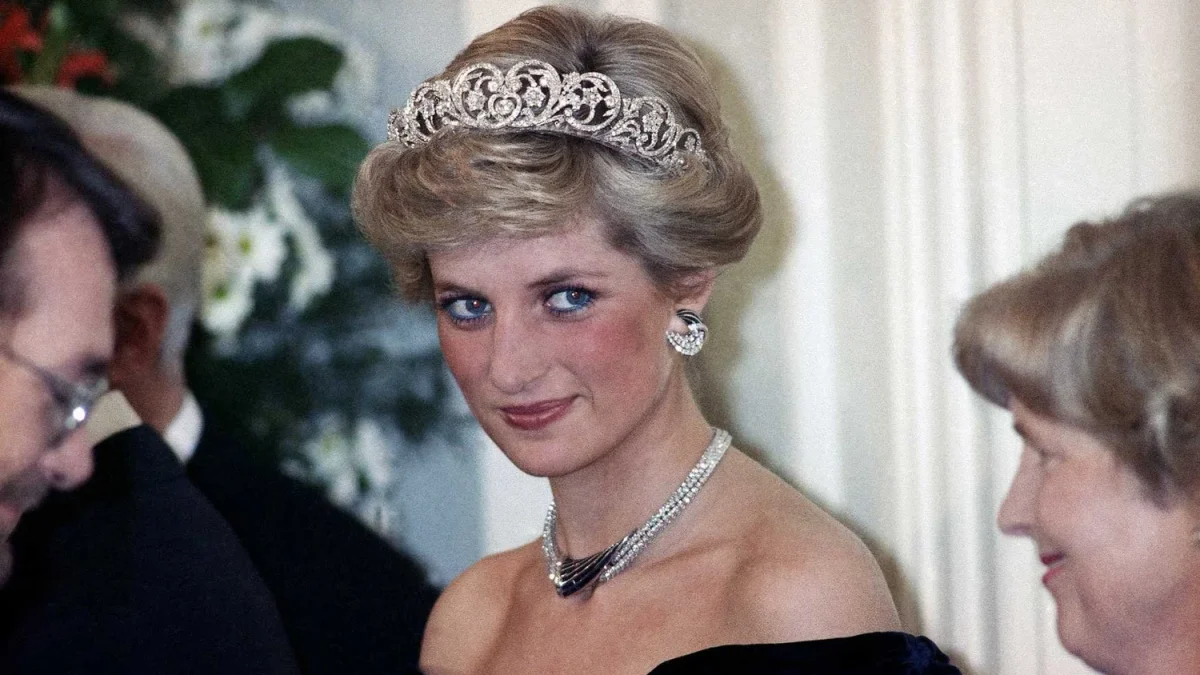
Diana, Princess of Wales (Diana Frances Spencer, 1 July 1961 to 31 August 1997) was a member of the British royal family as the first wife of Charles, Prince of Wales, and the mother of Prince William and Prince Harry. She became one of the most photographed and admired women in the world, known for her charity work with people with HIV and AIDS, her campaign against landmines and her warmth towards people she met. She died in a car crash in Paris at the age of 36. This biography follows her life and legacy.
Princess Diana at a Glance
| Birth name | Diana Frances Spencer |
| Born | 1 July 1961, Sandringham, Norfolk, England |
| Died | 31 August 1997, Paris, France (aged 36) |
| Title | Diana, Princess of Wales (1981 to 1996); Lady Diana Spencer before her marriage |
| Spouse | Charles, Prince of Wales (married 29 July 1981; divorced 28 August 1996) |
| Children | Prince William (born 1982) and Prince Harry (born 1984) |
| Best known for | Charity work, HIV and AIDS awareness, landmine campaign |
| Burial | Althorp, Northamptonshire |
Early Life
Diana was born at Park House, on the Sandringham estate in Norfolk, the fourth of five children of John Spencer, Viscount Althorp, later the 8th Earl Spencer, and Frances Spencer, Viscountess Althorp. She grew up in an aristocratic family with close links to the royal family. The Spencer family had been closely connected with the royal family for generations. In 1978 she spent three months working as a nanny in Hampshire and attended the Institut Alpin Videmanette, a finishing school in Switzerland, for one term, and she later worked as a preschool aide before her engagement.
Marriage to Prince Charles
Diana became engaged to Prince Charles in February 1981, and the couple married at St Paul's Cathedral in London on 29 July 1981, watched by a huge television audience around the world. At the altar she inadvertently reversed the order of Charles's first two names, and the traditional vow to "obey" was left out at the couple's request, which caused comment at the time. Within a few years the Queen lent her the Queen Mary's Lover's Knot Tiara and granted her the badge of the Royal Family Order of Elizabeth II. She became Princess of Wales, and she quickly became the most popular member of the royal family. The wedding was widely described as a "fairytale wedding" and was watched by a global television audience of 750 million people, while 600,000 spectators lined the streets. The couple had residences at Kensington Palace and Highgrove House, near Tetbury. The couple had two sons, Prince William, born on 21 June 1982, and Prince Harry, born on 15 September 1984. Amid some media criticism, she decided to take William, still a baby, on her first major tours of Australia and New Zealand, and the decision was popularly applauded. She chose the boys' first names, engaged a nanny of her own choosing, selected their schools and took them to school herself as often as her schedule permitted. She reportedly described Harry as "naughty, just like me" and William as "my little wise old man". The two boys were second and third in line to the throne.
Charity Work
By 1988 she was carrying out 191 official engagements a year, and 397 in 1991. From 1989 she was president of Great Ormond Street Hospital for Children, and from 1984 to 1996 she was president of Barnardo's, the children's charity. In 1988 she became patron of the British Red Cross, and she made several lengthy visits each week to Royal Brompton Hospital to comfort seriously ill or dying patients. Stephen Lee, director of the UK Institute of Charity Fundraising Managers, said: "Her overall effect on charity is probably more significant than any other person's in the 20th century." Diana used her public role to draw attention to subjects that others had avoided. In 1987 she held hands with an AIDS patient, one of her early efforts to destigmatise the condition, and she was the first British royal to make physical contact with such patients. She said: "HIV does not make people dangerous to know. You can shake their hands and give them a hug." In 1981 she established the Princess of Wales's Charities Trust, and in 1983 she confided to the premier of Newfoundland that she was finding it "very difficult to cope with the pressures of being Princess of Wales". She supported many charities, including those that worked with the homeless, with leprosy sufferers and with children's hospitals. She was patron of the HALO Trust, which removes landmines left behind by war, and in January 1997 pictures of her touring an Angolan minefield in a ballistic helmet and flak jacket were seen worldwide.
Separation and Divorce
By the early 1990s the marriage had broken down, and the couple separated in 1992. The journalist Martin Bashir interviewed Diana for the BBC programme Panorama, broadcast on 20 November 1995, in which she discussed extramarital affairs on both sides and her own struggles with depression and bulimia. The couple divorced on 28 August 1996, and Diana lost the style of Her Royal Highness, though she kept the title Diana, Princess of Wales, and remained the mother of the second and third in line to the throne.
Death in Paris
On 31 August 1997 Diana died in a car crash in the Pont de l'Alma tunnel in Paris, along with her companion Dodi Fayed and the driver, Henri Paul. She was 36. The news prompted an outpouring of grief in Britain and around the world, with mourners leaving a sea of flowers outside the royal palaces. The televised funeral on 6 September 1997 was watched by a British audience that peaked at 32.1 million and a United States audience that peaked at 50 million. She was buried on an island at Althorp, the Spencer family estate.
Legacy
Diana's legacy lives on through the charities that bear her name and through her sons, Prince William, now the Prince of Wales, and Prince Harry, who have spoken publicly about their mother and about mental health. Her landmine campaign raised awareness of the issue, and her work has been described as influential in the signing of the Ottawa Treaty, which created an international ban on the use of anti-personnel landmines. She was also patron of the Natural History Museum and president of the Royal Academy of Music and the Royal Academy of Dramatic Art. Her modernising approach to royal duties, her openness and her compassion changed the way the monarchy engaged with the public, and she remains one of the best-loved figures of her generation.