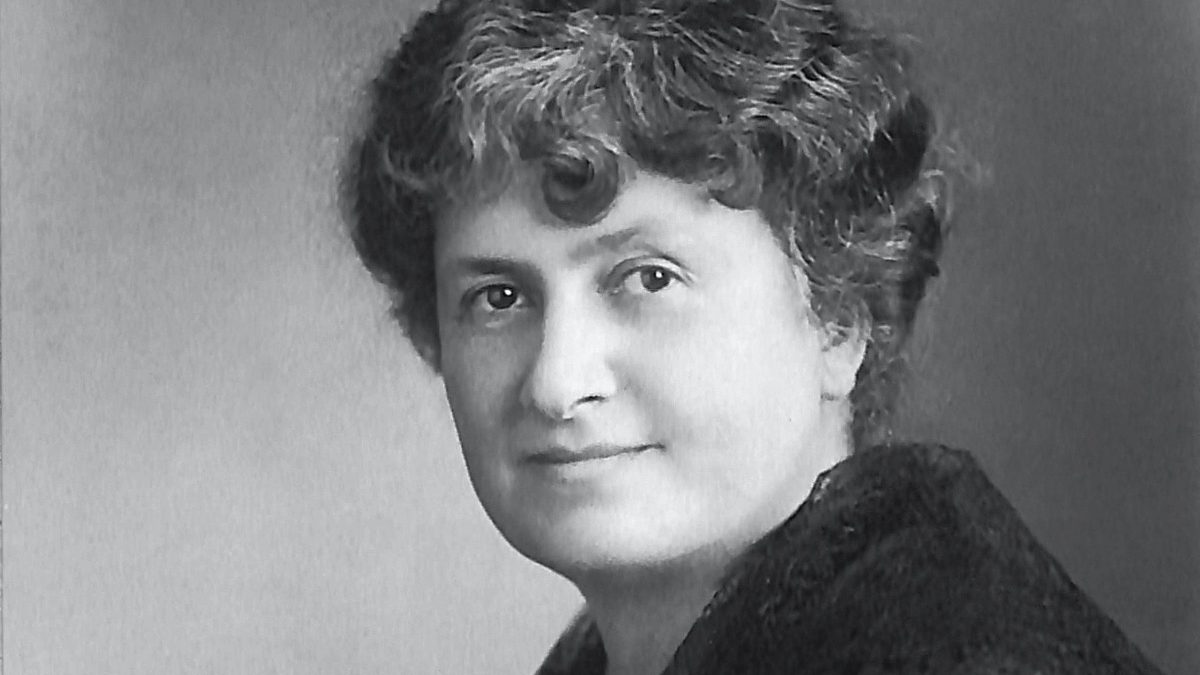
Maria Montessori (31 August 1870 to 6 May 1952) was an Italian physician and educator best known for her philosophy of education, the Montessori method, and for her writing on scientific pedagogy. As a girl she enrolled in classes at an all-boys technical school, hoping to become an engineer, but soon changed her mind and began medical studies. She became a physician, worked with children with learning difficulties, and in 1906 to 1907 began the classroom experiment that shaped her method. This biography follows her life, her method and her legacy.
Maria Montessori at a Glance
| Full name | Maria Tecla Artemisia Montessori |
| Born | 31 August 1870, Chiaravalle, Ancona, Italy |
| Died | 6 May 1952 (aged 81) |
| Profession | Physician and educator |
| Known for | The Montessori method; the Casa dei Bambini (Children's House) |
| Parents | Alessandro Montessori and Renilde Stoppani |
| Son | Mario Montessori (1898 to 1982) |
| Organisation | Association Montessori Internationale (founded with Mario in 1929) |
Childhood
Maria Montessori was born on 31 August 1870 in Chiaravalle, in the province of Ancona, Italy. Her father, Alessandro Montessori, was an official of the Ministry of Finance who worked in the local state-run tobacco factory, and her mother, Renilde Stoppani, was well educated for the times and was the niece of the geologist and paleontologist Antonio Stoppani. Because of her father's work, the family moved frequently. They moved to Florence in 1873 and to Rome in 1875, and she entered a public elementary school in 1876. Her early school record was not particularly noteworthy.
Education Against the Odds
In 1883 or 1884, at 13, Montessori entered a technical secondary school, where she studied Italian, arithmetic, algebra, geometry, accounting, history, geography and the sciences, and she graduated in 1886 with good grades. She continued at a technical institute, intending at first to become an engineer, and then she decided to study medicine. She appealed to Guido Baccelli, a professor at the University of Rome, but was strongly discouraged. In 1890 she enrolled at the University of Rome in a degree course in natural sciences.
She was met with hostility and harassment from some medical students and professors because of her gender. Her father also disapproved and wanted her to become a teacher, which was considered the only professional career appropriate to women at the time. Because her attendance at classes with men in the presence of a naked body was considered inappropriate, she had to perform her dissections of cadavers alone, after hours. She graduated from the University of Rome in 1896 and went into private practice.
Children With Learning Difficulties
In 1897 Montessori visited asylums in Rome as part of her work and observed children with mental disabilities, observations that were fundamental to her future educational work. From 1896 to 1901 she worked with and researched children experiencing cognitive delay, illness or disability. She became a prominent advocate for women's rights and for education for children with learning difficulties. In 1898 she spoke at the First Pedagogical Conference of Turin, urging the creation of special classes and institutions for children with learning difficulties and training for their teachers.
On 31 March 1898 she gave birth to her only child, a son named Mario, whose father was Giuseppe Montesano, a fellow doctor who was co-director with her of the Orthophrenic School of Rome. If Montessori married she would be expected to give up working professionally, and she decided instead to continue her work and studies. In 1900 the National League opened the Orthophrenic School, a medico-pedagogical institute for training teachers, with an attached laboratory classroom, and Montessori was appointed co-director. The school was an immediate success. In 1901 she left the school and her private practice, and in 1902 she enrolled in philosophy at the University of Rome, which included what is now considered psychology, though she did not graduate.
The Casa dei Bambini
In 1906 Montessori was invited to oversee the care and education of a group of children of working parents in a new apartment building for low-income families in the San Lorenzo district of Rome. She was interested in applying her methods to children without mental disabilities and accepted. The name Casa dei Bambini, or Children's House, was suggested to her. The first one opened in 1907 and a second was opened on 7 April 1907. In this first classroom she observed behaviours that formed the foundation of her method: episodes of deep attention and concentration, multiple repetitions of an activity and a sensitivity to order in the environment. Given a free choice of activity, the children showed more interest in practical activities and in her materials than in the toys provided.
On the basis of these observations she replaced the heavy furniture with child-sized tables and chairs light enough for the children to move, and placed child-sized materials on low, accessible shelves. She expanded the range of practical activities, such as sweeping and personal care, to include a wide variety of exercises. These features, child-sized furniture, freedom of choice, and hands-on materials, remain hallmarks of Montessori classrooms today. The first Casa was a success, and the classrooms soon attracted prominent educators and journalists.
International Expansion
In 1915 Montessori returned to the United States, sponsored by the National Education Association, to demonstrate her work at the Panama-Pacific International Exposition in San Francisco, where a glass-walled classroom was built. In 1922 she was invited to Italy on behalf of the government to give a course of lectures and to inspect Italian Montessori schools, and later that year Benito Mussolini's Fascist government came to power. In 1929 the first International Montessori Congress was held in Elsinore, Denmark, and Montessori and her son Mario founded the Association Montessori Internationale. In 1932 she spoke on Peace and Education at the Second International Montessori Congress in Nice, France.
Exile and the War Years
In 1936 Montessori and her family left Barcelona for England and soon moved to Laren, near Amsterdam, where she and Mario continued to develop new materials. In 1939 she gave a training course at the Theosophical Society in Madras, in India, and had intended to tour universities and then return to Europe. When Italy entered the Second World War on the side of Germany in 1940, Britain interned Italian citizens in India as enemy aliens, which affected her and her son's plans.
Death and Legacy
Montessori died on 6 May 1952, at the age of 81. Her legacy is a worldwide network of schools and teacher-training organisations, along with ideas that have become part of mainstream education: that children learn by doing, that they need freedom within a prepared environment, and that adults should observe before teaching. Her life also shows the importance of her early work with children others considered uneducable. The Montessori approach continues to be debated, adapted and widely practised.