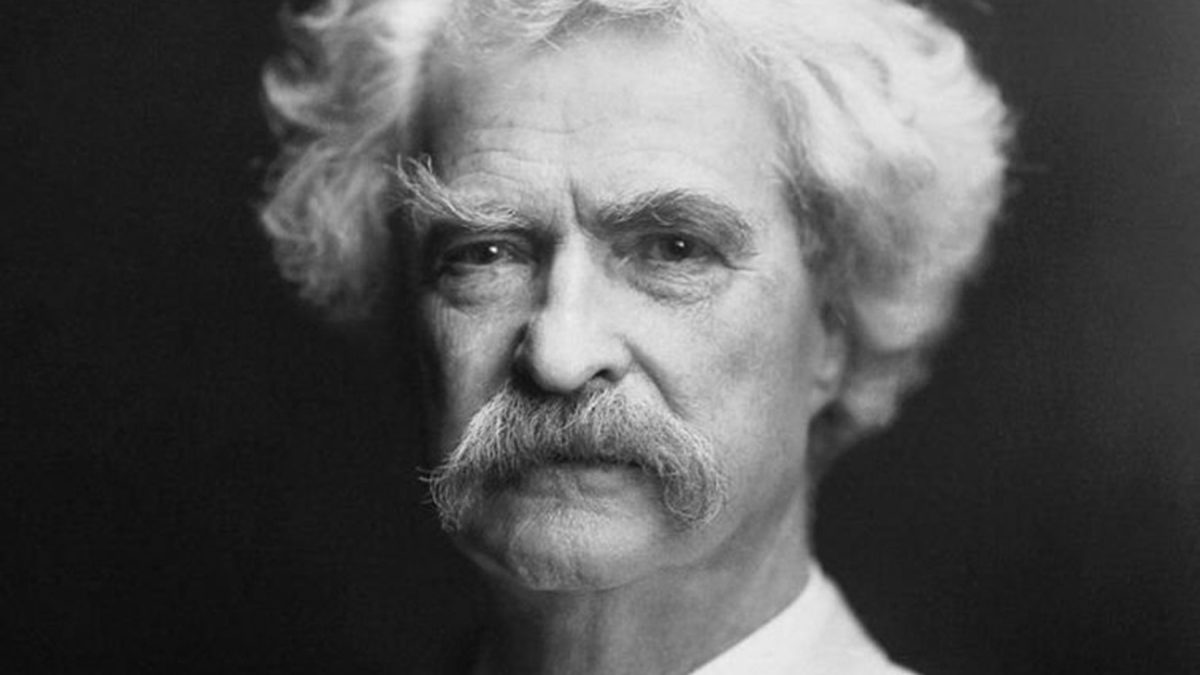
Mark Twain (Samuel Langhorne Clemens, 30 November 1835 to 21 April 1910) was an American writer, humorist and essayist. He has been praised as the "greatest humorist the United States has produced", and William Faulkner called him "the father of American literature". His novels include The Adventures of Tom Sawyer (1876) and Adventures of Huckleberry Finn (1884), the latter often called the "Great American Novel". He was born shortly after an appearance of Halley's Comet and died the day after the comet was at its closest to the Sun in 1910. This biography follows his life and work.
Mark Twain at a Glance
| Birth name | Samuel Langhorne Clemens |
| Born | 30 November 1835, Florida, Missouri, United States |
| Died | 21 April 1910, Redding, Connecticut (aged 74) |
| Profession | Writer, humorist, essayist and lecturer |
| Best-known works | The Adventures of Tom Sawyer, Adventures of Huckleberry Finn, Life on the Mississippi, A Connecticut Yankee in King Arthur's Court |
| Pen name origin | "Mark twain", the leadsman's cry for a river depth of two fathoms |
| Spouse | Olivia Langdon |
| Political role | Vice president of the American Anti-Imperialist League, 1901 to 1910 |
Boyhood in Hannibal
Samuel Clemens was born on 30 November 1835 in Florida, Missouri, the sixth of seven children of Jane Lampton and John Marshall Clemens. Only three of his siblings lived beyond childhood: Orion, Pamela and Henry. When he was four the family moved to Hannibal, Missouri, a port town on the Mississippi River that inspired the fictional town of St Petersburg in Tom Sawyer and Huckleberry Finn. Slavery was legal in Missouri at the time, and it became a theme in these writings. His father, an attorney and judge, died of pneumonia in 1847, when Twain was 11, and the following year he left school after the fifth grade to become a printer's apprentice. In 1851 he began working as a typesetter, contributing articles and humorous sketches to the Hannibal Journal, a newspaper owned by his brother Orion. At 18 he left Hannibal and worked as a printer in New York City, Philadelphia, St Louis and Cincinnati, educating himself in public libraries in the evenings.
On the River
In Life on the Mississippi Twain wrote that the one permanent ambition among his boyhood comrades was to be a steamboatman, and that a pilot had "a princely salary", from 150 to 250 dollars a month. The steamboat pilot Horace Bixby took him on as a cub pilot to teach him the river between New Orleans and St Louis, for 500 dollars payable out of his first wages. It was more than two years before he received his pilot's licence. Piloting also gave him his pen name, from "mark twain", the leadsman's cry for a measured river depth of two fathoms (12 feet), which was safe water for a steamboat. His younger brother Henry, whom he had arranged a post for on the steamboat Pennsylvania, died after the boiler exploded on 13 June 1858, and Twain was guilt-stricken and held himself responsible for the rest of his life. He worked on the river until the Civil War broke out in 1861, when traffic was curtailed, and he enlisted briefly in a local Confederate unit, the Marion Rangers, an experience he later described in "The Private History of a Campaign That Failed".
The Jumping Frog and Fame
Twain headed west to join Orion in Nevada, joked about his lack of success at mining and turned to journalism for the Virginia City Territorial Enterprise. He first achieved success as a writer with the humorous story "The Celebrated Jumping Frog of Calaveras County", published in 1865, which was based on a story he had heard at the Angels Hotel in Angels Camp, California. The short story brought him international attention. He wrote both fiction and non-fiction, and as his fame grew he became a much sought-after speaker, a friend to presidents, artists, industrialists and European royalty. He co-wrote The Gilded Age (1873) with Charles Dudley Warner, and his later books included A Connecticut Yankee in King Arthur's Court (1889) and Pudd'nhead Wilson (1894).
Lecture Tours and Copyright
In 1895 he visited Melbourne and Sydney as part of a world lecture tour. In 1897 he addressed the Concordia Press Club in Vienna in German, with the speech "The Horrors of the German Language", to the great amusement of the audience. He toured with the writer George Washington Cable in a reading tour that became known as the "Twins of Genius" tour, and he visited Toronto in 1884 and 1885 to secure Canadian and British copyrights for Huckleberry Finn, because publishers in Toronto had printed unauthorised editions of his books before an international copyright agreement was established in 1891. He estimated that one such edition of Tom Sawyer alone cost him 10,000 dollars. In 1906 he testified before a congressional committee in favour of extending copyright protection to the life of the author plus 50 years.
Bankruptcy and Recovery
Twain earned a great deal of money from his writing and lectures but invested in ventures that lost most of it, such as the Paige Compositor, a mechanical typesetter that failed because of its complexity and imprecision. He filed for bankruptcy after these setbacks, but overcame his financial troubles with the help of the Standard Oil executive Henry Huttleston Rogers, who helped him manage his finances and copyrights. Twain eventually paid all his creditors in full, even though his declaration of bankruptcy meant he was not required to do so.
Anti-Imperialism
Although Twain at first spoke in favour of American interests in the Hawaiian Islands, he later reversed his position. He became vice president of the American Anti-Imperialist League from 1901 until his death, and he came out strongly against the Philippine-American War and American colonialism. In 1905 he published a satirical pamphlet, "King Leopold's Soliloquy", about Belgian atrocities in the Congo Free State.
Family Losses
In his later years Twain lived at 14 West 10th Street in Manhattan. He passed through a period of deep depression which began in 1896 when his daughter Susy died of meningitis. His wife Olivia died in 1904 and his daughter Jean on 24 December 1909, which deepened his gloom, and his close friend Henry Rogers died suddenly on 20 May 1909.
Death and Legacy
In 1909 Twain wrote: "I came in with Halley's Comet in 1835; it's coming again next year, and I expect to go out with it. It would be a great disappointment in my life if I don't." He died of a heart attack the day after the comet was at its closest to the Sun, on 21 April 1910. One hundred years later the first volume of his autobiography was published. His humour, satire and ear for the American vernacular changed the direction of American literature, and his books remain among the most read and most debated in the language.