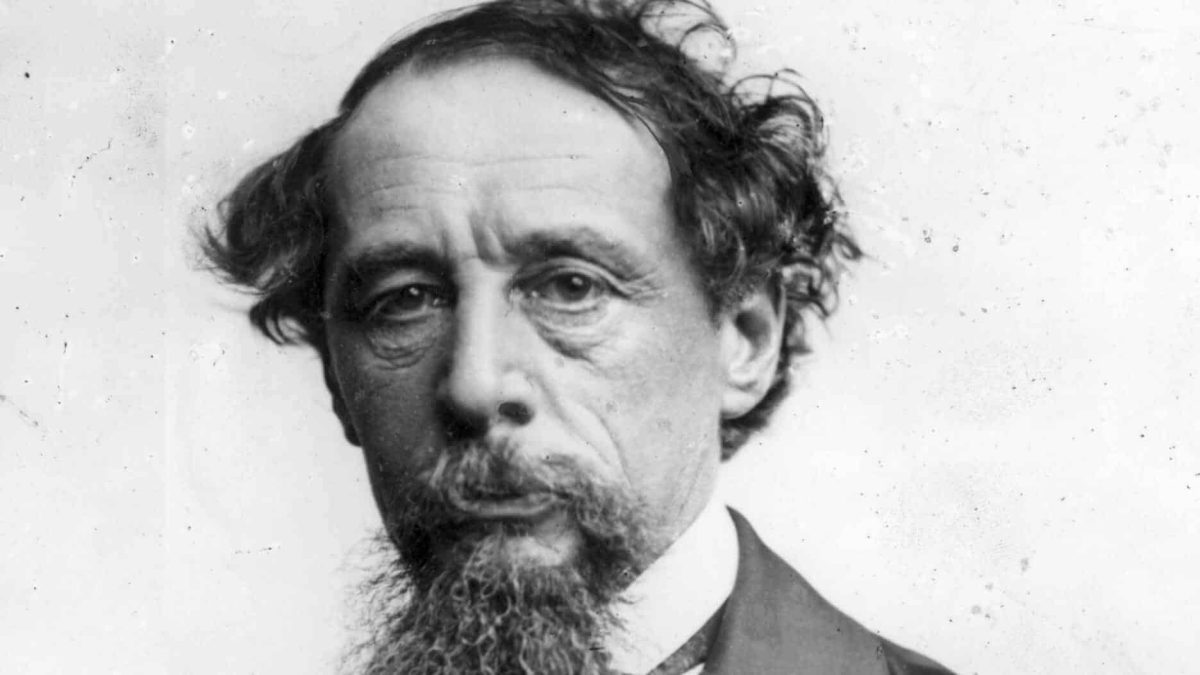
Charles Dickens (Charles John Huffam Dickens, 7 February 1812 to 9 June 1870) was an English writer and journalist who created some of literature's best-known fictional characters and is regarded by many as the greatest novelist of the Victorian era. His works enjoyed unprecedented popularity during his lifetime, and by the twentieth century critics and scholars had recognised him as a literary genius. He wrote 15 novels, five novellas and hundreds of short stories and articles, and campaigned vigorously for children's rights, education and other social reforms. This biography follows his life and work.
Charles Dickens at a Glance
| Full name | Charles John Huffam Dickens |
| Born | 7 February 1812, Landport, Portsea Island (Portsmouth), Hampshire, England |
| Died | 9 June 1870 (aged 58) |
| Profession | Novelist, journalist and editor |
| Best-known works | The Pickwick Papers, Oliver Twist, A Christmas Carol, David Copperfield, Bleak House, A Tale of Two Cities, Great Expectations |
| Output | 15 novels, five novellas and hundreds of short stories and articles |
| Parents | John Dickens and Elizabeth Barrow |
| Term in his name | "Dickensian" |
Early Life
Dickens was born on 7 February 1812 at 1 Mile End Terrace, Landport, the second of eight children of John Dickens, a clerk in the Royal Navy Pay Office, and Elizabeth Barrow. His father asked Christopher Huffam, a rigger in the Royal Navy, to act as godfather. When Charles was four the family moved to Sheerness and then to Chatham, in Kent, where he spent his formative years until the age of 11. His early life seems to have been idyllic, though he thought himself a "very small and not-over-particularly-taken-care-of boy". He read voraciously, including the novels of Tobias Smollett and Henry Fielding, Robinson Crusoe and The Arabian Nights. At the age of seven he first saw the clown Joseph Grimaldi perform in Rochester, and he later edited Grimaldi's memoirs.
The Blacking Warehouse and the Marshalsea
In June 1822 John Dickens was recalled to the Navy Pay Office in London and the family moved to Camden Town, leaving Kent amid rapidly mounting debts. In 1824, living beyond his means, John Dickens was forced by his creditors into the Marshalsea debtors' prison in Southwark, and his wife and youngest children joined him there, as was the practice at the time. Charles, then 12, boarded with a family friend in Camden Town and later lived in a back attic in Lant Street. To pay for his board and to help his family he was forced to leave school and work ten-hour days at Warren's Blacking Warehouse near the present Charing Cross railway station, where he earned six shillings a week pasting labels on pots of boot blacking. He remembered the old house, "literally overrun with rats", for the rest of his life. The experience made a lasting impression on him and became the foundation of his interest in the reform of socio-economic and labour conditions, and he used the Marshalsea as a setting in Little Dorrit.
Early Career
He had briefly returned to school after the blacking warehouse and then entered the world of newspapers. His father's imprisonment and the family's poverty were never far from his mind. After about three years he returned to school and then began his literary career as a journalist. His success began with the serial publication of The Pickwick Papers in 1836, a publishing phenomenon driven largely by the introduction of the character Sam Weller in the fourth episode, which sparked Pickwick merchandise and spin-offs. Within a few years Dickens had become an international literary celebrity, famous for his humour, satire and keen observation of character and society. His novels, most of them published in monthly or weekly instalments, pioneered the serial publication of narrative fiction, which became the dominant Victorian mode for novel publication. When his wife's podiatrist expressed distress at the way Miss Mowcher in David Copperfield seemed to reflect her own disabilities, Dickens improved the character with positive features, an example of how he responded to his audience. Cliffhanger endings kept readers in suspense, and the instalment format allowed him to judge his audience's reaction and sometimes to change his plot and characters accordingly. Masses of the illiterate poor would individually pay a halfpenny to have each new monthly episode read to them.
The Great Novels
His 1843 novella A Christmas Carol remains especially popular and continues to inspire adaptations in every creative medium. He resolved to "strike a sledge hammer blow" for the poor after a trip to Manchester to see the conditions of manufacturing workers and visits to the Field Lane Ragged School, and, as the tale took shape, he wrote that he "wept and laughed, and wept again" and walked the black streets of London for fifteen or twenty miles many a night. Martin Chuzzlewit was serialised between 1843 and 1844, and Dombey and Son followed in 1846 to 1848. Martin Chuzzlewit, the last of his picaresque novels, includes the dissolute nurse Sarah Gamp and one of the first literary private detectives, Mr Nadgett. After living briefly in Italy in 1844, Dickens travelled to Switzerland in 1846, where he began work on Dombey and Son. Oliver Twist and Great Expectations are also frequently adapted, and like many of his novels they evoke images of early Victorian London. Bleak House (1853), a satire on the judicial system, helped support a reformist movement that culminated in the 1870s legal reform in England, and A Tale of Two Cities (1859), set in London and Paris, is regarded as his best-known work of historical fiction.
Philanthropy and Campaigns
In May 1846 Angela Burdett Coutts, heir to the Coutts banking fortune, approached Dickens about setting up a home for the redemption of fallen women of the working class. She envisioned a home that would replace the punitive regimes of existing institutions with a reformative environment conducive to education and domestic skills. After initially resisting, Dickens became involved in the project, and throughout his career he campaigned for children's rights and education.
Public Readings
The most famous celebrity of his era, Dickens undertook, in response to public demand, a series of public reading tours in the later part of his career, and he edited a weekly journal for 20 years. He was also a tireless letter writer.
Legacy
The term "Dickensian" is used to describe something reminiscent of Dickens and his writings, such as poor social or working conditions or comically repulsive characters. He died on 9 June 1870. His novels, with their vivid cast of characters and their anger at poverty and injustice, helped to shape the way the Victorians thought about their cities, their children and their poor, and they are still read, adapted and quoted around the world.