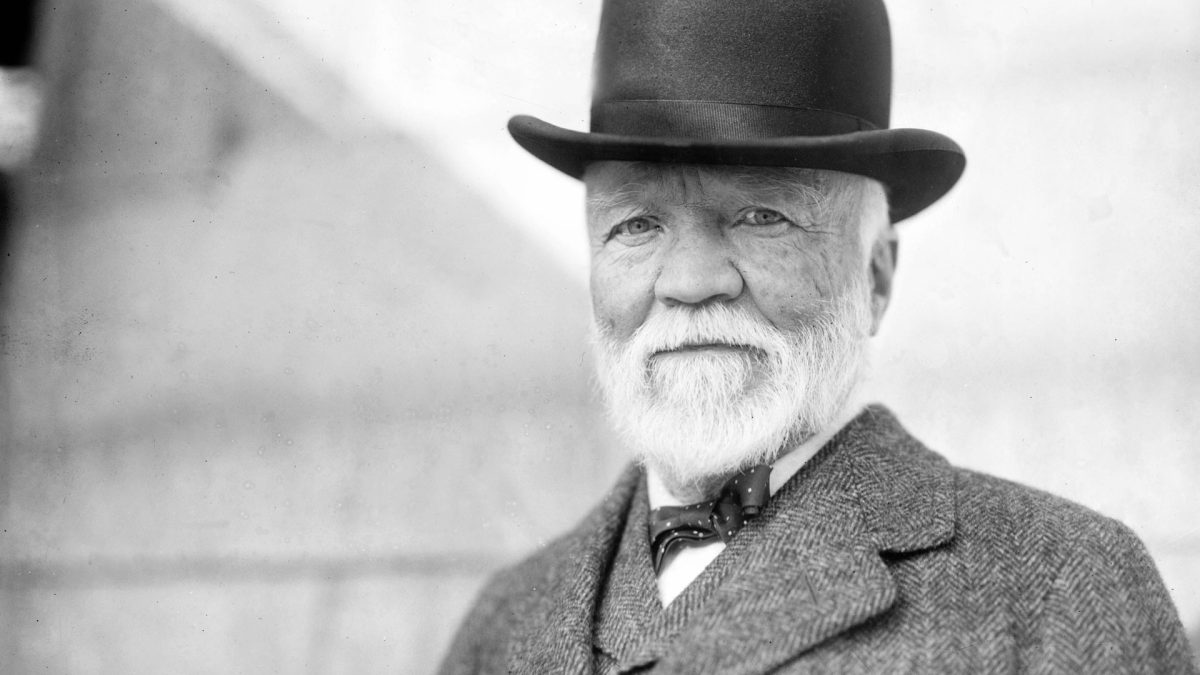
Andrew Carnegie (25 November 1835 to 11 August 1919) was a Scottish-American industrialist and philanthropist. He led the expansion of the American steel industry in the late nineteenth century and became one of the richest Americans in history. He became a leading philanthropist in the United States, Britain and the British Empire, and in the last 18 years of his life he gave away around 350 million dollars, almost 90 percent of his fortune, to charities, foundations and universities. This biography follows his life and philanthropy.
Andrew Carnegie at a Glance
| Full name | Andrew Carnegie |
| Born | 25 November 1835, Dunfermline, Scotland |
| Died | 11 August 1919 (aged 83) |
| Profession | Industrialist and philanthropist |
| Company | Carnegie Steel Company, sold in 1901 for 303,450,000 dollars to J. P. Morgan |
| Best-known essay | The Gospel of Wealth (1889) |
| Philanthropy | About 350 million dollars given away, almost 90 percent of his fortune |
| Institutions | Carnegie Hall, Peace Palace, Carnegie Corporation of New York, Carnegie Mellon University |
Early Life in Dunfermline
Andrew Carnegie was born to William Carnegie and Margaret Morrison Carnegie in Dunfermline, Scotland, in a typical weaver's cottage with only one main room, which served as a living room, dining room and bedroom and was shared with the neighbouring weaver's family. He was named after his paternal grandfather. His father had a successful weaving business, and in 1836 the family moved to a larger house in Edgar Street. Carnegie was educated at the Free School in Dunfermline, and his maternal uncle, the Scottish political leader George Lauder Sr., deeply influenced him as a boy by introducing him to the writings of Robert Burns and to historical Scottish heroes such as Robert the Bruce, William Wallace and Rob Roy. When Carnegie was 12, his father had fallen on tough times as a handloom weaver, and with the country in starvation his mother helped support the family by selling potted meats at her "sweetie shop".
Emigration to America
Struggling to make ends meet, the Carnegies borrowed money from George Lauder Sr. and moved to the United States in 1848 for the prospect of a better life. They went to Allegheny, Pennsylvania, where there was a demand for workers, and arrived in September 1848. Carnegie's first job was as a bobbin boy, changing spools of thread in a cotton mill 12 hours a day, six days a week, for a starting wage of 1.20 dollars a week. He then went to work for a Scottish manufacturer of bobbins, John Hay, for two dollars a week, running a small steam engine and firing the boiler in the cellar, and he later wrote that the work was even more irksome than the factory and that he spent nights worrying that the steam was too low or the boiler might burst.
Telegraph Boy
In 1849 Carnegie became a telegraph messenger boy in the Pittsburgh office of the Ohio Telegraph Company, on the recommendation of his uncle. He was a hard worker who memorised the locations of Pittsburgh's businesses and the faces of important men, and in this way he made many connections. He also learned to distinguish the different sounds of the incoming telegraph signals and developed the ability to translate them by ear, without using the paper slip, and within a year he was promoted to operator. His education and passion for reading were helped by Colonel James Anderson, who opened his personal library of 400 volumes to working boys each Saturday night, and Carnegie was grateful enough to resolve that, if wealth ever came to him, other poor boys would receive the same opportunity.
From Railroads to Steel
During the Civil War Pittsburgh became a centre of wartime production, with demand for iron products such as armour for gunboats, cannon and shells. Carnegie worked to develop several ironworks, eventually forming the Keystone Bridge Works and the Union Ironworks in Pittsburgh. Through the Keystone Bridge Company he supplied the steel for, and owned shares in, the landmark Eads Bridge across the Mississippi River at St Louis, completed in 1874, an important proof of concept for steel technology. In 1868, at the age of 33, he wrote that he proposed to take an income no greater than 50,000 dollars a year and "spend the surplus each year for benevolent purposes", adding that "the amassing of wealth is one of the worst species of idolatry". By the 1860s Carnegie had investments in railroads, railroad sleeping cars, bridges and oil derricks, and he accumulated further wealth as a bond salesman, raising money for American enterprise in Europe. He built Pittsburgh's Carnegie Steel Company. In 1901 he sold it to J. P. Morgan for 303,450,000 dollars, and it formed the basis of the US Steel Corporation. After the sale he surpassed John D. Rockefeller as the richest American of the time.
The Gospel of Wealth
In 1889 Carnegie published an article proclaiming "The Gospel of Wealth", which called on the rich to use their wealth to improve society, expressed support for progressive taxation and an estate tax, and stimulated a wave of philanthropy. He devoted the rest of his life to large-scale philanthropy, with a special emphasis on building local libraries, working for world peace, education and scientific research.
Philanthropy
Carnegie funded Carnegie Hall in New York City and the Peace Palace in The Hague. He founded the Carnegie Corporation of New York, the Carnegie Endowment for International Peace, the Carnegie Institution for Science, the Carnegie Trust for the Universities of Scotland, the Carnegie Hero Fund, Carnegie Mellon University and the Carnegie Museums of Pittsburgh, among others. In the last 18 years of his life he gave away around 350 million dollars, which is equivalent to about 6.9 billion dollars in 2025.
Death and Legacy
Carnegie died on 11 August 1919. His rags-to-riches story, from a one-room weaver's cottage to the richest man in America, and his insistence that the wealthy have a duty to give their money away, have made him one of the most influential figures in the history of philanthropy.