The Declaration of Independence is the founding document of the United States. On 4 July 1776 it was adopted unanimously by the Second Continental Congress, which was convened at the Pennsylvania State House, later renamed Independence Hall, in Philadelphia. The delegates became known as the nation's Founding Fathers. The Declaration explains why the Thirteen Colonies regarded themselves as independent sovereign states, no longer subject to British colonial rule, and it has become one of the most circulated, reprinted and influential documents in history. Its second sentence, "We hold these truths to be self-evident, that all men are created equal, that they are endowed by their Creator with certain unalienable Rights, that among these are Life, Liberty and the pursuit of Happiness", is considered one of the most significant lines in world history.
A War Already Under Way
By the time the Declaration was adopted in July 1776, the Thirteen Colonies and Great Britain had been at war for over a year. Relations had been deteriorating since 1763. Parliament had enacted a series of measures designed to increase revenue from the colonies, including the Stamp Act of 1765 and the Townshend Acts of 1767. The American Revolutionary War began in April 1775 with the Battles of Lexington and Concord, and the delegates of the colonies reconvened the Continental Congress in Philadelphia on 10 May. On 23 August 1775 King George III proclaimed the colonies to be in rebellion.
From Petition to Independence
In 1774 Parliament passed the Coercive Acts, known in the colonies as the Intolerable Acts, to punish the colonists for the Gaspee Affair of 1772 and the Boston Tea Party of 1773. In September 1774 the First Continental Congress met in Philadelphia to coordinate a response, organised a boycott of British goods and petitioned the king for repeal, but without success. In November 1774 King George wrote to Lord North that "blows must decide whether they are to be subject to this country or independent". Most colonists still hoped for reconciliation even after fighting began at Lexington and Concord. They were disabused of that notion in late 1775, when the king rejected Congress's second petition, issued a Proclamation of Rebellion and announced to Parliament on 26 October that he was considering "friendly offers of foreign assistance" to suppress the rebellion.
Even so, the Second Continental Congress at first lacked clear authority to declare independence. Delegates had been elected by 13 different governments and were bound by their instructions, and several colonies expressly forbade their delegates from taking any step towards separation. Between April and July 1776 a "complex political war" was fought to change those instructions. In January 1776 Thomas Paine's pamphlet Common Sense, published in Philadelphia, made a persuasive and impassioned case for independence and opened a debate on a subject that few had dared to discuss.
The Committee of Five
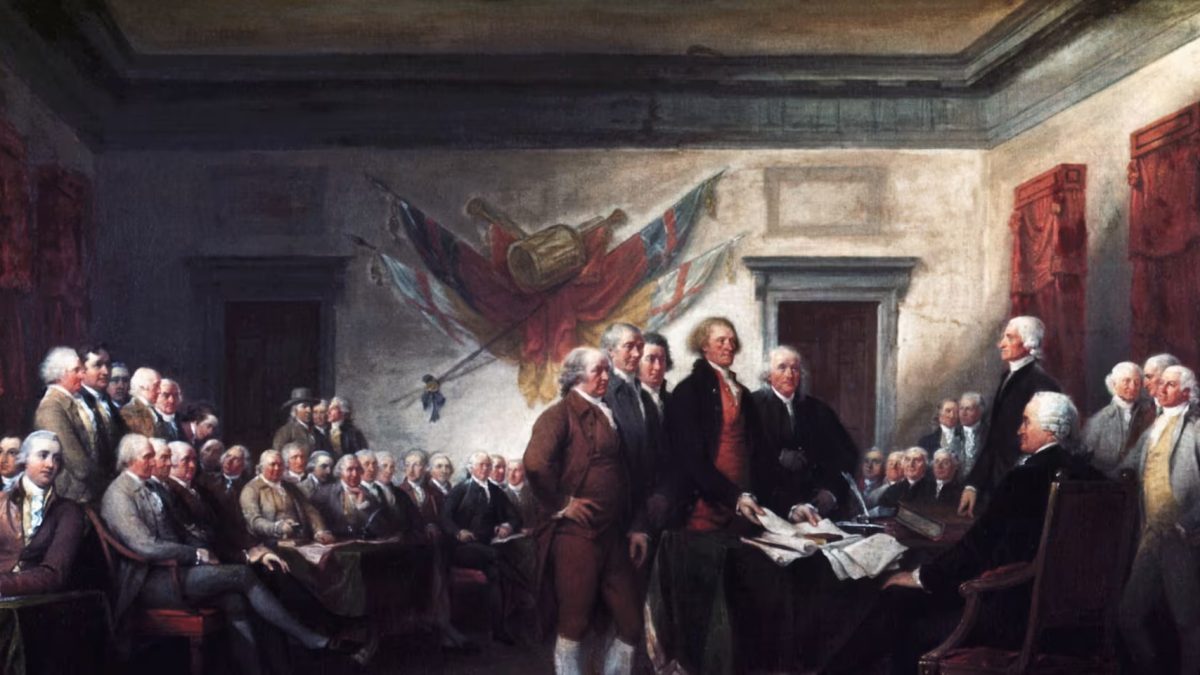
On 11 June 1776 Congress appointed a Committee of Five, John Adams, Benjamin Franklin, Thomas Jefferson, Robert R. Livingston and Roger Sherman, to draft and present the Declaration. Adams, a leading proponent of independence, persuaded the committee to charge Jefferson with writing the original draft, which Congress then edited. Jefferson largely wrote the Declaration between 11 and 28 June 1776. Two days before the Declaration was adopted, Congress passed the Lee Resolution, which resolved that the British no longer had governing authority over the Thirteen Colonies.
The Vote for Independence
On 2 July 1776 Congress approved the resolution for independence, and the declaration explaining it was approved and printed on 4 July. The vote in Congress was not simple. The New York delegation abstained because it lacked permission to vote for independence, and Delaware cast no vote at first because its delegation was split between Thomas McKean, who voted yes, and George Read, who voted no. South Carolina reversed its earlier opposition on 2 July, and in the Pennsylvania delegation John Dickinson and Robert Morris abstained, which allowed the delegation to vote three to two in favour. The tie in the Delaware delegation was broken by the arrival of Caesar Rodney, who voted for independence. The Declaration became official when Congress recorded its vote adopting the document on 4 July, and it was signed that day by John Hancock, the President of Congress, whose large, flamboyant signature became so iconic that "John Hancock" came to mean a signature in American English. The signatures of 56 delegates are affixed to the document, though the exact date on which each signed is debated.
Influences on Jefferson
Examination of the early drafts shows the influence of the Enlightenment philosopher John Locke and of Thomas Paine, the author of Common Sense, on Jefferson. He consulted the other members of the committee, who offered minor changes, before Congress edited the draft. Jefferson wrote that a number of authors exerted a general influence on the words of the Declaration, and he called Locke one of "the three greatest men that have ever lived".
What the Declaration Said
The Declaration presented the political, moral and legal justifications for independence from Great Britain. It cited 27 colonial grievances against the king and asserted certain natural and legal rights, including a right of revolution. In ratifying and signing it, the delegates knew that they were committing an act of high treason against the Crown, which was punishable by torture and death.
Publication
Two days after its ratification, on 6 July, the Declaration was published by The Pennsylvania Evening Post. The first public readings took place simultaneously on 8 July 1776, at noon, at three previously designated locations: Trenton, New Jersey; Easton, Pennsylvania; and Philadelphia. The printed Dunlap broadside was widely distributed following the signing, and two original copies are preserved in the Library of Congress. The signed copy of the Declaration, which is generally considered the official document, is on display at the National Archives in Washington. It was engrossed, or handwritten, by Timothy Matlack on the order of Congress on 19 July and was signed primarily on 2 August 1776.
A Global Statement of Rights
The Declaration has proved to be an influential and globally impactful statement on human rights. Abraham Lincoln viewed it as the moral standard to which the United States should strive, and he considered it a statement of principles through which the Constitution should be interpreted. In 1863 he made the Declaration the centrepiece of his Gettysburg Address, widely considered one of the most famous speeches in American history. The Pulitzer Prize-winning historian Joseph Ellis has written that the Declaration's opening words are "the most potent and consequential words in American history".
Why It Matters
The Declaration did not itself win independence: that required a long war. But it gave the American cause a moral and legal argument, explained to the world why the colonies were taking the step they had taken and set out a set of principles that later generations used to demand that the promise of equality be extended to all. Its language of natural rights and the consent of the governed has been quoted and adapted by reformers and independence movements around the world, and it remains the most important statement of the founding ideals of the United States.