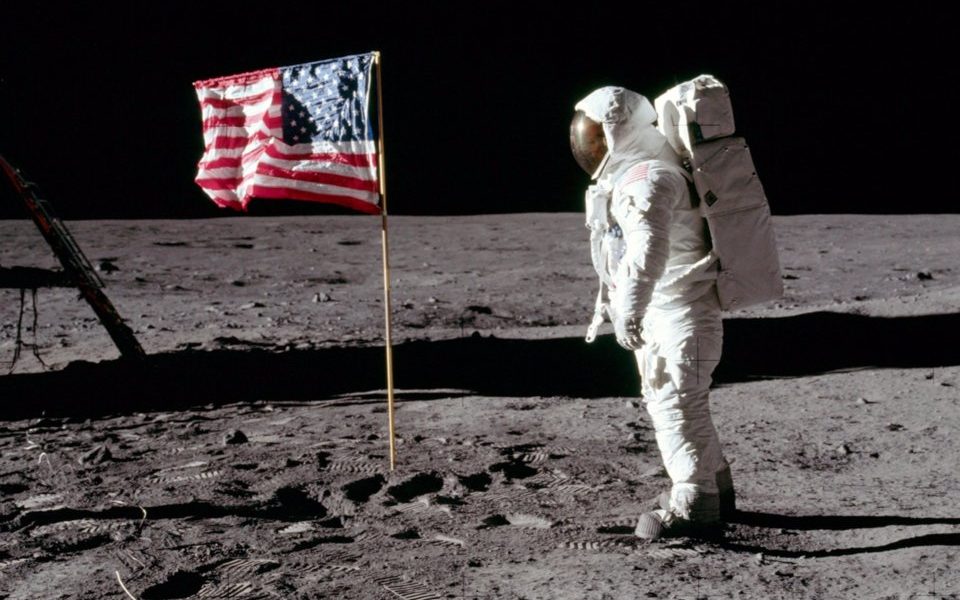
Apollo 11, which flew from 16 to 24 July 1969, was the American spaceflight that first landed humans on the Moon, and the fifth crewed mission of NASA's Apollo programme. The crew consisted of Commander Neil Armstrong, Command Module Pilot Michael Collins and Lunar Module Pilot Edwin "Buzz" Aldrin, all of whom were on their second and final spaceflight. The spacecraft was launched on a Saturn V rocket from the Kennedy Space Center in Florida on 16 July at 13:32 UTC and consisted of three parts: the command module, which housed the three astronauts and was the only part to return to Earth; the service module, which provided propulsion, electrical power, oxygen and water; and the Lunar Module, which had a descent stage for landing on the Moon and a lighter ascent stage with a cabin for two astronauts.
Landing on the Moon
After a three-day journey, Armstrong and Aldrin descended to the surface aboard the lunar module Eagle, landing in the Sea of Tranquility on 20 July at 20:17 UTC, while Collins remained in lunar orbit aboard the command module Columbia. As the descent began, the astronauts found themselves passing landmarks two or three seconds early, which meant that they were "long" and would land miles west of their target, and Eagle was travelling too fast. After landing, Armstrong reported to Mission Control: "Houston, Tranquility Base here. The Eagle has landed." Charles Duke, the capsule communicator, replied that "you got a bunch of guys about to turn blue".
The First Steps
Armstrong became the first human to walk on the Moon about six hours after landing, and Aldrin followed 19 minutes later. Together they spent around two and a half hours on the surface, planting an American flag, speaking with President Richard Nixon in the White House, deploying scientific instruments and collecting 21.5 kg (47.5 lb) of lunar material. Stepping onto the surface, Armstrong said: "That's one small step for [a] man, one giant leap for mankind." After more than 21 hours on the surface they rejoined Collins in lunar orbit, and the crew returned safely to Earth, splashing down in the Pacific Ocean on 24 July. The aircraft carrier USS Hornet was the primary recovery ship.
The Space Race
Apollo 11 was the culmination of the Space Race, a geopolitical competition between the United States and the Soviet Union rooted in Cold War rivalry. On 4 October 1957 the Soviet Union launched Sputnik 1, the first artificial satellite, which surprised the world and fuelled fears about Soviet technological and military capabilities. President Dwight Eisenhower responded by creating NASA and starting Project Mercury, which aimed to place a man in Earth orbit. The Soviets took the lead on 12 April 1961 when the cosmonaut Yuri Gagarin became the first person in space, and Alan Shepard became the first American in space on 5 May 1961, on a 15-minute suborbital flight. Because the Soviet Union had launch vehicles with higher lift capacity, President John F. Kennedy chose a challenge that exceeded the capabilities of the existing generation of rockets so that both countries would start from an equal position: a crewed mission to the Moon. The goal he set in May 1961, to land a man on the Moon and return him safely before the end of the decade, was fulfilled by Apollo 11. The programme overcame a severe setback with the fatal Apollo 1 launchpad fire in January 1967.
The Soviet Attempt
The Soviet Union, despite its early leads, was unable to match the Saturn V rocket. It then tried to beat the United States to return lunar material to Earth with uncrewed probes. On 13 July, three days before the launch of Apollo 11, it launched Luna 15, which reached lunar orbit before Apollo 11, but during its descent a malfunction made it crash into Mare Crisium on 21 July, about two hours before Armstrong and Aldrin took off from the Moon's surface to return to Earth.
The Crew
The first crew assignment of Armstrong, Jim Lovell and Aldrin was announced in November 1967, but delays in the lunar module, and an illness that required surgery for Collins, changed the line-up. Collins, who had been on the Apollo 8 crew, joined Armstrong's crew as Command Module Pilot after he recovered, and Lovell took his place. Apollo 11 was the second American mission in which all the crew members had prior spaceflight experience. The crew did not have the close cheerful camaraderie of Apollo 12; instead they forged an amiable working relationship, and Aldrin and Collins described the crew as "amiable strangers".
On the Surface
Preparations for the walk took longer than expected, three and a half hours instead of two, because the cabin contained many items beyond those laid out neatly in training, and Armstrong and Aldrin were ready to go outside six hours and 39 minutes after landing. Armstrong had some difficulty squeezing through the hatch with his portable life support system, and some of the highest heart rates recorded for Apollo astronauts occurred during moves in and out of the lunar module. Climbing down the nine-rung ladder, Armstrong pulled a D-ring to deploy the equipment assembly and activate the television camera. The mission used slow-scan television that was incompatible with broadcast television, so the picture was displayed on a special monitor that a conventional camera then filmed, which significantly reduced the quality. The signal was received at Goldstone in the United States but with better quality at the Honeysuckle Creek tracking station near Canberra, and the feed was then switched to the more sensitive Parkes radio telescope in Australia. At 02:56 UTC, six and a half hours after landing, Armstrong stepped off the landing pad and declared: "That's one small step for [a] man, one giant leap for mankind." The word "a" is not audible in the transmission, which is why it appears in square brackets, and Armstrong said he believed he had said "for a man". About seven minutes after stepping on to the surface he collected a contingency soil sample, to guarantee that some lunar soil would be brought back if the astronauts had to abandon the moonwalk in an emergency.
Worldwide Audience
Armstrong's moonwalk was broadcast live to an estimated 600 million viewers, roughly one-fifth of the world's population, making it among the most-watched television events in history. The lunar samples returned by the mission led to the identification of three previously unrecognised minerals, and the scientific instruments deployed on the surface continued returning data for years. The crew were honoured with ticker-tape parades, a world goodwill tour and the Presidential Medal of Freedom. The command module Columbia is preserved at the National Air and Space Museum in Washington, while the descent stage of Eagle remains on the lunar surface.
Why It Matters
Apollo 11 showed that humans could leave the Earth and walk on another world, and it remains the best-known achievement of the space age. It also demonstrated what a national effort on a vast scale could accomplish in less than a decade. For many people around the world, the pictures from the Sea of Tranquility are a symbol of human ambition and of what cooperation between science, engineering and government can achieve.