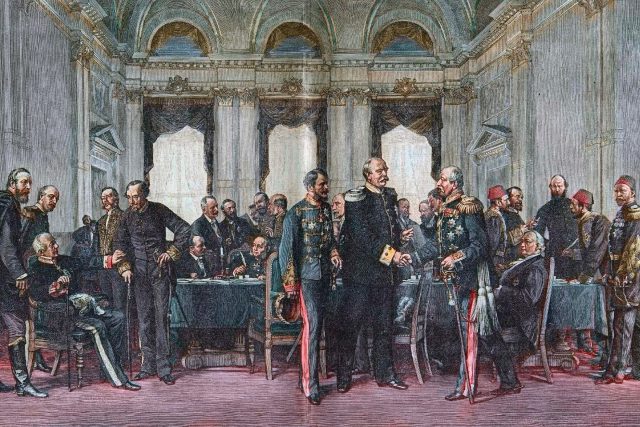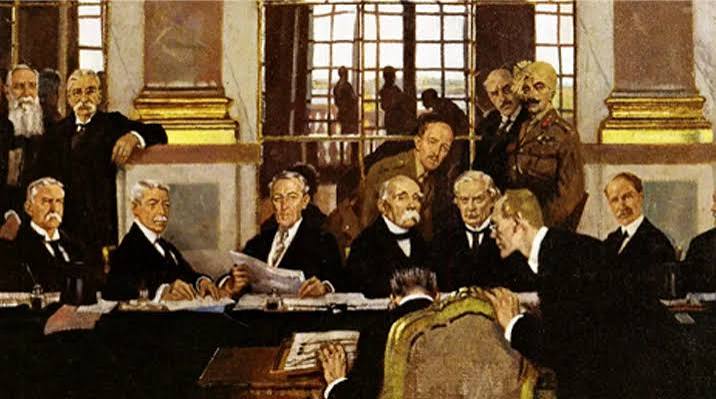
The Treaty of Versailles was a peace treaty signed on 28 June 1919. As the most important treaty of the First World War, it ended the state of war between Germany and most of the Allied Powers. It was signed in the Palace of Versailles exactly five years after the assassination of Archduke Franz Ferdinand, the proximate cause of the war. The other Central Powers on the German side signed separate treaties. Although the armistice of 11 November 1918 ended the actual fighting and agreed certain principles and conditions, including the payment of reparations, it took six months of Allied negotiations at the Paris Peace Conference to conclude the peace treaty. Germany was not allowed to take part in the negotiations before signing.
The Terms
The treaty required Germany to disarm, make territorial concessions, extradite alleged war criminals, agree to the Kaiser being put on trial, recognise the independence of states whose territory had previously been part of the German Empire, and pay reparations to the Entente powers. The most critical and controversial provision was Article 231: "The Allied and Associated Governments affirm and Germany accepts the responsibility of Germany and her allies for causing all the loss and damage to which the Allied and Associated Governments and their nationals have been subjected as a consequence of the war imposed upon them by the aggression of Germany and her allies." The other members of the Central Powers signed treaties with similar articles. Article 231 became known as the "War Guilt" clause.
Too Harsh, or Too Lenient?
Critics, including John Maynard Keynes, declared the treaty too harsh and styled it a "Carthaginian peace". On the other hand, prominent Allied figures such as the French Marshal Ferdinand Foch criticised the treaty for treating Germany too leniently, and the question remains the subject of debate among historians and economists. The result of these competing and sometimes conflicting goals among the victors was a compromise that left no one satisfied. In particular, Germany was neither pacified nor conciliated, nor was it permanently weakened.
What Followed
The United States never ratified the Versailles Treaty and made a separate peace treaty with Germany, although it was based on the Versailles Treaty. The problems that arose from the treaty led to the Locarno Treaties, which improved relations between Germany and the other European powers, and the reparation system was reorganised and the payments reduced in the Dawes Plan and the Young Plan. Bitter resentment of the treaty powered the rise of the Nazi Party and eventually the outbreak of a Second World War.
Versailles and Paris
Although it is often referred to as the "Versailles Conference", only the signing of the treaty took place at the historic palace. Most of the negotiations were in Paris, and the meetings of the "Big Four" took place generally at the French Ministry of Foreign Affairs on the Quai d'Orsay.
The War
War broke out following the July Crisis of 1914. Austria-Hungary declared war on Serbia, followed quickly by Germany declaring war on Russia on 1 August and on Belgium and France on 3 August. The German invasion of Belgium on 3 August led to a declaration of war by Britain on Germany on 4 August, creating the conflict that became the First World War. Two alliances faced off: the Central Powers, led by Germany, and the Triple Entente, led by Britain, France and Russia. In March 1918 the new Russian Soviet government under Vladimir Lenin signed the Treaty of Brest-Litovsk, which amounted to a surrender highly favourable to Germany. Sensing victory before the American Expeditionary Forces could be ready, Germany shifted forces to the Western Front and tried to overwhelm the Allies, but it failed. Instead the Allies won decisively on the battlefield, overwhelmed Germany's Turkish, Austrian and Bulgarian allies and forced an armistice in November 1918 that resembled a surrender.
The Fourteen Points
The United States entered the war against the Central Powers in 1917, and President Woodrow Wilson played a significant role in shaping the peace terms. On 8 January 1918 Wilson issued the Fourteen Points, which outlined a policy of free trade, open agreements and democracy. They called for a negotiated end to the war, international disarmament, the withdrawal of the Central Powers from occupied territories, the creation of a Polish state, the redrawing of Europe's borders along ethnic lines and the formation of a League of Nations to guarantee political independence and territorial integrity.
The Armistice and the Blockade
The armistice terms included the evacuation of Alsace-Lorraine, the Allied administration of the left bank of the Rhine, the surrender of a large quantity of war materiel and the agreed payment of "reparation for damage done". German forces evacuated occupied France, Belgium and Luxembourg within the 15 days that the armistice required, and by late 1918 Allied troops had entered Germany and begun the occupation of the Rhineland, with bridgeheads across the Rhine at Cologne, Koblenz and Mainz and a demilitarised zone 10 km wide separating the forces. The Allied blockade of Germany, a naval operation to stop raw materials and foodstuffs reaching the Central Powers, was maintained for eight months after the armistice, until Germany signed the treaty in June 1919. The German Board of Public Health stated in December 1918 that 763,000 German civilians had died during the blockade, although an academic study in 1928 put the death toll at 424,000. In March 1919 Winston Churchill told the House of Commons that "Germany is very near starvation". Germany finally agreed in March to surrender its fleet, and the Allies then allowed the import of 270,000 tons of foodstuffs.
Why It Matters
The Treaty of Versailles shaped the map and the politics of twentieth-century Europe. It created new states, redrew borders, established the League of Nations and imposed reparations on a defeated Germany, and its provisions provoked bitterness that extremists exploited. Historians still argue about whether it was too harsh or too weak, but most agree that it failed to produce a stable peace.