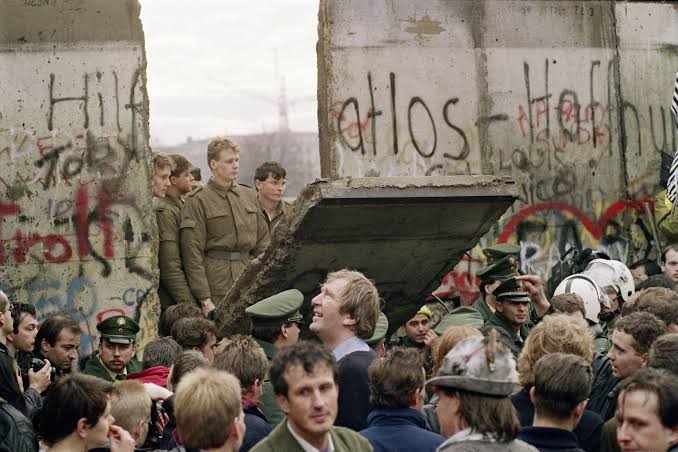
The fall of the Berlin Wall, and of the fortified inner German border, followed a Politburo press conference on 9 November 1989 at which it was prematurely announced that East Germans could travel without restrictions. In the decades before, hundreds had been killed by the border troops of the German Democratic Republic when trying to sneak through the Iron Curtain. People gathered at the Berlin border crossings, citing news broadcast in East and West, and puzzled border guards eventually let them pass in the late evening, with live television broadcasting the scenes worldwide. In the following days thousands crossed the border, and after this symbolic fall the obstacles were removed, former crossings were reopened and, after demolition, L-shaped concrete segments of the wall were spread around the world.
The Revolutions of 1989
In the early stages of the Revolutions of 1989 Hungary removed its border fence in May and opened its border in August, and after many East German families had fled into the West German embassy in Prague, Czechoslovakia followed in late September. The June 1989 Tiananmen Square protests and massacre had shown what could happen under communist rule. The opening of the Iron Curtain between Austria and Hungary at the Pan-European Picnic on 19 August 1989 set in motion a peaceful chain reaction, at the end of which East Germany no longer existed and the Eastern Bloc had disintegrated. After the picnic, tens of thousands of East Germans set off for Hungary. The leadership of the GDR in East Berlin did not dare to block the borders to the "socialist brother lands" completely, and the Soviet Union did not respond at all.
The Prague Embassy
By early November refugees were making their way to Hungary through Czechoslovakia or the West German embassy in Prague. On 30 September, following negotiations with East Germany and the Soviet Union, West German Foreign Minister Hans-Dietrich Genscher went to the embassy to inform the thousands of refugees personally that they were allowed to leave for West Germany. His speech from the balcony was drowned out by cheers after the words "We came to you to let you know that today your departure …" The next day the first refugees left Prague by train through the GDR for Bavaria. East Germany was also struggling to meet loan payments on foreign borrowing.
A Regime in Crisis
The long-term East German leader Erich Honecker was ousted in October, and his successor Egon Krenz promised reforms but was seen by the public as following his predecessor's policies, so protests demanding his resignation continued. On 1 November Krenz authorised the reopening of the border with Czechoslovakia, and on 4 November the Alexanderplatz demonstration took place. On 6 November the Interior Ministry published a draft of new travel regulations that made only cosmetic changes to the Honecker-era rules, which enraged citizens, and on 7 November Krenz approved the resignation of Prime Minister Willi Stoph and two-thirds of the Politburo.
The Wall
The Berlin Wall, officially the "Anti-fascist protection wall", was made up of two concrete walls, one facing the West and covered with graffiti. Both walls were 4 metres tall and had a length of 155 kilometres, and they were separated by a mined corridor called the death strip.
The Travel Rules
On 19 October Krenz asked Gerhard Lauter to draft a new travel policy. On 8 November the Politburo enacted the part of the draft that dealt with permanent departure immediately. Interior Ministry officials and Stasi bureaucrats concluded that the proposal to create a special border crossing was not feasible, and they wrote new text covering both emigration and temporary travel. On 9 November the Politburo decided that refugees could leave directly through crossing points between East and West Germany, including between East and West Berlin, and later the same day the proposal was modified to include private round-trip travel. The new regulations were due to take effect the following day.
The Press Conference
The announcement was made at an hour-long press conference led by Gunter Schabowski, the outgoing party leader in East Berlin and top party spokesman, beginning at 18:00 on 9 November and broadcast live on East German television and radio. When journalists asked when the regulations would take effect, Schabowski hesitated for a few seconds and replied: "As far as I know, it takes effect immediately, without delay." This was an apparent assumption based on the note's opening paragraph.
Shortly before the press conference, Schabowski had been handed a note from Krenz announcing the changes, but he had not been involved in the discussions about the new regulations and had not been fully updated, and he was given no instructions on how to handle the information. At 18:53, near the end of the conference, a journalist from the Italian agency ANSA asked whether the draft travel law of 6 November had been a mistake. Schabowski gave a confusing answer and then remembered the note, and he started reading from it, expressing surprise that the reporters had not yet seen it. When a reporter asked when the regulations would take effect, he hesitated for a few seconds and said that it was "immediately, without delay". The minister Gerhard Beil tried to interject that it was up to the Council of Ministers to decide, but Schabowski read on, and when another journalist asked whether the rule applied to the crossings to West Berlin, he shrugged and read the item that confirmed that it did. He ended the conference at 19:00.
The news began to spread at once. The West German news agency Deutsche Presse-Agentur issued a bulletin at 19:04 saying that East Germans would be able to cross the inner German border "immediately", and excerpts of the press conference were broadcast on the two main West German news programmes that night. Because the West German channels ARD and ZDF had been broadcasting to nearly all of East Germany since the late 1950s, huge numbers of East Germans saw the reports and made their way to the border crossings.
The Gates Open
Finally, at 22:45 on 9 November, according to one account, Harald Jager, commander of the Bornholmer Strasse border crossing, yielded, allowing guards to open the checkpoints and let people through with little or no checking of identity. Crowds streamed across, and the scenes were shown live around the world.
Reunification
After the symbolic fall, the Peaceful Revolution led to a total loss of control by the East German regime over the formerly fortified border and, soon, over the country itself. The first free elections in spring 1990 showed a preference for German reunification and for the West German Deutsche Mark, which arrived in July. Unification took place on 3 October 1990, when five new states joined the ten old states of the Federal Republic of Germany, with reunited Berlin as a 16th state. Soviet occupation forces left in 1994.
Why It Matters
The fall of the Berlin Wall became the best-known image of the end of the Cold War. It showed that the division of Europe could end peacefully, within a few months, because of the pressure of ordinary people, and it opened the way to the reunification of Germany and the collapse of the Eastern Bloc. The wall that had stood for decades as a symbol of division came to symbolise the possibility of freedom.