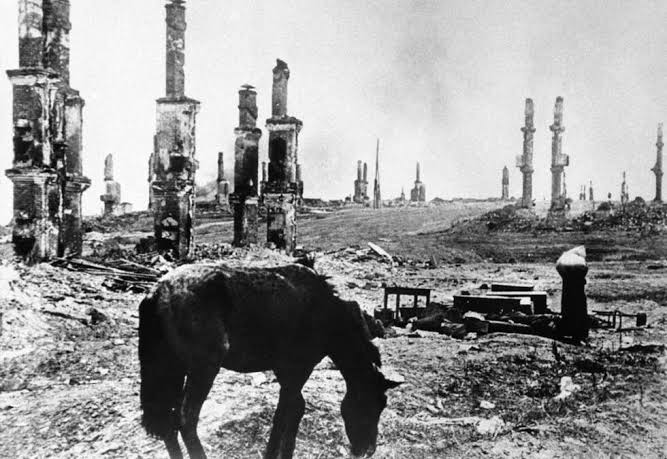
The Battle of Stalingrad was a major battle on the Eastern Front of the Second World War in which Nazi Germany and its Axis allies fought the Soviet Union for control of the city of Stalingrad, now Volgograd, in southern Russia. Marked by intense close-quarters combat and heavy civilian losses during aerial bombardment, it is considered the largest and deadliest urban battle in military history and the deadliest battle of the Second World War. By the end of the fighting the German 6th Army had been destroyed, the 4th Panzer Army had suffered severe losses and Army Group B was routed. The defeat ended Germany's 1942 summer offensive and passed the strategic initiative on the Eastern Front to the Soviet Union, and the Soviet victory is generally regarded as the pivotal turning point of the war in Europe.
Why Stalingrad?
Both sides placed great strategic importance on the city, which was one of the largest industrial centres of the Soviet Union and an important transport hub on the Volga River. After more than a year of intense fighting along a vast front, Germany's fuel supplies had dwindled, creating a strategic need to advance into the Caucasus to capture the Soviet oil fields. Controlling Stalingrad would provide a supply route for that campaign while preventing Soviet shipments along the Volga. The city also held significant symbolic importance because it bore the name of Joseph Stalin, the Soviet supreme leader.
The Summer of 1942
By the spring of 1942, despite the failure of Operation Barbarossa to defeat the Soviet Union in a single campaign, the Wehrmacht had captured vast territories, including Ukraine, Belarus and the Baltic republics. On the Western Front Germany held much of Europe, the U-boat offensive was curbing American support, and in North Africa Erwin Rommel had just captured Tobruk. In the east the Germans had stabilised a front running from Leningrad to Rostov. Hitler remained confident of breaking the Red Army, despite heavy losses west of Moscow in the winter of 1941 to 1942, and decided that the 1942 summer campaign would target the southern Soviet Union. The initial objectives around Stalingrad were to destroy the city's industrial capacity and block Volga River traffic, which was crucial for connecting the Caucasus and the Caspian Sea to central Russia, and the capture of the city would also disrupt Lend-Lease supplies through the Persian Corridor. On 23 July 1942 Hitler expanded the campaign's objectives to include occupying Stalingrad, a city with immense propaganda value.
The Approach and the Bombing
The Germans formed bridgeheads across the Don on 20 August, putting the 6th Army only a few dozen kilometres from Stalingrad. On 23 August the 6th Army reached the outskirts of the city in pursuit of the Soviet 62nd and 64th Armies, which had fallen back into it. The Soviets had enough warning of the German advance to ship grain, cattle and railway cars across the Volga, a "harvest victory" that left the city short of food even before the attack began, and the Luftwaffe cut off shipping on the Volga before the army reached the city: between 25 and 31 July, 32 Soviet ships were sunk. Luftflotte 4 dropped some 1,000 tons of bombs on 23 August, in what was at that point the most intense aerial bombardment on the Eastern Front, and at least 90 per cent of the city's housing stock was obliterated. The Stalingrad Tractor Factory nevertheless continued to turn out T-34 tanks until German troops burst into the plant. The German field marshal Ewald von Kleist said after the war that the capture of the city "was subsidiary to the main aim" and that, at the start, "Stalingrad was no more than a name on the map to us".
The Fight for the City
The German military first clashed with the Red Army's Stalingrad Front on the distant approaches to the city on 17 July. On 23 August the 6th Army and elements of the 4th Panzer Army launched their offensive with support from intensive bombing raids by the Luftwaffe, which reduced much of the city to rubble. As German forces advanced into the city, the battle degenerated into house-to-house fighting that escalated drastically as both sides continued pouring in reinforcements. By mid-November the Germans, at great cost, had pushed the Soviet defenders back into narrow zones along the west bank of the Volga. But winter set in, conditions became particularly brutal, with temperatures often dropping tens of degrees below freezing, and the fighting bogged down into trench warfare.
Operation Uranus
On 19 November the Red Army launched Operation Uranus, a two-pronged counterattack aimed at the Romanian armies protecting the flanks of the 6th Army. The Axis flanks were overrun and the 6th Army was encircled. Hitler, who exercised daily command from the Wolf's Lair, was determined to hold the city for Germany at all costs and forbade the 6th Army to try a breakout; instead, attempts were made to supply it by air and to break the encirclement from outside.
The Surrender
The Soviets managed to prevent the Germans from making enough airdrops to their trapped armies, but heavy fighting continued for another two months. On 2 February 1943 the 6th Army, having exhausted its ammunition and food, finally capitulated, making it the first of Hitler's field armies to surrender.
Commemoration
In post-Soviet Russia the legacy of the Red Army's victory at Stalingrad is commemorated among the Days of Military Honour of the Great Patriotic War. It is also well known in many other countries that belonged to the Allied powers, and it has become ingrained in popular culture.
Why It Matters
Stalingrad marked the point at which the German advance in the East was stopped and reversed, and it demonstrated that the Red Army could defeat the Wehrmacht in a decisive engagement. The scale of the losses and the suffering of the civilians in the city make it one of the most terrible chapters of the war. It remains a symbol of endurance for the Soviet Union and its successor states, and a turning point that shaped the outcome of the war in Europe.