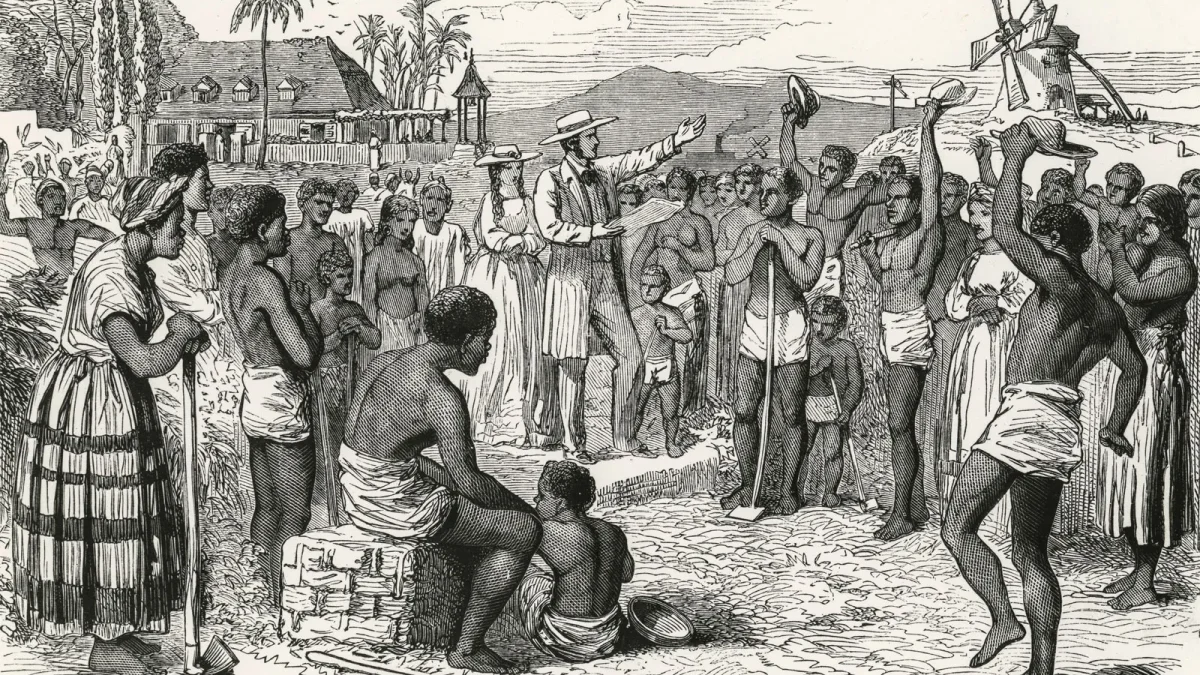
The Slavery Abolition Act 1833 was an act of the Parliament of the United Kingdom which abolished slavery in the British Empire by way of compensated emancipation. It was passed under the reforming Whig administration of Prime Minister Charles Grey, 2nd Earl Grey, and it worked by ordering the British government to purchase the freedom of all enslaved people in the empire and by outlawing the further practice of slavery. The act explicitly set out 19 separate pots of compensation covering the Caribbean, South Africa and Mauritius. Britain, Canada, Australia and New Zealand were technically included, although they had relatively few enslaved people at the time, and India was excluded. Around 800,000 freed people were attested in the claims process.
A Landmark With Limits
The 1833 Act was a landmark, but it did not end slavery throughout the entire British sphere of influence. It explicitly excluded territories such as British India, where slavery was addressed separately by the Indian Slavery Act of 1843. In regions colonised later, such as Nigeria, the abolition of existing local systems of slavery was a gradual process that extended into the early twentieth century. In British protectorates, which kept their own local laws, the institution persisted for much longer: slavery in Bahrain, for example, was not legally abolished until 1937.
The Somerset Case
Slavery had been judged to be without legal basis in England in 1772. In May of that year Lord Mansfield's judgment in the Somerset case freed an enslaved man who had been brought to England from Boston in the Province of Massachusetts Bay, and it helped to launch the movement to abolish slavery throughout the British Empire. The case ruled that slavery had no legal status in England because it had no basis in common law or statute, so that someone could not legally be a slave there. Many campaigners, including Granville Sharp, took the view that the ruling meant that no ownership could be exercised over enslaved people entering English or Scottish soil.
The Campaign
By 1783 an anti-slavery movement to abolish the slave trade throughout the empire had begun among the British public, and the Society for Effecting the Abolition of the Slave Trade was founded in 1787. The Wedgwood anti-slavery medallion, designed by Josiah Wedgwood, was, according to the BBC, "the most famous image of a black person in all of 18th-century art", and the abolitionist Thomas Clarkson wrote that fashion, which usually confines itself to worthless things, was "seen for once in the honourable office of promoting the cause of justice, humanity and freedom". After an incident involving Chloe Cooley, an enslaved woman brought to Canada by an American loyalist, the Lieutenant-Governor of Upper Canada, John Graves Simcoe, tabled the Act Against Slavery in 1793, which, once passed by the local Legislative Assembly, was the first legislation to outlaw the slave trade in a part of the British Empire. By the late eighteenth century Britain was simultaneously the largest slave trader and the centre of the largest abolitionist movement. William Wilberforce wrote in his diary in 1787 that his great purpose in life was to suppress the slave trade, and he went on to wage a 20-year fight against it.
From the Slave Trade to Slavery
Parliament passed the Slave Trade Act 1807, which outlawed the international slave trade in the British Empire but not slavery itself. The legislation was timed to coincide with the expected American Act Prohibiting Importation of Slaves, since the United States was Britain's chief rival in maritime commerce. It imposed fines that did little to deter those involved in the trade, and the abolitionist Henry Brougham, who realised that trading had continued, introduced the Slave Trade Felony Act 1811 as a new MP, which at last made the overseas slave trade a felony throughout the empire.
The Road to 1833
The Royal Navy established the West Africa Squadron to suppress the Atlantic slave trade by patrolling the coast of West Africa. It suppressed the trade without stopping it entirely, and between 1808 and 1860 it captured 1,600 slave ships and freed 150,000 Africans. In 1823 the Anti-Slavery Society was founded in London, with members including Joseph Sturge, Thomas Clarkson, William Wilberforce, Henry Brougham, Thomas Fowell Buxton and Elizabeth Heyrick. During the Christmas holiday of 1831 a large-scale slave revolt in Jamaica, known as the Baptist War, broke out, originally organised as a peaceful strike by the Baptist minister Samuel Sharpe. It was suppressed by the militia of the Jamaican planters and the British garrison ten days later, and because of the loss of property and life Parliament held two inquiries whose results contributed greatly to the abolition of slavery. Until then the sugar planters from rich British islands such as Jamaica and Barbados had been able to buy rotten and pocket boroughs and to form a body of resistance to moves to abolish slavery, known as the West India Lobby. The Reform Act 1832 swept away their rotten-borough seats, clearing the way for a majority of members of the House of Commons to push through a law abolishing slavery throughout the British Empire.
The Act Itself
The civil servants who produced the first draft of the compensation did not expect Parliament to approve the amount, and Lord Howick, an originator of one of the discarded proposals, did not believe that the House would approve even half of it. The members of the House of Commons saw things differently: the ownership of private property was of great importance to them, and an act that nullified the value of a legally held asset set a frightening precedent for the landowning classes who were so widely represented there. The compensation was therefore approved in the full amount of 20 million pounds. The act passed its second reading in the Commons unopposed on 22 July 1833, a week before William Wilberforce died, and its third reading on 7 August. It passed the Lords on 20 August and received royal assent on 28 August, and it came into force the following year, on 1 August 1834. Enslaved children below the age of six were freed immediately, and those over six were redesignated as "apprentices", whose servitude was to be abolished gradually in two stages: the first apprenticeships came to an end on 1 August 1838, and the final ones were scheduled to cease on 1 August 1840. The act specifically excluded the territories in the possession of the East India Company, the island of Ceylon and the island of Saint Helena, exceptions that were eliminated in 1843 by the Indian Slavery Act.
Why It Matters
The Slavery Abolition Act is widely seen as a turning point in the history of human rights, because it ended slavery as a legal institution in much of the world's largest empire. It is also controversial. The compensation went to the owners and not to the people who were freed, a point that historians and descendants have emphasised, and the abolition did not extend to every territory under British influence. Understanding both its achievement and its limits is part of understanding the long and unfinished struggle against slavery.