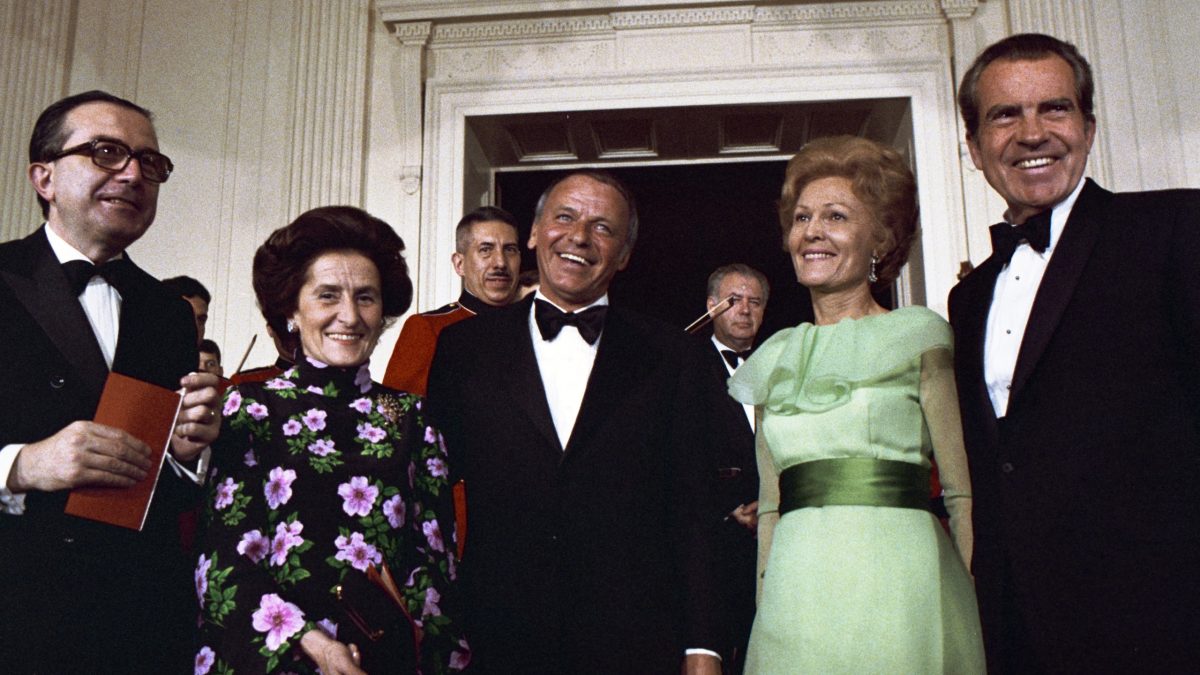
Frank Sinatra (12 December 1915 to 14 May 1998) was an American singer, conductor and actor nicknamed the "Chairman of the Board" and "Ol' Blue Eyes". He is regarded as one of the most influential entertainers of the 20th century, with an estimated 150 million record sales worldwide and an Academy Award for From Here to Eternity (1953). This biography follows his life, music and films.
Frank Sinatra at a Glance
| Full name | Francis Albert Sinatra |
| Born | 12 December 1915, Hoboken, New Jersey, United States |
| Died | 14 May 1998, Los Angeles (aged 82) |
| Profession | Singer, actor and conductor |
| Nicknames | The Voice, Ol' Blue Eyes, Chairman of the Board |
| Best-known songs | My Way, New York, New York |
| Film honour | Academy Award for Best Supporting Actor, From Here to Eternity (1953) |
| Records | An estimated 150 million sold |
| Spouses | Nancy Barbato, Ava Gardner, Mia Farrow, Barbara Marx |
Early Life in Hoboken
Francis Albert Sinatra was born on 12 December 1915 in a tenement at 415 Monroe Street in Hoboken, New Jersey, the only child of Italian immigrants Natalina "Dolly" Garaventa, from Genoa, and Antonino Martino "Marty" Sinatra, from Sicily. He weighed 13.5 pounds at birth and had to be delivered with forceps, which left scarring on his left cheek and neck and lifelong damage to his left eardrum. His mother was energetic and driven, and biographers believe she was the dominant factor in the development of his personality. His father, who was illiterate, was a bantamweight boxer who later worked his way up to captain in the Hoboken Fire Department.
Early Career and Sinatramania
Sinatra began his musical career in the swing era. He joined the Harry James band as vocalist in 1939 before signing with Columbia Records four years later. By May 1941 he topped the male singer polls in Billboard and DownBeat. His appeal to "bobby soxers", teenage girls, revealed a new audience for popular music, and the phenomenon known as "Sinatramania" began after his opening at the Paramount Theatre in New York on 30 December 1942. His first album, The Voice of Frank Sinatra, was released in 1946.
The Capitol Years
After a career slump in the late 1940s, he made a comeback in the 1950s, signing with Capitol Records and recording a series of albums with arrangements by Nelson Riddle, including In the Wee Small Hours (1955) and Songs for Swingin' Lovers! (1956). In 1960 he left Capitol to start his own label, Reprise Records.
Reprise and Collaborations
He collaborated with Count Basie on Sinatra-Basie (1962) and It Might as Well Be Swing (1964), and recorded Sinatra at the Sands in 1966 in Las Vegas. He recorded Francis Albert Sinatra & Antônio Carlos Jobim, one of the best-selling albums of 1967, and Francis A. & Edward K. with Duke Ellington in 1968. He retired in 1971 after the release of "My Way" but came out of retirement two years later, and his song "New York, New York" followed in 1980.
Acting Career
Sinatra won the Academy Award for Best Supporting Actor for From Here to Eternity (1953), then starred in The Man with the Golden Arm (1955) and The Manchurian Candidate (1962). He also appeared in musicals such as On the Town (1949), Guys and Dolls (1955), High Society (1956) and Pal Joey (1957), the last of which won him a Golden Globe. He directed the anti-war drama None but the Brave (1965), and on television The Frank Sinatra Show began on CBS in 1950.
War Years
Sinatra did not serve in the military during World War II. Army files reported that he had been rejected for psychiatric reasons, and a rumour reported by the columnist Walter Winchell that he paid $40,000 to avoid service was found to be without merit by the FBI. Toward the end of the war he entertained troops on overseas USO tours with the comedian Phil Silvers.
Marriages and Family
Sinatra married Nancy Barbato in 1939, and they had three children: Nancy (born 1940), Frank Jr. (1944 to 2016) and Tina (born 1948); they divorced in 1951. He married the actress Ava Gardner in 1951, in a turbulent marriage that ended in 1957. He married Mia Farrow on 19 July 1966, and they divorced in August 1968. On 11 July 1976 he married Barbara Marx, the former wife of Zeppo Marx, at Sunnylands in Rancho Mirage, California.
Honours
Sinatra was recognised at the Kennedy Center Honors in 1983, awarded the Presidential Medal of Freedom in 1985 and received the Congressional Gold Medal in 1997. He earned 13 Grammy Awards, including the Trustees Award, the Legend Award and the Lifetime Achievement Award, and he received the Golden Globe Cecil B. DeMille Award in 1971.
Death
In the final years of his life, Sinatra was in ill health and frequently hospitalised for heart and breathing problems, high blood pressure, pneumonia and bladder cancer. He made no public appearances after a heart attack in February 1997. On the evening of 14 May 1998 he died in his sleep, aged 82, after another heart attack at Cedars-Sinai Medical Center in Los Angeles, with his wife Barbara at his side.
Style and Personality
Sinatra was known for his immaculate sense of style. He spent lavishly on custom-tailored tuxedos and pin-striped suits, and with the Tommy Dorsey band he earned the nickname "Lady Macbeth" because of his frequent showering and changes of outfit. His deep blue eyes earned him the nickname "Ol' Blue Eyes". The writer Santopietro described him as the personification of America in the 1950s, "cocky, eye on the main chance, optimistic, and full of the sense of possibility".
His career also had setbacks. In 1970 he released Watertown, a critically acclaimed concept album, which sold only 30,000 copies that year and peaked at number 101 on the charts. Later in 1970 he left Caesars Palace after an incident in which an executive pulled a gun on him, and in 1967 he had pulled out of the Sands after a fight with its new owner, Howard Hughes. His retirement, announced in June 1971 at a concert in Hollywood to raise money for the Motion Picture and TV Relief Fund, lasted two years.
Legacy
The critic Robert Christgau called Sinatra "the greatest singer of the 20th century". His phrasing, his ability to tell a story in a song and his control over his own career, including his ownership of a record label, made him a model for later artists. He is still regarded as an iconic figure of American popular culture.