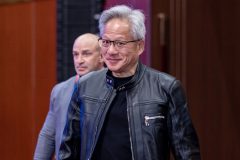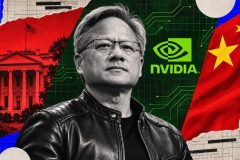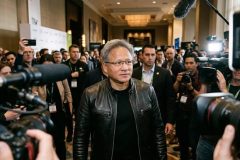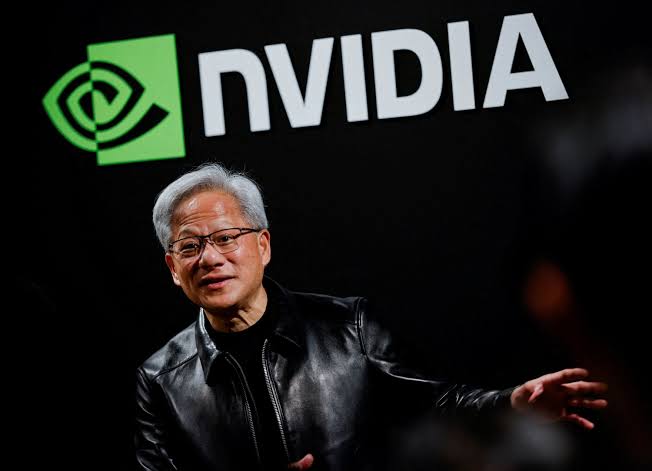
Nvidia has firmly ruled out letting its ousted co-founder Jensen Huang return as chief executive, even as the company reported that its quarterly sales had doubled to more than $100bn. The results, the first since Huang's dramatic exit last week, covered the three months to 25 October, a period that ended just before the scandal surfaced. At the same time, Washington has introduced new restrictions aimed at stopping Chinese firms from reaching advanced American chips through data centres in third countries, and the affair is now shadowing a summit between US President Donald Trump and Chinese President Xi Jinping. Together, these developments show how a corporate crisis has become a geopolitical one.
The financial numbers are striking. According to the BBC, Nvidia said sales for the three months to 25 October rose to $115.8bn (£86.9bn), and profits also doubled from a year earlier, reaching $65bn. Sales from data centres, which are a significant part of the business, doubled to $107bn. Shares jumped by 4.8% in after-hours trading. The company said its rapid growth is poised to continue and that revenue will rise by another 13% in the next quarter. Because of the uncertainty around Huang's exit, analysts had not been sure that Nvidia would provide any forward-looking guidance at all.
The leadership position was the harder question. Earlier on Tuesday, Huang said he would be "honoured" to return and lead Nvidia, having quit following alleged extramarital affairs, including one with a suspected spy for China. Nvidia's chair, Harvey Jones, answered directly: "The board does not intend to reinstate him." Interim chief executive Colette Kress told investors it was "business as usual" and said, "We've got this." She added that "our momentum is real. Our demand is accelerating. Our supply is growing," and that customers, partners and employees remain committed. Jones said the company would not take questions about Huang or about Nvidia's investigation into his conduct, but he confirmed that the search for a permanent chief executive is under way with an executive search firm, considering internal and external candidates. "With the advanced technology and the national security dynamics in the marketplace, our new chief executive will have to navigate those waters carefully," he said, adding that the board would not rush.
Analysts were quick to read the numbers as reassurance. Daniela Hathorn of the trading platform Capital.com said the results "offer a strong answer to concerns that demand for AI infrastructure is cooling" and ease immediate worries that Huang was irreplaceable. She also flagged the longer-term issue: "The harder question is whether Nvidia can preserve the strategic advantage Huang helped build." His exit, she said, is unlikely to change orders already committed, but could matter more when the company makes its next decisions on products, partnerships and investment. Not everyone is ready to move on. Michael Monaghan of the investment firm Founder ETFs, who is an Nvidia investor, told the BBC he wants Huang back and is waiting for the results of a thorough investigation rather than relying on what he called "salacious allegations" made in the media. The strong earnings, he said, come "from the machine that Jensen built".
Kress disclosed one detail with direct bearing on China. She said Nvidia is no longer shipping Hopper data centre semiconductors to that country. The Hopper technology is in the H200 processors that Nvidia won approval to sell in China after Huang's repeated lobbying in Washington, a decision the BBC described as rare because the US had spent years trying to limit China's access to the most advanced chips. Kress did not explain why shipments had stopped.
The scandal itself centres on Alice Huang, a Chinese businesswoman who is alleged in US intelligence reports to have ties to China's Ministry of State Security. The BBC says that claim remains unproven. She is a former director of the Singapore data centre company Megaspeed, which is Nvidia's biggest buyer in Southeast Asia and is accused of illegally smuggling chips to Chinese firms after buying them for data centres in Malaysia, Indonesia and Thailand. Megaspeed has denied the allegations, defended its business as "legitimate and lawful", and said it has retained external legal counsel for an internal investigation. It also said Alice Huang stepped down as a director in late 2023 and left the firm last year. China's foreign ministry called the spy claims a "smear against China", with spokesperson Mao Ning saying the US should stop fabricating "so-called espionage narratives" to justify technological blockades.
The timing collided with new US export rules. On Monday, Washington announced interim rules that increase scrutiny of data centre operators in Singapore, Malaysia, Thailand, Indonesia and Brazil. They restrict not only the export of advanced chips but also access to their computing power, which Chinese firms currently rent abroad to train artificial intelligence models. Operators will need a US licence to buy advanced chips from Nvidia or other American makers, issued on a case-by-case basis. The US Commerce Department's Bureau of Industry and Security said the five countries "present a higher-than-normal risk of diversion", and that the measures are meant to ensure sensitive US technology "cannot be circumvented through remote computing arrangements involving data centers in third countries".
The stakes for China are large. Research by the Institute for Progress, a US think tank, projects that at least 30% of China's advanced AI computing power will come from renting overseas or smuggling in 2027. That makes the new rules, in the words of one analyst quoted by the BBC, a removal of "one of the more practical routes Chinese AI developers had to accessing frontier computing power". Beijing called the rules "economic coercion" and said it "will take necessary measures to firmly safeguard its own legitimate rights and interests". Chinese labs such as DeepSeek and Moonshot have come close to American rivals, and the Institute for Progress estimates that the top US models lead the best Chinese platforms by only about six and a half months. Even so, experts told the BBC that China still needs advanced US chips for its best models to stay competitive.
Southeast Asian governments are also affected. Singapore was an early adopter of data centres, but when it limited new construction, investment flowed to Malaysia and Thailand, with Johor in Malaysia and Batam in Indonesia approving billions of dollars of projects, often with incentives such as cheaper land. Naoise McDonagh of Edith Cowan University said Malaysia and Thailand, whose rollouts have been heavily driven by Chinese buyers, could be hit hardest. Reema Bhattacharya of Verisk Maplecroft, however, said the rules are unlikely to derail the data centre boom as a whole, and that investment backed by major tech firms with identifiable customers should "remain relatively resilient". Singapore said it is "engaging relevant US authorities" and exploring how to facilitate trusted access for local firms, Brazil said it is monitoring developments, and Malaysia has said it "will not allow itself to be used to get around export controls".
All of this lands days before Trump meets Xi in Shenzhen. The BBC's China correspondent noted that Democrats, who will control Congress from January, have taken a hard line. Congressman Ted Lieu said the administration had been "1,000%" too deferential to Nvidia, and Zoe Lofgren suggested Congress would now be more likely to restrict AI chip sales to China. Beijing is worried that the scandal strengthens those voices, and Chinese state media compared it with the 2023 surveillance balloon incident that derailed a planned visit by then Secretary of State Antony Blinken. Both leaders still have reasons to keep talking: China's economy is under pressure, and a trade truce is due to expire in January, while Trump may seek foreign policy wins after the midterms. But analysts warn that technology restrictions can trigger cycles of retaliation, and China has powerful tools, including its dominance in processing rare earth minerals.
What happens next will be decided on two tracks. In the boardroom, Nvidia has to find a permanent chief executive who can manage a company that leads the AI buildout and is now caught up in national security politics. In diplomacy, Washington and Beijing have to decide whether chip controls and espionage claims will overshadow the trade talks they both say they want. The earnings show that demand for Nvidia's products has not slowed, but the scandal has shown how closely that demand is tied to questions of national power.