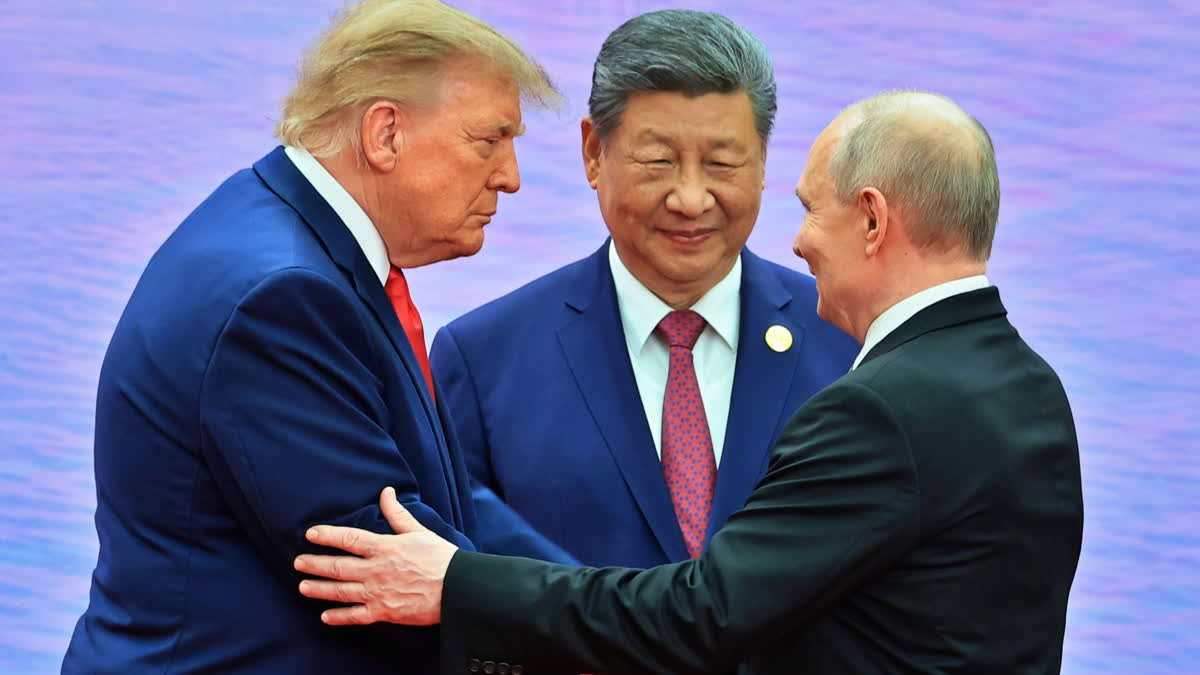
The leaders of the world's three most powerful militaries are meeting around one table for the first time. US President Donald Trump, Chinese President Xi Jinping and Russian President Vladimir Putin are due to hold a three-way meeting on Thursday, 19 November, in the southern Chinese city of Shenzhen, on the sidelines of the Asia-Pacific Economic Cooperation (APEC) summit that China is hosting on 18 and 19 November. Trump flew to China after attending the Association of Southeast Asian Nations meeting in Manila, and Xi greeted him at the airport on Wednesday. The BBC noted that Xi met him in person there, which it described as a first for a foreign leader. Ostensibly an economic gathering for Asia-Pacific leaders, the summit has become a showcase for Beijing, which has managed to seat two rivals at its own table.
The case for treating this as a genuine breakthrough rests on the sheer rarity of the image. Commentators have compared the meeting with the 1945 Yalta conference, where US President Franklin Roosevelt, British Prime Minister Winston Churchill and Soviet leader Joseph Stalin met in Crimea to shape the post-war order. For Xi, the BBC said, the summit demonstrates China's grip on the global economy and world politics, and shows that Beijing is no longer merely reacting to decisions made in Washington, London or Brussels. Shenzhen itself was part of the message: the BBC described driverless cars cruising past, drones overhead and robots dancing in the streets. The White House has said Trump intends to raise the war with Iran and a possible three-way agreement on nuclear armament. That second item is the one with real potential, because the New START treaty, the last major US-Russian arms control agreement, lapsed in February and left no cap on the two largest arsenals.
Yet the case against expecting much is stronger, and most of the analysts quoted by Al Jazeera and the BBC make it. Vuk Vuksanovic of King's College London called the Yalta comparison "a far cry" from reality, noting that at Yalta the leaders had a shared idea of how the world would look afterwards, while today there is not even the contour of such a plan. Scott Lucas of University College Dublin summed the meeting up as "a summit of Trump's ego, Putin's tactics, China's strategy". Ukraine is not expected to be on the formal agenda, because Xi is understood to be reluctant to be drawn into what he sees as a European matter. The BBC added that Beijing does not want the war to dominate the talks, since Xi is trying to balance his closeness to Putin against the importance of the European Union as an export market. China also resists the nuclear idea. Trump rejected a Russian offer to extend New START after it expired, demanding instead a new and modernised deal that includes Beijing, but Xi is understood to be unenthusiastic about joining a treaty China did not help write. Beijing's argument, as the BBC set it out, is that its arsenal is considerably smaller than those of Washington and Moscow, so it would be unfair to bind it to their limits.
Each leader arrives with a different need. Trump comes, in Vuksanovic's words, "wounded domestically" after the Republican Party's heavy defeat in the US midterm elections, in which Democrats gained control of both houses of Congress, and with the war on Iran weighing on his legacy given his 2024 pledge to avoid another "forever war". Analysts say he wants something he can present as a win at home. The trade relationship gives him some room: tariffs on Chinese goods peaked at 145 percent and China's retaliatory tariffs on US goods at 125 percent before a temporary truce was agreed in Busan, South Korea, in October 2025. That truce has since been extended to 10 January 2027. China's rare earth exports to the US remain about 75 percent below normal levels, according to the Center for Strategic and International Studies. Putin's priority is the war in Ukraine and an end to the isolation that European and US sanctions have imposed. Lucas argues that Moscow wants political cover from Beijing and a Washington that stops backing Kyiv, and that Russia wants to break the notion that it is isolated. Russian oil exports to China rose 35 percent in the first quarter of 2026, according to a Kremlin aide, and Xi and Putin signed more than 40 cooperation agreements in Beijing in May.
Xi, for his part, has the most to protect and the most to gain from the optics. The BBC pointed out that he will want to control the picture from start to finish, but that he must now share the stage with two unpredictable leaders, one of whom has already threatened to go off script. There is a risk that Trump and Putin dominate the meeting and leave Xi looking like a host rather than the architect of a major diplomatic moment. Even so, the BBC said, the meeting is important to Xi as he heads towards next year's Communist Party Congress, where he is expected to secure a historic fourth term. At home he faces a property crisis that has dented consumer confidence, heavily indebted local governments, slowing manufacturing and youth unemployment: the BBC reported that about one in five young people are thought to be struggling to find work. A photograph with Trump and Putin lets him argue that China is no longer a rising power but a country shaping the rules of a new era.
The summit also lands against a tense backdrop. Trump has strained ties with traditional allies, at times floating troop withdrawals from South Korea and cuts to assistance for Japan, while his administration still describes China as Washington's main rival. Trump's rhetoric towards Putin has softened in recent months and hardened towards Ukrainian President Volodymyr Zelensky. His envoys Steve Witkoff and Jared Kushner brokered Russia-Ukraine talks in Abu Dhabi on 10 and 11 November, the first in direct format since February, and some analysts worry that Russia could be offered concessions on NATO or allowed to keep land it has seized, which would alarm European leaders. Putin, speaking at the APEC meeting, described Western powers as "former hegemons" and said Europe was experiencing a "humiliating decline". Xi called for China and Russia to "lead and advance the trend towards a multipolar world". Europeans will watch from the outside, aware that decisions touching their security may be discussed without them.
Why this matters goes beyond the handshake. If the three leaders manage even a general statement on nuclear arms, it would be the first sign that the post-New START vacuum could be filled, and for a world that has had no binding limit on the two biggest arsenals since February, that would count. If they do not, the meeting still shows how power is now arranged: China as convener, Russia as a partner that needs Beijing's markets, and the United States as a participant rather than the organiser of the global conversation. Deborah Elms of the Hinrich Foundation said that a handshake without incident would be seen as a win, which tells you how low expectations are.
The realistic conclusion is that Shenzhen will produce images more than agreements. The three leaders disagree on Ukraine, on nuclear limits, on Iran and on trade, and no one in the analysis quoted here expects those gaps to close in a single afternoon. What the meeting does establish is a channel. Three-way contact between the world's largest military powers, once it exists, is hard to take back, and that may prove its most lasting result even if the communique is thin. Delima News will report any outcome as it is confirmed.