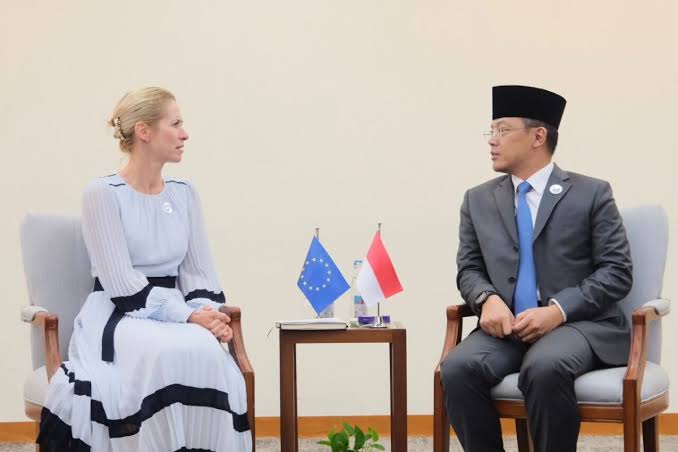
European Union governments have approved the signing of a trade deal with Indonesia that was first concluded in September 2025, Al Jazeera reports, in a move aimed at offsetting the impact of US President Donald Trump's tariffs. The decision by the Council of the European Union on Wednesday, 18 November, also allows the agreement to be applied provisionally. Both sides will remove import duties on more than 90 percent of products, and Indonesia's 50 percent duty on EU cars will be eliminated within five years. The EU and Indonesia will now sign the agreements, which then go to the European Parliament for approval.
The argument in favour is that it ties the bloc more closely to a large and growing partner. Al Jazeera notes that Indonesia is the fourth most populous country in the world. Irish Foreign and Trade Minister Helen McEntee said the agreements will make it easier for European firms to trade and invest, remove tariffs on almost all goods traded between the two sides, and save businesses an estimated 600 million ($658.3 million) a year in customs duties. The removal of Indonesia's 50 percent duty on EU cars within five years is a notable concession. For European exporters facing US tariffs, access to a market of that scale is valuable precisely because it does not depend on Washington.
The case for caution is that the path to this deal was difficult and may not be smooth. Indonesia has negotiated a free trade and investment agreement with the EU since 2016, according to Al Jazeera, and relations became strained after the European Commission decided to phase out palm oil from transport fuel by 2030 and imposed anti-subsidy duties on Indonesia's biodiesel exports. Those disputes did not disappear because a deal was concluded; they are part of the background against which it will be applied. The agreement also still needs the approval of the European Parliament, so provisional application, while helpful, does not give it final legal certainty.
There is a timing issue as well. Indonesia will graduate from the EU's generalised scheme of preferences on 1 January 2027, after which its exports will no longer benefit from preferential tariffs, the Council said. This means the new agreement becomes the main framework for Indonesian goods entering the EU just as the older preferences end, giving both sides a strong incentive to apply it quickly. Al Jazeera reports that both sides want the agreement applied as swiftly as possible. If provisional application were delayed past the start of the year, Indonesian exporters could face a gap, which would work against the aim of the deal.
The deal matters because of the strategy behind it. By striking agreements outside the United States, the EU is trying to reduce its exposure to Trump's tariffs and to widen the set of partners it trades with. Al Jazeera describes the deal as part of an effort to offset the impact of US tariffs, and related reporting by DW points to wider efforts to deepen EU ties with the Association of Southeast Asian Nations, although businesses there still struggle with informal barriers. Indonesia, for its part, secures access to a large market and gets a path to the end of its palm oil and biodiesel disputes, if the new framework is respected.
Several practical questions remain. It is not yet clear how quickly European carmakers will use the opening in Indonesia, since the 50 percent duty on EU cars will be eliminated over a period of up to five years rather than at once. It is also unclear how the Parliament will vote, given that debates on palm oil and the environment have been sensitive in Europe. These details will determine whether the headline figure of more than 90 percent of products translates into real trade growth, and the 600 million annual savings in customs duties is an estimate from a minister rather than a measured outcome.
The conclusion is that the agreement is a clear signal of intent rather than a finished result. It shows the EU preferring to deepen partnerships with large emerging economies at a time when its largest trading partner has become less predictable. Whether it delivers will depend on the Parliament's vote, on the handling of palm oil and biodiesel, and on whether businesses on both sides take up the opportunity, and Delima News will follow its progress through the approval process.