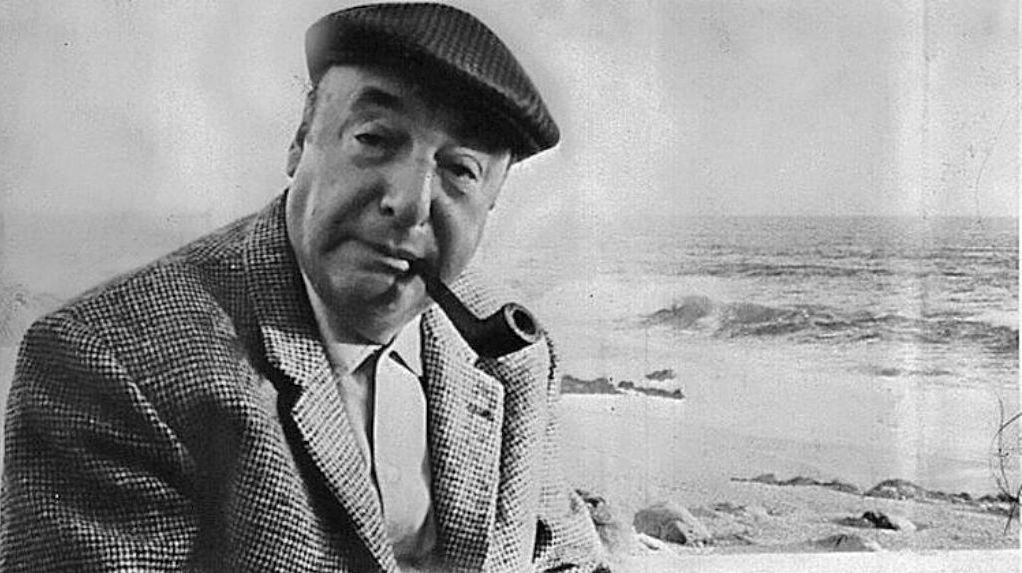
Pablo Neruda (12 July 1904 to 23 September 1973) was a Chilean poet, diplomat and politician who won the 1971 Nobel Prize in Literature. Born Ricardo Eliécer Neftalí Reyes Basoalto, he became known as a poet at 13 and wrote in many styles, from surrealist verse and historical epics to political manifestos and passionate love poems. He is often considered the national poet of Chile. This biography covers his life, work and the continuing debate about his death.
Pablo Neruda at a Glance
| Full name | Ricardo Eliécer Neftalí Reyes Basoalto |
| Born | 12 July 1904, Parral, Chile |
| Died | 23 September 1973, Santiago, Chile (aged 69) |
| Profession | Poet, diplomat and politician |
| Pen name | Pablo Neruda, adopted by mid-1920 |
| Best-known works | Twenty Love Poems and a Song of Despair (1924), Residencia en la Tierra, Canto General (1950) |
| Daughter | Malva Marina Reyes (1934 to 1943) |
| Honour | Nobel Prize in Literature, 1971 |
| Political role | Senator for the Chilean Communist Party; ambassador to France under Salvador Allende |
Early Life
Neruda was born on 12 July 1904 in Parral, a city in Linares Province about 350 km south of Santiago. His father, José del Carmen Reyes Morales, was a railway employee, and his mother, Rosa Neftalí Basoalto Opazo, was a schoolteacher who died on 14 September, two months after his birth. He grew up in Temuco with a half-brother, Rodolfo, and a half-sister, Laura Herminia, and wrote his first poems in the winter of 1914. He was an atheist.
His father opposed his interest in literature, but he found encouragement elsewhere, notably from the future Nobel laureate Gabriela Mistral, who headed the local school. On 18 July 1917, aged 13, he published his first work, an essay titled "Entusiasmo y perseverancia", in the daily La Mañana. By mid-1920 he had adopted the pseudonym Pablo Neruda. He is thought to have taken it from the Czech poet Jan Neruda, though some sources point to the violinist Wilma Neruda, who is mentioned in a Sherlock Holmes novel.
Rise as a Poet
In 1921 he moved to Santiago to study French at the Universidad de Chile with the plan of becoming a teacher, but he soon devoted himself to poetry. His first book, Crepusculario, appeared in 1923, followed in 1924 by Veinte poemas de amor y una canción desesperada (Twenty Love Poems and a Song of Despair), a collection that was controversial for its eroticism, given the author's youth. It became his best-known work, millions of copies have been sold, and almost a century later it is still the best-selling poetry book in the Spanish language. By 20 he had an international reputation but still faced poverty.
Diplomat in Asia and Spain
Out of financial desperation, in 1927 he took an honorary consulship in Rangoon in British-ruled Burma, and later worked in Colombo, Batavia and Singapore. In Batavia in 1928 he met and married his first wife, a Dutch bank employee known as Maruca. During these years of isolation he read widely, experimented with forms and wrote the first two volumes of Residencia en la Tierra, which include many surrealist poems.
Back in Chile he was posted to Buenos Aires and then Barcelona, and succeeded Gabriela Mistral as consul in Madrid, where he befriended writers including Rafael Alberti, Federico García Lorca and César Vallejo. His only child, Malva Marina, was born in Madrid in 1934. She had severe health problems, including hydrocephalus, and died in 1943 at the age of eight after spending most of her life with a foster family in the Netherlands, having been neglected by her father, a painful chapter in his biography.
Politics and Exile
The Spanish Civil War politicised him. The execution of García Lorca by forces loyal to Franco was the key catalyst, and Neruda remained a committed Communist for the rest of his life. In 1943, on his return to Chile, he visited Machu Picchu in Peru, which inspired the 12-part poem Alturas de Macchu Picchu, completed in 1945 and followed by Canto General in 1950, in which he celebrated the achievement of the ancient civilisation while condemning the slavery that made it possible.
He served a term as a senator for the Chilean Communist Party. When President Gabriel González Videla outlawed communism in 1948, a warrant was issued for his arrest after his "Yo acuso" speech. Friends hid him for months, moving him from house to house for 13 months, and in 1949 he escaped through a mountain pass near Maihue Lake into Argentina. He did not return to Chile for more than three years.
Nobel Prize and Ambassador to France
A close adviser to the socialist president Salvador Allende, he served as Chile's ambassador to France under Allende and won the Nobel Prize in Literature in 1971. When he returned to Chile after accepting the prize in Stockholm, Allende invited him to read at the Estadio Nacional before 70,000 people.
Death and the Controversy
In September 1973 Neruda was diagnosed with prostate cancer. The same month, the coup led by Augusto Pinochet overthrew Allende's government and Allende died by suicide. Neruda made plans to flee to Mexico. On 23 September, the day before his planned departure, he died at the Santa María clinic in Santiago. The official cause was complications from prostate cancer, but the circumstances have been debated ever since.
In 2011 an investigation opened after Manuel Araya, his former assistant and driver, claimed that Neruda had been murdered on Pinochet's orders, saying the poet had told him a doctor had injected him with an unknown substance. In 2013 Judge Mario Carroza ordered his remains exhumed. Initial tests found no evidence of poisoning, but in 2015 the Chilean government said it was "clearly possible and highly likely" that third parties had caused his death. In 2017 a panel of 13 forensic experts reported no sign that he had died of cancer and identified evidence of a potentially "laboratory cultivated bacteria". A 2023 toxicology report confirmed the presence of Clostridium botulinum in his teeth, and a court of appeals reopened the official inquiry in February 2024.
Legacy
Neruda's works have been popular and influential worldwide. Gabriel García Márquez once called him "the greatest poet of the 20th century in any language", and the critic Harold Bloom included him among the writers central to the Western tradition in The Western Canon. His life shows the pull between art and politics in 20th-century Latin America: he wrote some of the most intimate love poems in Spanish and some of its most public political verse. The unresolved question of how he died keeps his story part of the wider history of the 1973 coup.