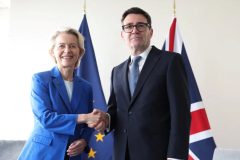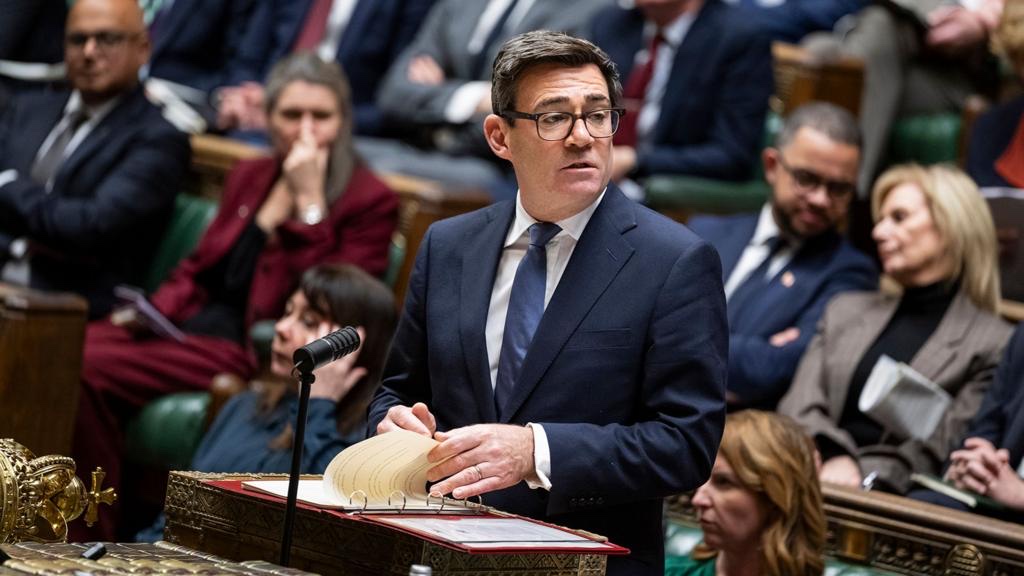
Prime Minister Andy Burnham has told MPs that his new agreements with the European Union are "pragmatic" and "not a prelude to anything", as he came under fire from a succession of former prime ministers who say he risks reopening the Brexit debate. Speaking in the Commons on Monday, 23 November 2026, after Friday's EU-UK summit in Brussels, Burnham said there was "no fixed destination" in talks to explore closer ties with the bloc, and that it would be "unthinkable" for the UK to rejoin without a referendum.
The summit produced a new deal covering British food exports, emissions trading and a youth experience scheme. It also completed the latest stage of the government's post-Brexit "reset" of relations with the EU, and both sides agreed to "brainstorm" options for their long-term relationship. Burnham has previously suggested that the options for the future could include rejoining the customs union, the single market, or a fresh referendum on full EU membership. However, he has ruled out major changes before the next general election, saying he will stick to Labour's 2024 manifesto pledge not to return to the single market, the customs union or freedom of movement.
In the Commons, Conservative MP Sir Edward Leigh said the reset was "a prelude to the prime minister's sincere desire to rejoin the EU and have another referendum", and warned it risked leading to another Scottish independence referendum. Burnham replied: "It's not a prelude to anything. It's a pragmatic approach and it will continue to be a pragmatic approach. If it's in Britain's national interest, I will recommend it to this House. If it is not, then I won't. There is no fixed opinion here. There is no fixed destination." He added that "Europe could change again in the next year, 18 months, and we'll have to obviously watch how life changes. But where Britain can make progress, surely we should make progress."
Asked by Conservative MP Sir Bernard Jenkin to give a clear statement that it would be unthinkable for any prime minister to take the UK back into the EU without a referendum, Burnham said: "Yes, it would be unthinkable." He also told MPs that the government's forthcoming 10-year "plan for Britain", to be published next month, will consider the "range of options for our long-term relationship with our largest market", and that the results of the "informal exchanges of ideas" with the EU will be presented around the time of the next joint summit. To laughter from the opposition benches he said: "So there will be no banging on about Europe from this side or a running commentary." The words echoed those used by Conservative former prime minister Lord Cameron in 2006.
The criticism from Burnham's predecessors has been sustained. Baroness May, who spent three years negotiating an EU exit deal, told the BBC's Sunday with Laura Kuenssberg she was "aghast" he could be considering rejoining, and urged him to "accept Brexit and move on". She said: "Brexit is done." She also accused him of wanting "to pat people on the head" by suggesting voters got it wrong the first time. Rishi Sunak warned that reopening the "divisive" debate would be "a huge distraction for government". Earlier this month Boris Johnson called it "madness" for Burnham to make Brexit his "political priority" and said he believed the public would back Brexit again if given another vote. Lord Cameron has warned against "another decade-long debate about whether we should be in or out". Even Sir Tony Blair, a prominent opponent of Brexit, has said the UK should only rejoin if the EU reforms and allows more technological innovation.
Burnham's response was sharp: "They're stuck in the past because they can't face up to the bad deal that they did," he said, adding: "I'm not a prime minister that's going to be stuck in the past." Conservative leader Kemi Badenoch said Burnham had "oversold" the deal, which "wasn't really about reducing the cost of living" but about "committing Britain to becoming a rule taker from Brussels, something he had no mandate to do". She said six former prime ministers, including Blair, were criticising his direction, and that "the only person living in the past is the man trying to take Britain back to 2015". Her deputy, Alex Burghart, said the Conservatives would scrap Burnham's deal and that it would not lead to lower prices in the shops.
Reaction from other parties was mixed. Liberal Democrat leader Sir Ed Davey welcomed the agreements but said a "totally new deal for Britain" is needed. Reform UK deputy leader Richard Tice called it a "terrible" deal, while Green MP Ellie Chowns said "bold and brave politics, not baby steps" are needed.
BBC political editor Chris Mason observed that Burnham's address felt like an attempt by a man who chose to turn the Europe conversation up to full blast this autumn to turn the volume back down. He recalled that in 2006 a newly elected David Cameron promised to stop "banging on" about Europe, and a decade later held and lost a referendum. Mason noted that Burnham did not rule out seeking a mandate for another in-or-out referendum at the next election, but "very carefully left his options open". He also suggested that Burnham's remark about Europe changing in the coming years was a nod, without naming her, to the possibility that Marine Le Pen could become president of France.
Outside Parliament, campaign groups are forming. A group called Stay Out has launched to argue against closer ties, while the European Movement is helping to launch a rival outfit called Get In. Mason called it a reminder that the EU question "has a knack of getting under the skin of British politics, often to the exclusion of other things".
What does the EU make of it? Mason reports that EU sources see Burnham's wish to "brainstorm" the future relationship as "normal diplomacy", with one saying there are few options and they are clear: "The status quo. The customs union. The single market. And full membership." The same source said: "We don't need a template. It will be part of the regular discussion," indicating there will be no structured negotiation for now.
The detail of the agreements will now come under scrutiny. On Thursday the government will publish its European Partnerships Bill, the legislation needed to enact the summit deals in the UK, and the legal text of the agreements is due later in the week. Mason notes that if Britain were to reverse the food export arrangement within the next 10 years, Brussels is expected to charge London for reinstalling the checkpoints that will soon no longer be needed. Other talks are continuing, including on university tuition fees, where the EU wants a deal within six months so that EU students pay no more than British students at UK universities, with a reciprocal arrangement for UK students in Europe. Whitehall figures are also encouraged by the EU's willingness to include the UK in its "Made in Europe" plan to protect European industry from China, and there is the question of the EU's common electricity market. Foreign Secretary Ed Miliband has said the broader deal is not dependent on a tuition fees agreement.
The politics will be difficult to manage. Burnham has made clear that incremental changes only take the UK so far, and Mason says he plainly has an appetite to go further, with the open question being how much further. For Labour, the challenge is to deliver the economic benefits promised without allowing the issue to dominate the next election campaign. For the Conservatives, the deal is an opening to portray the government as drifting towards rejoining. And for the former prime ministers, the intervention is both a warning and a reminder of how costly the Brexit argument was for each of them. Whether Burnham can turn down the volume, as he promised, may be the defining question of the next year in British politics.