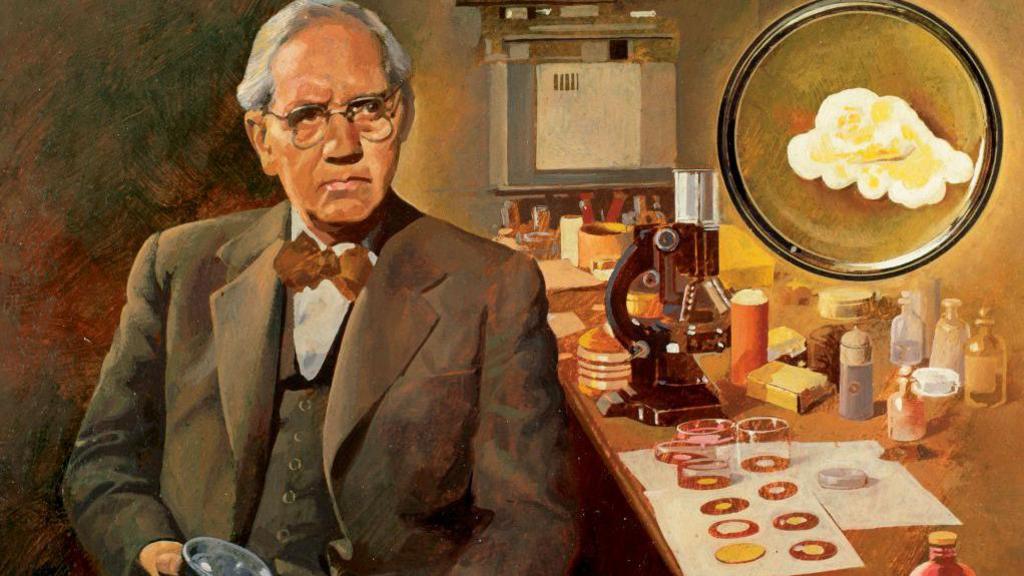
Sir Alexander Fleming (6 August 1881 to 11 March 1955) was a Scottish physician and microbiologist who shared the 1945 Nobel Prize in Physiology or Medicine with Howard Florey and Ernst Chain for the discovery of penicillin and its curative effect in various infectious diseases. Penicillin was the first antibiotic substance discovered, and his 1928 discovery of what was later named benzylpenicillin from the mould Penicillium rubens has been described as the single greatest victory ever achieved over disease. This biography follows his life, his discovery and his warning about antibiotic resistance.
Alexander Fleming at a Glance
| Full name | Sir Alexander Fleming |
| Born | 6 August 1881, Lochfield farm near Darvel, Ayrshire, Scotland |
| Died | 11 March 1955, London (aged 73) |
| Profession | Physician and microbiologist |
| Known for | Discovery of penicillin (1928) and of the enzyme lysozyme (1922) |
| Nobel Prize | Physiology or Medicine, 1945, shared with Howard Florey and Ernst Chain |
| Knighted | 1944 |
| Wives | Sarah Marion McElroy (married 1915) and Amalia Koutsouri-Vourekas (married 1953) |
| Son | Robert Fleming (1924 to 2015) |
Early Life in Ayrshire
Alexander Fleming was born on 6 August 1881 at Lochfield farm near Darvel in Ayrshire, Scotland. He was the third of four children of the farmer Hugh Fleming and Grace Stirling Morton, the daughter of a neighbouring farmer. Hugh had four surviving children from an earlier marriage; he was 59 when he married Grace and died when Alexander was seven. Fleming attended Loudoun Moor School and Darvel School and won a two-year scholarship to Kilmarnock Academy before moving to London, where he attended the Royal Polytechnic Institution.
After working in a shipping office for four years, the 20-year-old Fleming inherited some money from an uncle. His elder brother Tom was already a physician and suggested that Alexander follow the same career. In 1901 he enrolled at St Mary's Hospital Medical School in Paddington, and in 1906 he qualified with an MBBS degree with distinction. He had been a private in the London Scottish Regiment of the Volunteer Force from 1900 to 1914 and a member of the medical school's rifle club, and it was the captain of the club, wishing to keep him in the team, who suggested that he join the research department at St Mary's. There he became assistant bacteriologist to Sir Almroth Wright, a pioneer of vaccine therapy and immunology. In 1908 he gained a BSc degree with gold medal in bacteriology.
The First World War
Commissioned as a lieutenant in 1914 and promoted to captain in 1917, Fleming served throughout the First World War in the Royal Army Medical Corps and was mentioned in dispatches. He and his colleagues worked in battlefield hospitals on the Western Front in France, and he witnessed the death of many soldiers from sepsis caused by infected wounds. He observed that the antiseptics used to treat such wounds often made the injuries worse. In a 1917 article in The Lancet he described an experiment, made possible by his own glassblowing skills, that explained why antiseptics were killing more soldiers than infection itself: they worked on the surface but did not reach bacteria sheltering deep in wounds, and they appeared to remove protective agents produced by the body. Wright supported his findings, but most army physicians continued to use antiseptics.
The Discovery of Lysozyme
After the war Fleming returned to St Mary's in 1918 and was elected Professor of Bacteriology of the University of London in 1928. His colleague V. D. Allison recalled that Fleming was not a tidy researcher, and that his untidiness helped to explain his success. In late 1921, while maintaining agar plates for bacteria, Fleming found that adding nasal mucus inhibited bacterial growth. He tested tears contributed by co-workers, and found that the bactericidal agent was present in many body fluids. He named the substance lysozyme. The substance was the first antimicrobial protein found to be part of the body's innate immunity, although its importance was not recognised for decades. Fleming reported the discovery to the Medical Research Club and to the Royal Society, where it attracted little attention. In his Nobel lecture he later said: "Penicillin was not the first antibiotic I happened to discover."
The Discovery of Penicillin
On 3 September 1928, Fleming returned to his laboratory after a family holiday in Suffolk. Before leaving he had inoculated culture plates with staphylococci and left them on a bench. On his return he noticed that one culture was contaminated with a fungus, and that the colonies of staphylococci immediately surrounding the fungus had been destroyed while those farther away were normal. He famously remarked, "That's funny." He identified the mould as being from the genus Penicillium, which was later resolved as Penicillium rubens, and he named the active substance penicillin. He later recalled that he had not planned to revolutionise all medicine by discovering the world's first antibiotic, but that this was what he did.
Fleming published the discovery in 1929 in the British Journal of Experimental Pathology, but little attention was paid to it. The difficulty was producing penicillin in large amounts and isolating the main compound, and chemical purification proved futile even with the help of biochemists at the London School of Hygiene and Tropical Medicine. Penicillin languished largely forgotten in the 1930s, and when Fleming talked about its medical importance at the Second International Congress of Microbiology in London in 1936, few believed him.
Florey, Chain and Mass Production
At Oxford, Ernst Chain and Edward Abraham were studying the molecular structure of the antibiotic, and Howard Florey headed their department. Norman Heatley suggested transferring the active ingredient back into water by changing its acidity, which produced enough of the drug to begin testing on animals. After the Oxford team developed a method of purifying penicillin to a first stable form in 1940, several clinical trials followed, and their success inspired the team to develop methods for mass production. Fleming was modest about his part. He called his fame the "Fleming Myth" and praised Florey and Chain for turning a laboratory curiosity into a practical drug. The scientist Sir Henry Harris summed up the process: without Fleming, no Chain; without Chain, no Florey; without Florey, no Heatley; without Heatley, no penicillin.
In August 1942, Harry Lambert, an associate of Fleming's brother Robert, was admitted to St Mary's Hospital with a life-threatening streptococcal meningitis. Fleming found that his penicillin could kill the bacteria and, at his request, Florey sent a sample, which Fleming administered into Lambert's spinal canal. Lambert showed signs of improvement the next day and recovered completely within a week. The case convinced the British government of the importance of penicillin, and a Penicillin Committee was created on 5 April 1943. By D-Day in 1944, enough penicillin had been produced to treat all the wounded of the Allied troops.
A Warning About Resistance
Fleming discovered very early that bacteria developed antibiotic resistance whenever too little penicillin was used or when it was used for too short a period. On 26 June 1945 he warned that "the microbes are educated to resist penicillin" and that a "thoughtless person playing with penicillin is morally responsible for the death of the man who finally succumbs to infection with the penicillin-resistant organism." In his Nobel lecture he said the time might come when penicillin could be bought by anyone in the shops, and that an ignorant man could underdose himself and make his microbes resistant. His warning is regarded as prophetic, because antibiotic resistance is now one of the major challenges in medicine.
Honours and Family
Fleming was knighted for his scientific achievements in 1944 and shared the Nobel Prize in Physiology or Medicine in 1945. In 1999 Time magazine named him in its list of the 100 most important people of the 20th century, and in 2002 he was included in the BBC's poll of the 100 Greatest Britons. When he learned in 1944 that two Americans had patented a method of penicillin production, he was furious and said: "I found penicillin and have given it free for the benefit of humanity. Why should it become a profit-making monopoly of manufacturers in another country?"
On 24 December 1915 Fleming married a trained nurse, Sarah Marion McElroy of Killala, County Mayo, Ireland. Their only child, Robert Fleming, who lived from 1924 to 2015, became a general medical practitioner. After his first wife's death in 1949, Fleming married Amalia Koutsouri-Vourekas, a Greek colleague at St Mary's, on 9 April 1953; she died in 1986. From 1921 until his death he owned a country home named The Dhoon in Barton Mills, Suffolk.
Death and Legacy
Fleming died of a heart attack at his home in London on 11 March 1955, and his ashes are buried in St Paul's Cathedral. The laboratory at St Mary's Hospital where he found penicillin is now home to the Fleming Museum, and Imperial College London opened the Sir Alexander Fleming Building in 1998. Penicillin has saved millions of lives, and its discovery marks the start of modern antibiotics. His story also remains a reminder that scientific progress depends on curiosity, collaboration and the willingness to notice when something looks funny.