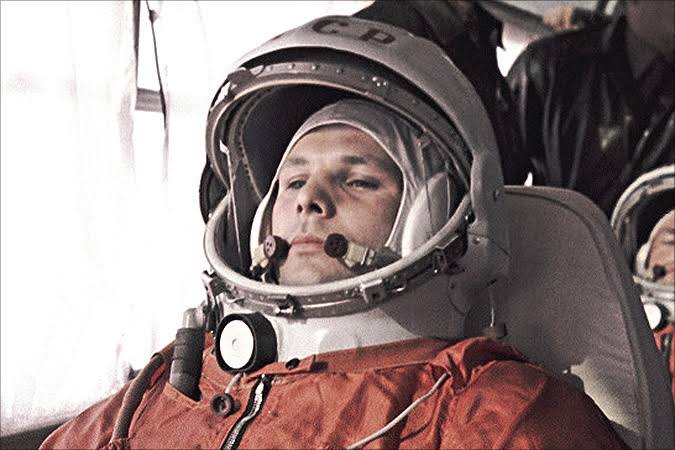
Yuri Gagarin (9 March 1934 to 27 March 1968) was a Soviet pilot and cosmonaut who became the first person to journey into outer space. Travelling on Vostok 1, he completed one orbit of Earth on 12 April 1961, a flight that lasted 108 minutes. The achievement, at the height of the Space Race, made him an international celebrity and earned him his country's highest distinction, Hero of the Soviet Union. This biography follows his life, flight and death.
Yuri Gagarin at a Glance
| Full name | Yuri Alekseyevich Gagarin |
| Born | 9 March 1934, Klushino, Russian SFSR, Soviet Union |
| Died | 27 March 1968, near Kirzhach, Soviet Union (aged 34) |
| Profession | Soviet Air Forces pilot and cosmonaut |
| Famous mission | Vostok 1, 12 April 1961, call sign Kedr |
| Spouse | Valentina Goryacheva (married 1957) |
| Children | Yelena (born 1959) and Galina (born 1961) |
| Honours | Hero of the Soviet Union, Order of Lenin, Tsiolkovsky Gold Medal |
Early Life and Family
Gagarin was born on 9 March 1934 in the village of Klushino, near Gzhatsk, which was renamed Gagarin in 1968 after his death. His parents worked on a state farm: Aleksey Ivanovich Gagarin was a carpenter and Anna Timofeyevna Gagarina a dairy farmer. Yuri was the third of four children, with an elder brother Valentin, a sister Zoya and a younger brother Boris.
Like millions of Soviet citizens his family suffered during the German occupation in the Second World War. The Germans captured Klushino on 18 October 1941 and burned down the school, ending Yuri's first year of education. A Nazi officer took over the family home, and the Gagarins spent 21 months in a mud hut of about 3 by 3 metres on the land behind it. In early 1943 his two elder siblings were deported to Poland for slave labour; they escaped and returned home only in 1945.
Education and Early Career
In 1946 the family moved to Gzhatsk, where Gagarin studied in a crude school and built model aeroplanes with other children. In 1950, aged 16, he began an apprenticeship as a foundryman at a steel plant in Lyubertsy near Moscow and graduated with honours in 1951 in mouldmaking and foundry work. He was then selected for the Industrial Technical School in Saratov, where he studied tractors and volunteered at a local flying club, training on a biplane and then the Yakovlev Yak-18. He also earned money as a part-time dock labourer on the Volga.
Air Force Service
In 1955 he was accepted to the First Chkalov Higher Air Force Pilots School in Orenburg and trained on the MiG-15. He twice struggled to land and risked dismissal until his instructor gave him a cushion to improve his view from the cockpit. On 5 November 1957 he was commissioned a lieutenant with 166 hours and 47 minutes of flight time, and he was posted to the Luostari Air Base near the Norwegian border. After the launch of Luna 3 in October 1959 he expressed an interest in space exploration, and he was promoted to senior lieutenant on 6 November 1959.
Selection as a Cosmonaut
From 154 qualified pilots, military doctors chose 29 cosmonaut candidates, and the first twelve, including Gagarin, were approved on 7 March 1960. Chief engineer Sergei Korolev said candidates had to be under 72 kg and no taller than 1.70 metres, and Gagarin was 1.57 metres tall. When the candidates were asked to vote anonymously for who they would like to be first, all but three chose Gagarin. He was placed in the accelerated "Vanguard Six" group on 30 May 1960. A doctor described him in August 1960 as "modest", with a "fantastic memory" and quick reactions. His training included parachute jumps, centrifuge tests, an isolation chamber from 26 July to 5 August 1960 and oxygen-starvation exercises. On 8 April 1961 the State Commission formally approved him as the primary pilot, with Gherman Titov as backup.
Vostok 1: 12 April 1961
On 12 April 1961, at 6:07 am UTC, Vostok 1 launched from the Baikonur Cosmodrome. Korolev told him, "We wish you a good flight," and Gagarin replied, "Off we go! Goodbye, until we meet soon, dear friends." His word "Poyekhali!" (Off we go!) became a popular expression of the dawn of the Space Age. The spacecraft orbited for 108 minutes before returning to Earth in Kazakhstan. About 7,000 metres up he ejected from the capsule as planned and landed by parachute, which led to a dispute: the world governing body for air records then required pilots to land with their craft, and the Soviets initially did not admit he had not. The records were nonetheless certified and the rules revised.
Fame
Gagarin became a national hero and a worldwide celebrity. A long motorcade took him to the Kremlin, where Nikita Khrushchev awarded him Hero of the Soviet Union. On 14 April a 12-mile parade attended by millions ended in Red Square, and he also received the Order of Lenin. In 1962 he became a deputy to the Soviet of the Union and was later elected to the Soviet of Nationalities. He became Deputy Training Director of the cosmonaut training facility on 20 December 1963. Soviet officials, including Nikolai Kamanin, tried to keep him from flying again, noting he was "too dear to mankind to risk his life".
Personal Life
Gagarin met Valentina Goryacheva, a medical technician, at the May Day celebrations in Moscow in 1957, and they married on 7 November of that year, the day he graduated from flight school. They had two daughters: Yelena, born in 1959, an art historian who has directed the Moscow Kremlin Museums since 2001, and Galina, born in 1961, a professor of economics. In his youth he was a keen sportsman who played ice hockey as a goalkeeper and coached a basketball team.
Death
Gagarin served as backup for Soyuz 1, whose crash killed his friend Vladimir Komarov. After completing his studies at the Zhukovsky Air Force Engineering Academy in February 1968 he was allowed to fly again. On 27 March 1968, during a routine training flight from Chkalovsky air base, he and instructor Vladimir Seryogin died when their MiG-15UTI crashed near Kirzhach. Their ashes were interred in the Kremlin wall. The cause has been the subject of speculation, and a KGB report declassified in March 2003 said the actions of airbase personnel contributed, including outdated weather information given to the pilots and external fuel tanks left on the aircraft.
Legacy
Gagarin's single orbit opened the age of human spaceflight. The cosmonaut training centre was later named after him, and his phrase "Poyekhali!" still marks the start of space missions in the former Eastern Bloc. A widely repeated line that he said "I don't see any god up here" does not appear in the record of his flight communications, according to a friend, who said it came from a speech by Khrushchev. What is documented is the achievement itself: 108 minutes that changed what humanity could attempt.