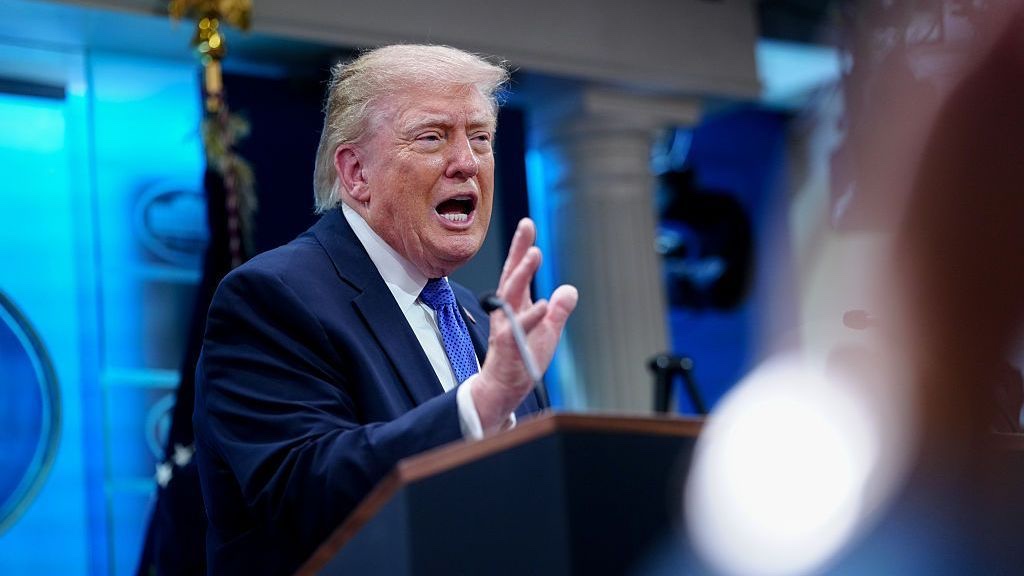
US President Donald Trump has said he will ban American companies from building artificial intelligence data centres overseas, threatening a "tremendous tax" for tech firms that do so. Speaking to reporters in a press briefing after returning from his trip to Asia, he said: "We're going to keep it all in this country." The comments, reported by the BBC on Friday, 20 November 2026, came with very little detail on how such a policy would work, and Mr. Trump acknowledged that members of his own cabinet were hearing about it for the first time.
"We're not going to allow our companies to build data centres outside of our country," he said. "Because China will take all of them, and we're not allowing that to happen." He added: "I don't know if that's a breaking story, but I haven't even said that to my people. But I'm telling them now, they're here." It remains unclear whether the idea will become formal policy, and it is also unclear how it would be enforced if it did. The BBC noted that tech giants including Meta and Google have already entered agreements to build data centres overseas.
Mr. Trump raised the idea after saying that the United States was leading on data centre construction and that he would not allow China to beat the US when it came to AI, which he calls "super intelligence", or SI. His remarks follow an announcement earlier in the week that would restrict the export of advanced computer chips and who can access the computing power provided by them. On Monday, Washington said firms would need a licence to buy advanced chips, so that US officials can monitor whether they are being used to serve Chinese companies or being smuggled into China. The measure will affect South East Asian countries that have invested heavily in data centres, as Chinese companies seek to rent computing power from overseas.
Data centres are crucial to the AI boom. These vast, warehouse-style buildings house the advanced chips and servers that are needed to run AI programmes such as Claude and ChatGPT. As of April, there were about 3,000 data centres across the US, with another 1,500 in various stages of approval and construction, according to the Pew Research Centre. Many are built in rural areas, and concerns about noise pollution and energy consumption have fuelled opposition. Data centres were a central issue in the midterm elections earlier in November, with many Democratic candidates promising tougher regulation on their construction, and several of them won on 3 November.
At the same press briefing, Mr. Trump struck a more welcoming tone towards data centres at home. "You ought to take advantage of the data centres," he said. "Make them pay you, make them pay your community, but take advantage, don't shut them off." He added: "We have a lot of places that want them badly, and they're great places. They have energy and they have everything. They're tremendous assets." The message is therefore twofold: build more at home, and do not build them abroad, particularly in places that could benefit China.
The foreign dimension is already a live issue. Large technology firms, often called AI hyperscalers because of the size of their investments in AI, have been branching out into other countries, and Canada has moved to offer itself as an alternative location with less local pushback so far. Meta has already broken ground on a data centre in the province of Alberta, and Anthropic has signed a long-term agreement to lease a proposed data centre in Nova Scotia. The BBC reported that it had reached out to Meta for comment on Mr. Trump's remarks, and no company response was included in its report.
Europe is also part of the picture. In September, Google announced a 13bn ($15bn; £11bn) investment in AI infrastructure in Finland, including funding for three data centres. Last month, building work for two of those centres was halted because of concerns over the clearance of more than 300 hectares of forest. Mr. Trump specifically called out the Finland project, saying his administration was "not allowing that to happen". The mention suggests that the president is aware of individual projects and sees them as part of the competition with China, although it is not clear what legal tools he would use to stop them.
The idea raises several practical questions. One is how a ban could be enforced on companies that operate globally and sign contracts with foreign partners. Another is what a "tremendous tax" would look like, and whether Congress would need to approve it. A third is the effect on allies: countries that have courted US tech investment, from Canada to Finland, would be affected, and trade partners could respond. The BBC's report stresses that it remains unclear how any such policy would be brought in, and the president's own remarks that his team was only now being told indicate that the proposal is at an early stage.
There is also a political context. With data centres having become a contested issue in US communities, the idea of keeping them at home might appeal to some voters who want the jobs and tax revenues, but it might also antagonise those who object to the noise, land use and electricity demand. Mr. Trump's comment that communities should "make them pay" suggests that he sees data centres as a bargaining chip for local governments. At the same time, his threat of a tax on overseas construction would put pressure on companies that have been looking abroad precisely because of difficulties at home.
For the technology industry, the uncertainty is a problem. Building data centres takes years of planning and billions of dollars, and companies need clarity about the rules before committing. A sudden policy shift could strand investments or force companies to change their plans, and it might also slow the global spread of AI services that depend on local computing capacity. On the other hand, supporters of tougher control argue that keeping advanced computing power under US oversight reduces the risk of it being used by rivals, and the licensing regime for chips shows that the administration is moving in that direction.
For other countries, the message is mixed. Nations that have invested heavily in data centre infrastructure, especially in South East Asia, are already being affected by the licensing rules, and a ban on US-built facilities overseas would add to their concerns. Those that have offered themselves as alternatives, such as Canada, may find that the opportunity is uncertain. Governments will want to know whether the president's remarks translate into an executive order or legislation, and companies will be watching for details.
At this stage, the statement is best understood as a signal of intent rather than a settled policy. Mr. Trump said his people were "here" and that he was telling them now, which suggests that officials will be asked to work out the details in the coming days or weeks. Whether that leads to a formal measure, a tax proposal or simply a statement that fades will depend on the reaction of industry, Congress and allies. For now, the world's biggest technology companies have a new factor to weigh in deciding where to put the machines that power the AI boom.