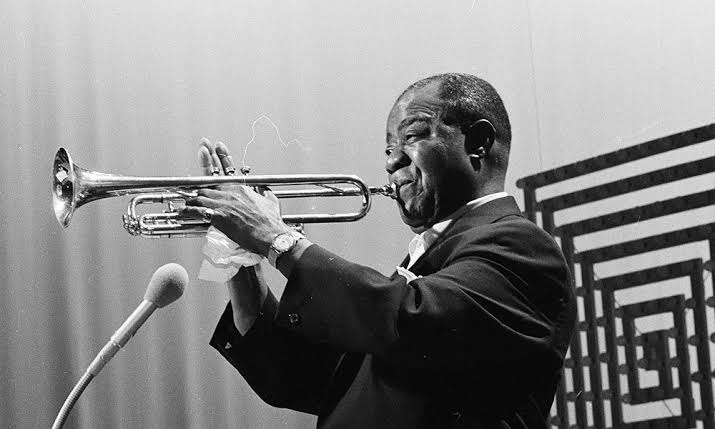
Louis Armstrong (Louis Daniel Armstrong, 4 August 1901 to 6 July 1971), nicknamed "Satchmo", "Satch" and "Pops", was an American jazz and blues trumpeter and vocalist. Among the most influential figures in jazz, his career spanned five decades and several eras in the history of the genre. Born and raised in New Orleans, he came to prominence in the 1920s as an inventive trumpet and cornet player, and by the 1950s he was an international musical icon. This biography follows his life and music.
Louis Armstrong at a Glance
| Full name | Louis Daniel Armstrong |
| Born | 4 August 1901 (believed), New Orleans, Louisiana, United States |
| Died | 6 July 1971 (aged 69) |
| Nicknames | Satchmo, Satch and Pops |
| Profession | Jazz trumpeter, singer and entertainer |
| Best-known songs | What a Wonderful World, Hello, Dolly!, La Vie en rose, On the Sunny Side of the Street, When the Saints Go Marching In |
| Awards | Grammy Award for Best Male Vocal Performance (1965), Grammy Lifetime Achievement Award (1972) |
| Mentor | Joe "King" Oliver |
Early Life in New Orleans
Armstrong is believed to have been born in New Orleans on 4 August 1901, but the accuracy of this date has been heavily debated, and he himself often claimed to have been born on 4 July 1900. His parents were Mary Estelle "Mayann" Albert and William Armstrong, and his mother gave birth at home when she was around 16. A daughter, Beatrice, nicknamed "Mama Lucy", followed less than a year and a half later, and his father abandoned the family shortly afterwards. Armstrong was raised by his grandmother until the age of five, when he was returned to his mother, and he spent his youth in poverty in a rough neighbourhood known as the Battlefield. At six he started attending the Fisk School for Boys, a school that accepted Black children in the racially segregated school system of New Orleans.
The Karnoffsky Family
He worked for the Karnoffskys, a family of Lithuanian Jews, at their home, helping their sons collect "rags and bones" and deliver coal. In 1969, while recovering at Beth Israel Hospital in New York, he wrote a memoir about the family, in which he said that they taught him "how to live, real life and determination" and credited them with teaching him to sing "from the heart". His first musical performance may have been at the side of the Karnoffskys' junk wagon, where he played a tin horn to attract customers, and Morris Karnoffsky gave him an advance towards buying a cornet from a pawn shop. As an adult he wore a Star of David given to him by his manager, Joe Glaser, until the end of his life, in part in memory of this family.
Waif's Home and First Instruments
When Armstrong was 11 he dropped out of school and joined a quartet of boys who sang in the streets for money. On 31 December 1912 he borrowed his stepfather's gun without permission and fired a blank into the air, and he was arrested and sentenced the next day to detention at the Colored Waif's Home, where life was spartan. The cornetist Bunk Johnson said he taught the eleven-year-old to play by ear, though in his later years Armstrong credited King Oliver.
Chicago, New York and the 1920s
Lil Hardin, whom Armstrong married in 1924, urged him to seek more prominent billing and to develop his style apart from the influence of Oliver. Around 1922 Armstrong followed his mentor, Joe "King" Oliver, to Chicago to play in Oliver's Creole Jazz Band. He earned a reputation at "cutting contests", and his fame reached the bandleader Fletcher Henderson, which took him to New York City, where he became a featured and musically influential band soloist and recording artist. He was a foundational influence in jazz, shifting the focus of the music from collective improvisation to solo performance. In 1925 he returned to Chicago, disillusioned with New York, and led the Hot Five recordings. His 1928 "Weather Bird" duet with the pianist Earl "Fatha" Hines, and his trumpet introduction and solo in "West End Blues", remain some of the most influential improvisations in jazz history, and young trumpet players across the country bought the records and memorised his solos.
Singer and Entertainer
Armstrong was an influential singer as well, with an instantly recognisable, rich, gravelly voice, and he was skilled at scat singing. He collaborated with Ella Fitzgerald on three records, Ella and Louis (1956), Ella and Louis Again (1957) and Porgy and Bess (1959). He appeared in films including A Rhapsody in Black and Blue (1932), Cabin in the Sky (1943), High Society (1956), Paris Blues (1961), A Man Called Adam (1966) and Hello, Dolly! (1969). Beyond his music he was beloved as an entertainer, often joking with the audience and keeping a joyful public image at all times.
Crossover Success and Civil Rights
After years on the road, Armstrong settled permanently in Queens, New York, in 1943 with his fourth wife, Lucille. In the week beginning 9 May 1964, his recording of "Hello, Dolly!" went to number one, and an album of the same title shot to number one as well, knocking The Beatles off the top of the chart. He was one of the first popular African American entertainers to "cross over" to wide popularity with white and international audiences, and he could reach the upper echelons of American society at a time when this was difficult for Black men. He rarely discussed racial issues publicly, sometimes to the dismay of fellow Black Americans, but he took a well-publicised stand for desegregation during the Little Rock Crisis.
Honours
Armstrong won the Grammy Award for Best Male Vocal Performance for "Hello, Dolly!" in 1965 and a posthumous Grammy Lifetime Achievement Award in 1972. He was inducted into the DownBeat Jazz Hall of Fame, the Rock and Roll Hall of Fame and the National Rhythm and Blues Hall of Fame. His recording of "Melancholy Blues" is included on the Voyager Golden Record, a sample of the sights and sounds of Earth sent into space.
Death and Legacy
Armstrong died of a heart attack in his sleep on 6 July 1971, while hoping to get back on the road. He was living in Corona, Queens, New York City, and was buried in Flushing Cemetery in Queens. By the end of his life his influence had spread to popular music, and he remains a towering figure in the history of jazz, a musician who changed the way the trumpet was played and the way songs were sung.