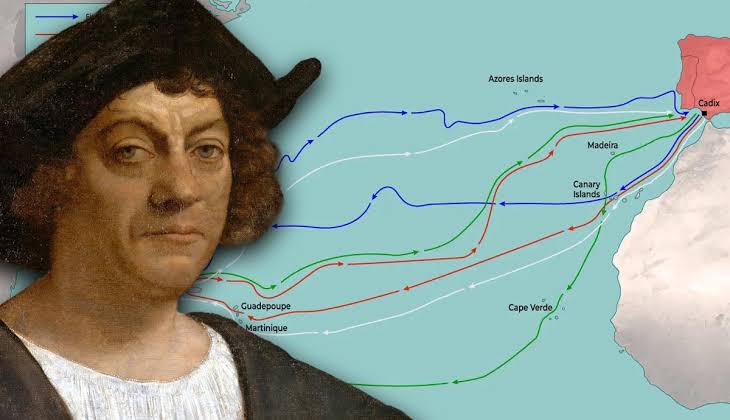
Between 1492 and 1504 the Italian explorer and navigator Christopher Columbus led four transatlantic maritime expeditions to the Americas in the name of the Catholic Monarchs of Spain. The voyages led to Europeans learning about the New World and were an early breakthrough in what is known in Europe as the Age of Exploration, which saw the colonisation of the Americas, a related biological exchange and the beginning of transatlantic trade. These events, whose effects and consequences persist to the present, are often cited as the beginning of the modern era. They are also among the most contested events in history, because the same voyages that Europeans celebrated as discovery began the Spanish conquest of the Americas, which were already inhabited by Indigenous peoples.
Why Columbus Sailed West
Born in the Republic of Genoa, Columbus was a navigator who sailed in search of a westward route to India, China, Japan and the Spice Islands, thought to be the East Asian source of spices and other precious goods that were otherwise obtainable only through arduous overland routes. He was partly inspired by the thirteenth-century Italian explorer Marco Polo. His initial belief that he had reached "the Indies" explains why the Bahamas and the other islands of the Caribbean came to be called the "West Indies". Until the middle of the fifteenth century Europe had enjoyed a safe land passage to China and India under the hegemony of the Mongol Empire, the Pax Mongolica. With the fall of Constantinople to the Ottoman Empire in 1453, European countries sought to compete with the Silk Road, now dominated by what historians call the gunpowder empires, by making more use of ocean voyages to establish new trade routes.
Portugal, Castile and the Catholic Monarchs
Portugal was the main European power interested in overseas trade routes, while its neighbour, the kingdom of Castile, was slower to begin exploring the Atlantic because of the land it had to reconquer from the Moors in the Reconquista. That changed in the late fifteenth century, after the dynastic union by marriage of Queen Isabella I of Castile and King Ferdinand II of Aragon, together known as the Catholic Monarchs of Spain, in 1469, and the completion of the Reconquista in 1492, when the joint rulers conquered the Moorish kingdom of Granada. The fledgling Spanish empire decided to fund Columbus's expedition in the hope of finding new trade routes and of getting around the lock that Portugal had secured on Africa and the Indian Ocean with the 1481 papal bull Aeterni regis.
The Plan
By the 1480s Christopher and his brother Bartholomew had developed a plan to reach the Indies, then understood as roughly all of southern and eastern Asia, by sailing directly west across what was believed to be the single "Ocean Sea", the Atlantic. About 1481 the Florentine cosmographer Paolo dal Pozzo Toscanelli sent Columbus a map showing such a route, with no landmass in between other than the mythical island of Antillia. In 1484, on the island of La Gomera in the Canaries, Columbus heard from some inhabitants of El Hierro that there was supposed to be a group of islands to the west.
The Flat-Earth Myth
A popular misconception holds that Columbus had difficulty winning support for his plan because Europeans thought the Earth was flat. The belief can be traced to a seventeenth-century campaign by Protestants against Catholicism, and it was popularised in works such as Washington Irving's 1828 biography of Columbus. In fact the knowledge that the Earth is spherical was widespread, having been the general opinion of ancient Greek science and gaining support throughout the Middle Ages, and writers such as Bede mention it in The Reckoning of Time.
The First Voyage
Columbus and his crew took three medium-sized ships, the largest of which was a carrack, the Santa Maria, which was owned and captained by Juan de la Cosa and was under Columbus's direct command. The other two were smaller caravels, the Pinta and the Nina, piloted by the Pinzon brothers, Martin Alonso and Vicente Yanez. On the morning of 3 August 1492 the expedition left the Port of Palos, going down the Rio Tinto and into the Atlantic, and three days later the rudder of the Pinta broke.
The Pinta's rudder was secured with ropes until the fleet reached the Canary Islands on 9 August, where it was replaced on Gran Canaria. By 2 September the ships had met at La Gomera, where the Nina's lateen sails were re-rigged as standard square sails, and on 6 September they set out on what turned out to be a five-week voyage westward across the Atlantic. On 13 September Columbus observed that the needle of his compass no longer pointed to the North Star, which was once believed to be his discovery of magnetic declination but was later shown to have been known already, in Europe and in China. After 29 days out of sight of land, on 7 October the crew spotted immense flocks of birds and Columbus changed course to follow their flight. On 10 October he quelled a mutiny by sailors who wanted to abandon the search and return to Spain. At about 10 pm on 11 October Columbus thought he saw a light "like a little wax candle rising and falling", and four hours later land was sighted by a sailor named Rodrigo de Triana aboard the Pinta, whose captain, Martin Alonso Pinzon, verified the sighting and alerted Columbus.
The Second Voyage
The stated purpose of the second voyage, in 1493 to 1496, was to convert the Indigenous Americans to Christianity. The Treaty of Tordesillas, ratified in the next decade by Pope Julius II, moved the line dividing the Spanish and Portuguese spheres of influence to 370 leagues west of the Azores or Cape Verde. As the fleet sailed along the southern coast of Puerto Rico in November 1493, a Taino woman and boy who had volunteered to join them on board in Guadeloupe were among those rescued from the Caribs, according to the account of fleet member Diego Alvarez Chanca.
Four Voyages, Many Consequences
In all, Columbus led four voyages between 1492 and 1504. He died in 1506, and the next year the New World was named "America" after the Italian explorer Amerigo Vespucci, who realised that it was a separate landmass. The search for a westward route to Asia was completed in 1521, when the Magellan expedition sailed across the Pacific Ocean and reached Southeast Asia, before returning to Europe and completing the first circumnavigation of the world.
A Contested Legacy
At the time of the voyages the Americas were inhabited by Indigenous Americans, and Columbus later took part in the beginning of the Spanish conquest. The same voyages that opened a new era of exploration and exchange also began a period of colonisation that had devastating effects on Indigenous societies, and today the figure of Columbus is celebrated by some and criticised by others. Historians agree, though, that 1492 was a turning point in world history, which connected the Eastern and Western hemispheres and set in motion the biological, economic and cultural exchanges that have shaped the modern world.