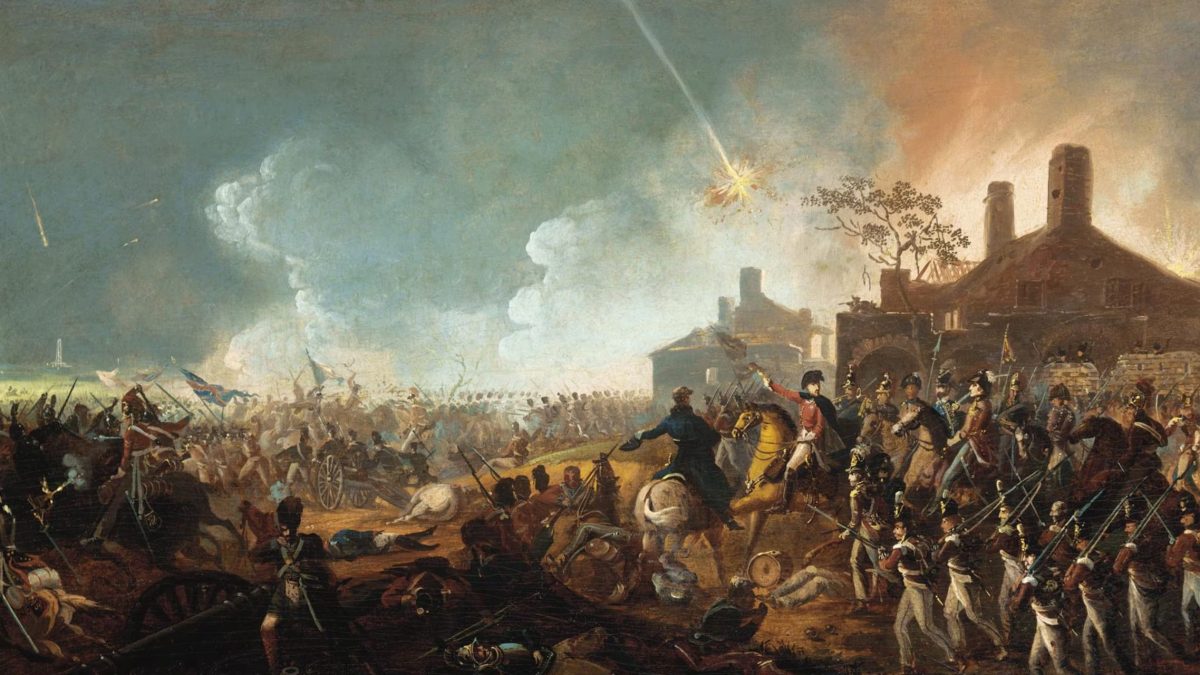
The Battle of Waterloo was fought on Sunday 18 June 1815, near Waterloo, then in the United Kingdom of the Netherlands and now in Belgium. It was the last engagement with Napoleon I. The French Imperial Army under Napoleon was defeated by two armies of the Seventh Coalition: a British-led force, with units from the United Kingdom, the Netherlands, Hanover, Brunswick and Nassau, under Field Marshal Arthur Wellesley, Duke of Wellington, and three corps of the Prussian army under Field Marshal Gebhard Leberecht von Blucher. In France it was known at the time as the Battle of Mont Saint-Jean and in Prussia as La Belle Alliance, "the Beautiful Alliance", after an inn.
The Hundred Days
Napoleon's return to power in March 1815, the beginning of the Hundred Days, led many states that had previously opposed him to form the Seventh Coalition and mobilise their armies in a hurry. On 13 March 1815, six days before Napoleon reached Paris, the powers at the Congress of Vienna declared him an outlaw, and four days later the United Kingdom, Russia, Austria and Prussia mobilised to defeat him. Critically outnumbered, Napoleon knew that his only chance of remaining in power was to attack before the coalition was ready. By June he had raised a total army strength of about 300,000 men, but the force at his disposal at Waterloo was less than a third of that size, although the rank and file were mostly loyal and experienced soldiers.
The Plan: Divide the Allies
Wellington's and Blucher's armies were stationed close to the north-eastern border of France. Napoleon planned to attack them separately, before they could link up and invade France with the other members of the coalition. Had he succeeded in destroying the coalition forces south of Brussels before they were reinforced, he might have been able to drive the British back to the sea and knock Prussia out of the war, which would have bought him time to recruit and train more men before turning against the Austrians and Russians. He also considered that a French victory might cause French-speaking sympathisers in Belgium to launch a friendly revolution, and he knew that many of the coalition troops in Belgium were second-line units of dubious quality and loyalty.
The French Advance
Napoleon divided his army into a left wing under Marshal Ney, a right wing under Marshal Grouchy and a reserve under his own command, close enough to support one another. Crossing the frontier near Charleroi before dawn on 15 June, the French rapidly overran coalition outposts and secured a "central position" between the armies of Wellington and Blucher. He hoped that this would prevent them from combining, and that he could destroy first the Prussian army and then Wellington's. Wellington was not certain until very late on the night of 15 June that the attack at Charleroi was the main French thrust. In the early hours of 16 June, at the Duchess of Richmond's ball in Brussels, he received a dispatch from the Prince of Orange and was shocked by the speed of Napoleon's advance. He ordered his army to concentrate at Quatre Bras, where the Prince of Orange was holding a tenuous position against Ney's left wing. The Dutch officers Prince Bernhard of Saxe-Weimar and General Perponcher, who were better informed about the French advance than other allied commanders, took the initiative to hold the crossroads, and General Constant de Rebecque disobeyed Wellington's orders to march to Nivelles. Had they obeyed, Quatre Bras would probably have fallen to the French, and the campaign might have been very different. Wellington arrived and took command, drove Ney back and secured the crossroads by early evening, but too late to help the Prussians, who had already been defeated at Ligny.
Ligny, Quatre Bras and Wavre
On 16 June Napoleon attacked the bulk of the Prussian army at the Battle of Ligny with his main force, while a small part of the French Imperial Army fought the Battle of Quatre Bras to prevent the Anglo-allied army from reinforcing the Prussians. The Anglo-allied army held its ground at Quatre Bras but could not reinforce the Prussians. On the 17th the Prussians withdrew from Ligny in good order, and Wellington withdrew in parallel with them northward to Waterloo. Napoleon sent a third of his forces to pursue the Prussians, which led to a separate battle with the Prussian rearguard at Wavre on 18 and 19 June and prevented that French force from taking part at Waterloo.
The Battle
When he learned that the Prussian army was able to support him, Wellington decided to offer battle on the Mont-Saint-Jean escarpment across the Brussels road, near the village of Waterloo. There he withstood repeated French attacks throughout the afternoon of 18 June, and was eventually helped by the 50,000 Prussians who arrived progressively, attacked the French flank and inflicted heavy casualties. In front of the ridge there were three positions that could be fortified, including, on the extreme right, the chateau, garden and orchard of Hougoumont, a large and well-built country house that was initially hidden in trees. In the evening Napoleon assaulted the Anglo-allied line with his last reserves, the senior infantry battalions of the Imperial Guard. With the Prussians breaking through on the French right flank, the Anglo-allied army repulsed the Imperial Guard and the French army was routed. Wellington described the battle as "the nearest-run thing you ever saw in your life". It was the second-bloodiest single-day battle of the Napoleonic Wars, after Borodino.
The End of Napoleon
Waterloo was the decisive engagement of the Waterloo campaign and Napoleon's last. He abdicated four days later, and coalition forces entered Paris on 7 July. The defeat marked the end of the Hundred Days and precipitated his second and definitive abdication as Emperor of the French, which ended the First French Empire. Some French garrisons held out, and the last of them, Longwy, capitulated on 13 September 1815. Louis XVIII was restored to the throne of France, and Napoleon was exiled to Saint Helena, where he died in 1821. The Treaty of Paris was signed on 20 November 1815.
A Long Peace
Waterloo set a historical milestone between serial European wars and decades of relative peace, often referred to as the Pax Britannica. In popular culture the phrase "meeting one's Waterloo" has become an expression for experiencing a catastrophic reversal or undoing.
Why It Matters
The battle ended more than two decades of war that had begun with the French Revolution, and it ensured that the settlement reached at the Congress of Vienna would be defended against the return of Napoleon. It also became a symbol: of Wellington's defensive skill, of the importance of the Prussian intervention and of how narrowly a battle can be won. For France it marked the end of the empire and the restoration of the monarchy, and for Europe it opened a long period in which no single power was able to dominate the continent by force.