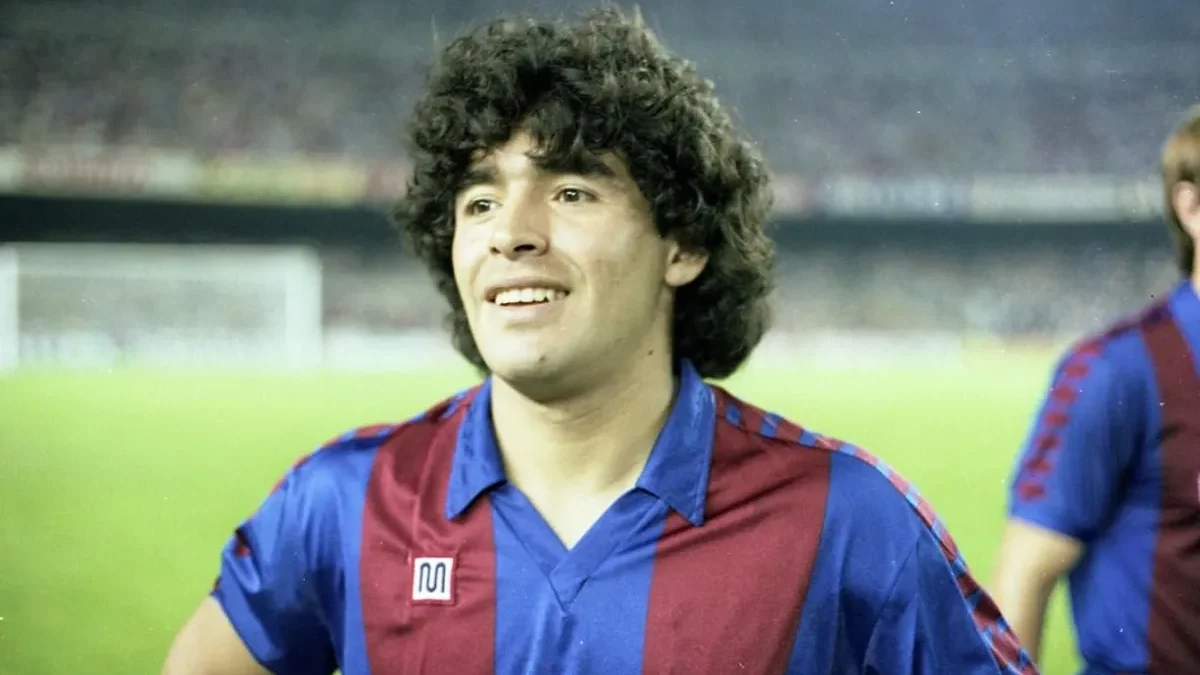
Diego Armando Maradona (30 October 1960 to 25 November 2020) was an Argentine footballer and manager, widely regarded as one of the greatest players of all time. He captained Argentina to victory at the 1986 World Cup, scoring two of the most famous goals in the history of the game against England in the quarter-final, and he led Napoli to the first league titles in the club's history. He died at his home near Buenos Aires at the age of 60. This biography follows his life and career.
Diego Maradona at a Glance
| Full name | Diego Armando Maradona |
| Born | 30 October 1960, Lanus, Buenos Aires Province, Argentina |
| Died | 25 November 2020, Dique Lujan, Buenos Aires Province, Argentina (aged 60) |
| Position | Attacking midfielder and forward |
| Clubs | Argentinos Juniors, Boca Juniors, Barcelona, Napoli, Sevilla, Newell's Old Boys |
| Argentina record | 91 caps and 34 goals |
| Major honours | 1986 FIFA World Cup, two Serie A titles with Napoli, 1989 UEFA Cup |
| Wife | Claudia Villafane (married 1989; divorced 2004) |
| Managerial roles | Argentina (2008 to 2010), Gimnasia y Esgrima La Plata (2019 to 2020) |
Childhood in Villa Fiorito
Maradona was born in the Lanus area of Buenos Aires Province and raised in Villa Fiorito, a poor shantytown in the south of the capital area. He was the fifth of eight children of a working-class family. His talent was clear from an early age, and as a boy he was spotted by a scout and joined the youth teams of Argentinos Juniors, the club with which he would make his professional debut in October 1976, just days before his sixteenth birthday. He later said that the family's poverty helped to shape the competitive streak in his play.
Argentinos Juniors, Boca Juniors and Barcelona
After five years at Argentinos Juniors, Maradona moved to Boca Juniors in 1981 and won the Argentine league title. He had already shown his promise at youth level, leading Argentina to the 1979 FIFA World Youth Championship. In 1982 he joined Barcelona for a then world-record fee of 5 million pounds. His first season was disrupted in December 1982 when he was diagnosed with hepatitis B, which kept him out for nearly three months, and in September 1983 a tackle by Andoni Goikoetxea of Athletic Bilbao broke his left ankle and sidelined him for four months. He won the Copa del Rey and the Copa de la Liga in 1983, but he left Spain in 1984.
Napoli: The Years of Glory
In 1984 Maradona signed for Napoli, then a club with little recent success, and became the leader of a team that transformed the city's footballing fortunes. He broke his own world transfer record to join the club. Under his captaincy Napoli won their first two Serie A titles, in 1986 to 1987 and 1989 to 1990, together with the Coppa Italia in 1987, the 1988 to 1989 UEFA Cup and the Supercoppa Italiana in 1990. Napoli presented him in front of 75,000 spectators at the Stadio San Paolo on 5 July 1984, and local fans saw him as a saviour. After the title was won in 1986 to 1987, the celebrations in Naples were described as a round-the-clock carnival that ran for over a week, murals of him were painted on the city's ancient buildings and newborn children were named after him. He remains a revered figure in Naples, where murals honour him and the stadium has been renamed after him. He later faced backlash from some local fans after the 1990 World Cup, when Argentina beat Italy in a semi-final at the San Paolo.
The 1986 World Cup
Maradona's greatest moment came at the 1986 World Cup in Mexico, where he captained Argentina to the title. In the quarter-final against England on 22 June 1986 he scored twice within four minutes. The first, in which he punched the ball past the goalkeeper Peter Shilton, became known as the "Hand of God", a phrase he used himself afterwards. The second, in which he ran with the ball from his own half past five England players, was voted the Goal of the Century by FIFA. In the semi-final he scored both goals in the win over Belgium, and in the final he set up Jorge Burruchaga's winning goal. Maradona finished the tournament with five goals and five assists, and Argentina went on to beat West Germany 3-2 in the final in Mexico City. Maradona also led his country to the 1990 World Cup final, in Italy, which they lost to West Germany.
Controversy, Bans and Expulsion
Maradona's career was marked by problems off the field. He had a long struggle with drug addiction, and in 1991 he was banned from football for 15 months after testing positive for cocaine. At the 1994 World Cup in the United States he scored against Greece but was sent home after failing a drug test for ephedrine. He later played for Sevilla and Newell.s Old Boys before returning to Boca Juniors, where he retired in 1997. He also suffered from obesity, at one point weighing 130 kg, and he underwent gastric bypass surgery in Cartagena, Colombia, on 6 March 2005.
Family
Maradona married his long-time fiancee Claudia Villafane on 7 November 1989 in Buenos Aires, and the couple had two daughters, Dalma, born in 1987, and Giannina, born in 1989. They divorced in 2004. He later acknowledged a son, Diego Sinagra, who was born in Italy, and he had another son, Diego Fernando, born in 2013.
Management and Later Life
After winning his first three matches as coach, he oversaw a 6-1 defeat to Bolivia, equalling the team's worst ever margin of defeat, and with two qualifiers remaining Argentina were in fifth place before two wins secured qualification. Maradona managed Argentina from 2008 to 2010, including at the 2010 World Cup, where the team lost 4-0 to Germany in the quarter-finals. He also managed clubs in the United Arab Emirates, Mexico and Argentina, ending his managerial career with Gimnasia de La Plata in 2020. He maintained friendly relations with political leaders in Latin America, and he was a fan of Fidel Castro.
Death and Legacy
Maradona suffered cardiac arrest and died in his sleep on 25 November 2020 at his home in Dique Lujan, Buenos Aires Province, weeks after emergency surgery to treat a subdural hematoma in his brain. He was 60. Argentina declared three days of national mourning, and his death prompted a criminal investigation into the medical care he had received. On 4 December 2020 Napoli renamed its home ground the Stadio Diego Armando Maradona. In 2000 he shared FIFA's Player of the Century award with Pelé, after an internet vote. He is remembered for his remarkable dribbling, vision and control of the ball, and for a life that was as controversial as it was brilliant.