The race for next year's FIFA presidential election has entered a decisive phase, with candidates rushing to submit nominations ahead of Wednesday's deadline. Incumbent Gianni Infantino is seeking a fourth term at the head of world football's governing body, but many in the sport oppose his re-election following his now-aborted plan to sell stakes in future World Cups to private investors. Standing against him are three challengers: Philippe Diallo, president of the French Football Federation, Kozo Tashima, a top Japanese football official, and Ramon Vega, a former Switzerland player. The vote will take place at the 77th FIFA Congress on 18 March 2027 in Rabat, Morocco, the first Congress since the 2026 World Cup in North America, which Spain won.
Infantino's case for a new mandate rests on his record and on the support he says he has. He has led FIFA since February 2016, when he succeeded fellow Swiss Sepp Blatter, who resigned in June 2015 and was later banned by FIFA's ethics committee for eight years over a conflict of interest and disloyalty linked to a $2m payment. The 56-year-old administrator believes he has the backing of the "vast, vast majority" of member associations. "I'm just coming back off Tokyo, where the Asian Football Confederation has fully endorsed me. I was in Cape Verde, where all African countries have endorsed me," he told the BBC. Last month the head of Asian football endorsed his bid in a dramatic change of heart, and support across confederations gives him what Al Jazeera describes as a commanding position among FIFA's 211 voting members.
The mechanics favour a candidate with broad geographic support. Each of the 211 member nations holds an equal vote and can back only one candidate. If only two candidates contest an election, a simple majority of more than 50 percent is enough, which means 106 member nations. With more than two candidates, as now, a two-thirds majority is required in the first round, and further rounds are held with the candidate who has the fewest votes eliminated each time until two remain, at which point a simple majority decides. Candidates need the backing of five national associations to stand. In a four-way race, then, the challengers' task is not only to attract votes but to prevent Infantino from reaching a decisive two-thirds before the field narrows.
The opposition is built on grievance over the investor plan. In July, Infantino faced worldwide backlash after an unsuccessful attempt to bring private investors into a proposed FIFA commercial entity that would hold rights linked to competitions including the World Cup. UEFA, CONCACAF and the Asian Football Confederation led the opposition, signing a letter saying football "belongs to no individual". The AFC later did a U-turn and threw its weight behind Infantino, who has since apologised for the failed project. UEFA's member associations account for 55 votes and CONCACAF's for 35, so their resistance could still cause problems, even if it falls short of blocking him.
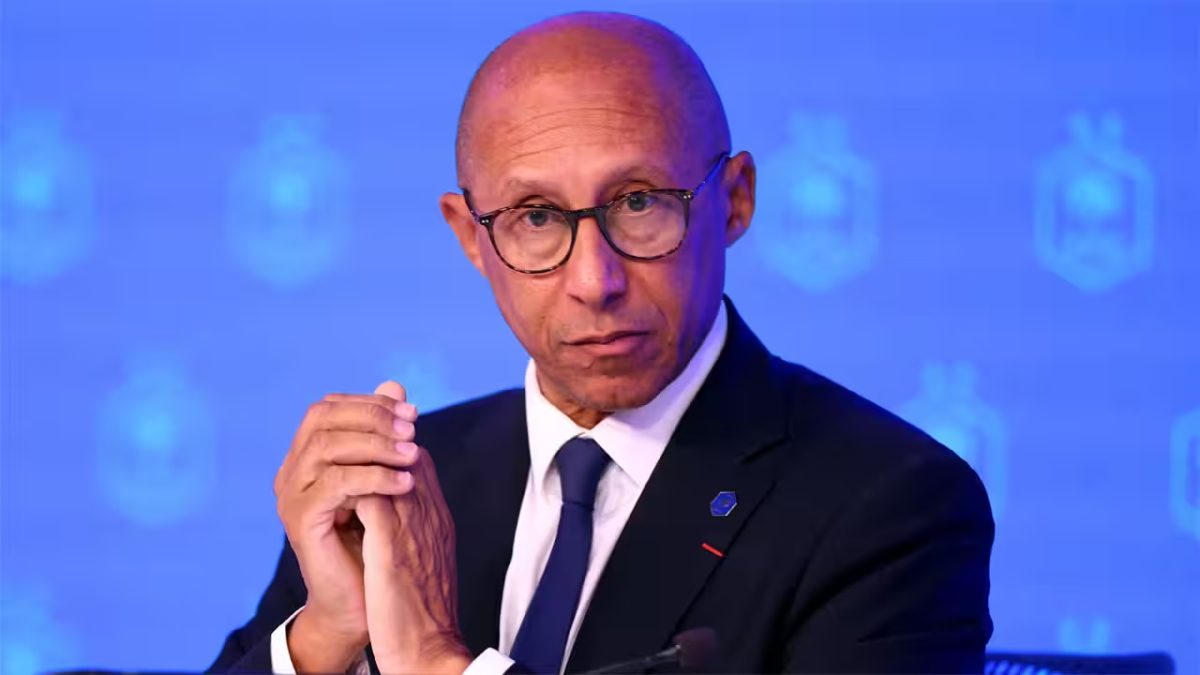
The strongest challenger is Diallo, who has the unanimous backing of European national associations. The 63-year-old, the son of a Senegalese boxing champion, has been president of the French Football Federation since January 2023. But his candidacy reflects Europe's difficulty in finding a champion: UEFA had been struggling to find a credible opponent and named Diallo only two days before the nomination deadline. AFP reported that former Arsenal manager Arsene Wenger, now FIFA's chief of global football development, had been UEFA's "Plan A" and that Diallo had never been seen as a solution until it became clear Wenger would not stand. CONCACAF chief Victor Montagliani had also been mooted, but announced that he wants a new term as head of his own confederation instead.
The other two candidates add colour and symbolism. Tashima, the Japan Football Association's honorary president, is a former Japan international who has served on the FIFA Council since 2015 and became JFA president the following year. His candidacy is the first from Japan in history, and he believes he has a 20 to 30 percent chance of winning. Vega, a former Tottenham Hotspur centre-back, was the first to publicly declare he would challenge fellow Swiss citizen Infantino. Neither is expected to threaten the incumbent's lead on their own, but the presence of four names ensures the first round will not be a simple referendum on Infantino and may split the vote of those who want change.
The most legally interesting question is whether Infantino can stand at all. Miguel Maduro, the former head of FIFA's governance committee, said earlier this month that Article 33, paragraph two of the statutes is clear that no person may serve as president for more than three terms. "Gianni Infantino has been elected three times; he's been president of FIFA for three terms," Maduro told reporters. "So, in my view, there's no way to reconcile another presidency of Infantino." The human rights organisation FairSquare wrote to member associations urging them to declare Infantino ineligible. Infantino's response is that his first spell, when he was elected at an Extraordinary Congress in 2016 after Blatter's resignation, completed an interrupted mandate and should not count. In December 2022 the FIFA Council unanimously confirmed that the period between 2016 and 2019 does not count as a term, although FairSquare says the reasoning was never made public.
That dispute leaves the election open to challenge on process even if the vote is not close. For football's governing body, which has spent a decade trying to rebuild trust after the scandals that ended Blatter's era, the symbolism matters. FIFA has never had a woman as president in its 122-year history; the highest administrative post a woman has held there was secretary-general, filled by Senegalese diplomat and former UN official Fatma Samoura in 2016. A fourth Infantino term would run through 2031, and critics say the combination of term-limit controversy, commercial ambition and an all-male field highlights how little the structure of power has changed.
For the voters, the choice may come down to a pragmatic calculation. Infantino told the BBC that "if we are serious about democracy, about believing that everyone has the same vote and the same voice all over the world," the views of the vast majority must be respected. That argument is persuasive to the many federations in Asia and Africa who have endorsed him, and it fits a system in which small federations count as much as large ones. His opponents, however, say that European and North American dissent shows the strains inside the game's wealthiest regions. Between now and 18 March in Rabat, the question is whether the dissent can be organised into a winning coalition or whether Infantino's lead among the majority of the 211 members proves decisive.