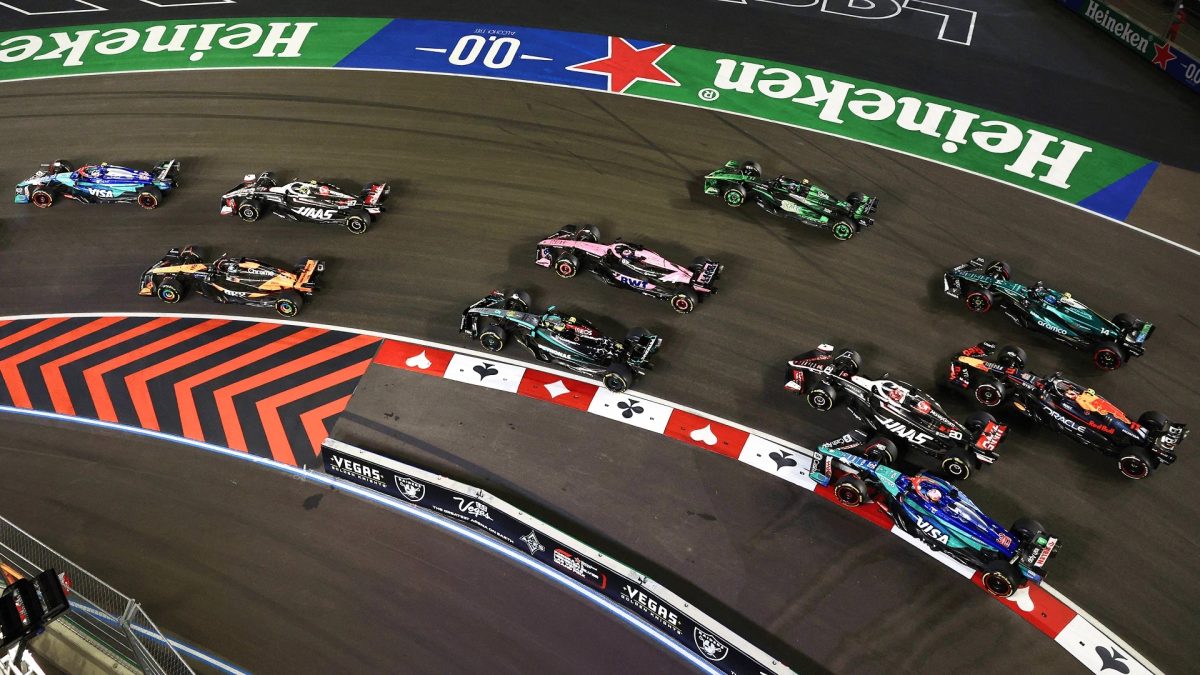
Max Verstappen won an extraordinary Las Vegas Grand Prix on Sunday, 22 November 2026, in a race that featured 34 lead changes in 50 laps and a non-stop battle at the front. The Red Bull driver, who started from pole, was the one constant in a contest that saw the lead swapped between him and the Mercedes drivers George Russell and Kimi Antonelli time and again. In the final laps, the Mercedes challenge unravelled, Russell crashed, and Ferrari drivers Lewis Hamilton and Charles Leclerc collided yet again, leaving Verstappen to take a victory that Lando Norris described as coming at the end of "the most chaotic race ever in the history of Formula 1".
The numbers give a sense of the spectacle. There were 34 overtaking moves for the lead in 50 laps and 352 overtakes overall, according to the BBC. The biggest advantage the leader ever had was 1.5 seconds, and for much of the race the leading group of 10 cars were tied together, with five cars fighting nose to tail for the lead going into the final lap. The BBC's F1 correspondent said it was a grand prix more reminiscent of American oval racing than Formula 1, and that it depended on the unique circumstances of the Las Vegas circuit and the energy-starved hybrid engines used this year.
Verstappen's approach was a mix of racecraft and tactical thinking. Lap after lap, he would lose the lead to Russell on the Strip only to take it back at the last corner, usually by going around the outside. If that did not work, and Russell passed later in the lap or led across the line, Verstappen developed a trademark move around the outside of Turn Three to get back in front. "How many overtakes did I do?" he asked his engineer on the slowing-down lap. "Yeah, and not many of them on the straight," his new engineer Tom Hart replied. The race was punctuated by a mid-race safety car, but through it all Verstappen seemed to be in control.
As the race wore on, Antonelli became the main threat. The Italian, who started sixth, passed Russell with 12 laps to go and took over as Verstappen's chief challenger. At one point, Verstappen asked his team to come up with a better electrical energy deployment strategy for the final lap because he thought Mercedes had "figured it out". The team told him that he had already come up with the best approach. In the end he needn't have worried, because his rivals gave him enough of a gap at the start of the final lap that he did not have to defend too hard.
The moment that changed the race came with two laps to go. Russell, who had been Verstappen's main threat from the start, tried to pass his Mercedes team-mate Antonelli for second place and locked up his brakes over the bumps heading into Turn Five. He went straight into the barrier. He managed to reverse out, but a podium finish became ninth place. The bumps had earlier taken Red Bull's Isack Hadjar out of the lead battle when his front wing broke. For Russell, the timing was cruel, because he had revived his long-running spat with Verstappen the day before, saying after qualifying: "Somebody has got to stand up to that guy."
Verstappen had the last word. Over the radio, after seeing Russell's mistake, he said: "Hah, hah. Well done. My God." Afterwards, he was blunter. "He speaks a lot next to the track, and it doesn't really bother me because he's so far below my level that it doesn't really make any sense for me anyway to try and challenge that," he said. "And today, karma is a bitch. It was honestly fantastic when I looked in my mirror and I saw what was happening." The exchange adds another chapter to a rivalry that the BBC's reporters describe as having "blown up again", and it suggests that the two drivers will be watched closely in the final races of the season.
With Russell out of the picture, Antonelli looked set to challenge Verstappen for the win, but the McLarens had other ideas. Oscar Piastri had driven an outstanding race to recover from starting 17th because of an engine penalty, and Norris had at one point dropped out of the top 10 in the chaotic lead battle. They were third and fourth around the penultimate lap, and both swept around Antonelli on the outside of the fast final corner heading into the last lap. Antonelli had lifted off the throttle because he wanted to stay behind Verstappen and attack him later, but in doing so he triggered a setting in the engine defined by the rules that left him without battery power.
Mercedes team boss Toto Wolff said Antonelli had a "secret" deployment strategy for the final lap that he felt would have kept the Italian ahead through the final corners after passing Verstappen down the Strip. Instead, the loss of battery power delayed Antonelli sufficiently that he could not recover. Antonelli, whom the BBC calls the world champion, dropped to fifth on the final lap but was able to reclaim the place from Alpine's Pierre Gasly at the end of the long straight. Norris finished second, with the two McLarens on the podium, and Verstappen took the win.
At Ferrari, there was more drama. Charles Leclerc tipped his team-mate Lewis Hamilton into a spin with 22 laps to go, costing both drivers points in a race where, at one stage, they were racing with the McLarens. Leclerc was given a 10-second penalty for the incident, which meant he finished 10th, three places behind Hamilton. Hamilton had earlier been given a 10-second penalty of his own for passing Norris off the track in a fight for position that also involved Leclerc. It was the second race-compromising incident for the pair within three grands prix.
The team's reaction was furious. Team principal Frederic Vasseur described the incident as "completely unacceptable". "It's a lack of respect for the team, for the sponsor, the same speech as after Mexico," he said. "We passed the message to Charles to not overtake because in this kind of race you have to overtake the cars in front of you or you're passed by others… Charles clearly made a mistake." He added that the team had had a conversation in Brazil after the drivers' first-lap fight in Mexico had cost them a win, and that the message about thinking of the team had been clear.
Hamilton, the seven-time champion, said such an incident "should never happen" but added that "the question should be for Ferrari now." Asked about whether he should be given number-one status, he said: "I've never asked to be number one. I genuinely haven't ever asked." Leclerc said: "We just need to fix whatever is not working." Before the collision, the drivers had exchanged views on team radio, with Leclerc expressing concern about how Hamilton was defending and Hamilton saying they should focus on catching the cars in front. The Ferrari battle has been tense all season, with disputes over strategy and on-track racing, and Hamilton ignoring two separate calls to pit in different races.
The race also had a strategic and technical dimension. The BBC noted that the combination of Las Vegas's long straights and this year's hybrid engines, which can run out of electrical energy, created a situation in which cars could not simply defend their position and had to keep overtaking to avoid being passed by others. That explains the huge number of lead changes and the fine margins between success and failure. Verstappen's skill in managing his energy and positioning, according to the BBC's driver ratings, was the key to his win.
Formula 1 now moves from Las Vegas to the Middle East for the Qatar Grand Prix at the Lusail International Circuit from 27 to 29 November, in a hectic end to the season. Verstappen leaves Nevada with momentum, a satisfied feeling after a mind game with Russell, and the knowledge that he can win in the most demanding circumstances. Mercedes must decide how to handle the fallout from Russell's crash and Antonelli's lost battery power, while Ferrari faces another uncomfortable discussion about how its drivers race each other. If Las Vegas was any indication, the final rounds of the season will not be dull.