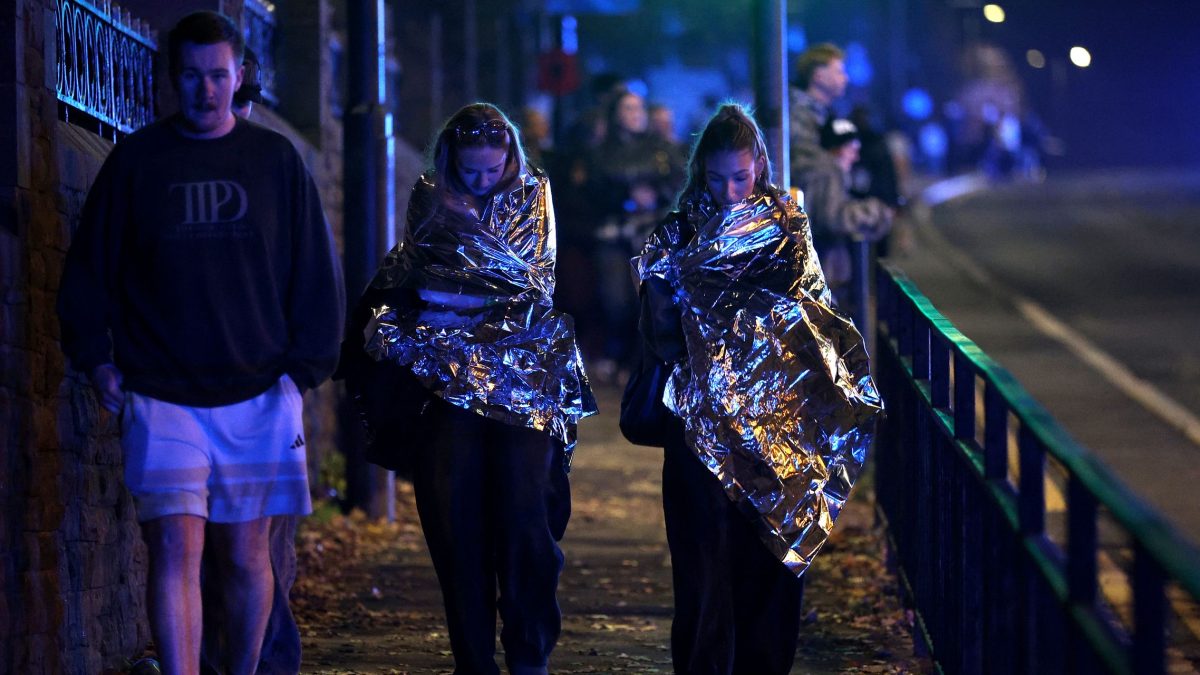
Police in Manchester are investigating after about 12,000 people were evacuated from a concert by US rapper Don Toliver at the Co-op Live arena when an "unknown substance" was released into the crowd. The incident happened towards the end of the show at about 22:00 GMT on Sunday, 22 November 2026, and left fans describing a "horrible smell", people "screaming" and some "coughing up blood". Greater Manchester Police (GMP) declared a major incident, initially believing the substance to be tear gas.
One woman was taken to Manchester Royal Infirmary for further assessment and treatment, and 88 other people were assessed by paramedics for "eye and respiratory symptoms", according to the force and the North West Ambulance Service. The 88 underwent "dry decontamination at the scene" and were accommodated at the nearby Etihad Stadium while the incident was managed. The ambulance service said several crews attended, including its Hazardous Area Response Team. The major incident was lifted at about 04:00 GMT. Police said no arrests had been made and that detectives were investigating "whether any criminality has occurred in relation to this incident".
Fans' accounts were vivid. A group of friends from Scunthorpe, standing in the mosh pit when the substance was released, said they "heard a pop" and "everyone coughing" and running away. One of them, Molly, 19, said: "People not breathing, gagging, gasping for air. It was quite traumatic. People being wheeled out in wheelchairs covered in tinfoil, and no-one in the venue knew what was going on." Another, Kyan, 22, said it "sent a sting into your eyes". Jack, 21, said some people had "pink liquid" on them and that he was told to take off his clothes and put on a hazmat suit, slippers and a mask before being taken to the Etihad to be observed. Charlie, 20, said the process felt "a bit invasive" and "confusing". Leon Douzi, who said he was right next to where the substance was released, described someone holding a can and "this gas coming out", adding: "It just hit me in the throat."
Football journalist Joey Howe, who was at the gig, told BBC Radio Manchester that he saw "a lot of people streaming out" and that when the lights came on Toliver was being rushed off stage. He said people were coming through in wheelchairs "choking" and called it "really distressing". Another attendee said that after an hour or so of the gig being stopped, fans were finally told to evacuate. Police have stated that it was "an isolated incident" and that there is "no wider threat to the public". Assistant Chief Constable Tom Harding said enquiries "remain ongoing to establish the nature of the substance, where it came from and any associated risk", with tests continuing on items found at the venue. He urged anyone who left the event and has since become unwell to attend their local hospital. Greater Manchester Mayor Bev Craig thanked emergency services and venue staff for their "professionalism".
The incident has led to questions about security. Some fans complained about a lack of searches on the way in. Malachi Clarke, 19, said security was "not good at all" and that bags were not being checked "to the point where I had to ask them if they needed to check mine". Jessica Moult-Boffey, 23, said she felt "confused on how something like that got into a venue of that size". Co-op Live says on its website that it has a range of security measures, some visible and others not, and uses "frictionless security screening that detects prohibited items without you needing to empty your pockets". Figen Murray, the mother of a Manchester Arena attack victim who campaigned for a new law to prevent terrorist attacks at public venues, said people should feel "assured". She said the current technology is "good enough" but needs to become "more sophisticated" in coming years, and noted that venues are focused on keeping out items such as explosives that could cause mass casualties.
There are signs the incident may not have been the first. Fans at Toliver's other gigs have claimed that similar incidents happened earlier on his tour: they reported that a spray or gas was released into the crowd in Zurich and Paris. Police have not said whether the cases are linked. The tour, called Nitrous, is the latest for the 32-year-old artist, whose real name is Caleb Zackery Toliver and who recently received five nominations for the 2027 Grammy Awards, including Best New Artist.
The knock-on effects for the tour were immediate. Toliver was due to play The O2 in London on Monday and Wembley Arena on Tuesday, but promoter Live Nation said his "stage and production equipment remains in Manchester and cannot be moved in time". The Wembley show has been rescheduled to 14 December, and the O2 gig to 15 December. Tuesday's Wembley appearance had been due to be the last gig of his world tour before a break from the road ahead of a Coachella appearance next spring. Live Nation said that all fans at the Manchester show will receive a full refund, processed automatically, saying: "We are sorry to everyone affected by last night's events in Manchester."
Toliver wrote on Instagram: "I'm very sad to sit here and say I have to reschedule The O2 London show to December 15th due to (the) unfortunate incident last night." He added: "I just wanna make sure everyone is safe and the next show goes on properly. My heart and prayers are with everyone that was injured last night." He asked people to stop bringing substances into his shows: "The only thing I love more than creating music is performing for my fans… It ain't cool." Toliver is best known for singles such as No Idea and After Party, from his 2020 debut studio album Heaven or Hell, which was a hit on TikTok, and for featuring on Travis Scott's track Can't Say from the album Astroworld.
The episode raises broader questions about safety at live events. Large arenas rely on layers of security: bag checks, screening, CCTV, staff and plain-clothed officers, as Murray notes, but the incident suggests that a determined person can still get an irritant into a crowd. The venue, which says it is working closely with police, will face scrutiny over how the substance entered and over how the evacuation was handled, especially given fans' reports that people inside did not know what was happening for a long period. Organisers will also face a decision about whether to change screening at the remaining shows of a tour where earlier incidents have been reported.
For the fans affected, the priority is recovery: several said they were still suffering from headaches, chest pains and sore throats a day later. For the police, the priority is identifying the substance and whoever released it. For the music industry, the incident is another reminder that audience safety is not an afterthought. A concert is an environment where thousands of people are packed tightly together, and when something goes wrong the effects spread fast. Manchester has had painful experience of what can happen at live events, and the swift declaration of a major incident reflects how seriously authorities take any threat to crowds. The answers that fans have asked for, about what the substance was and how it got in, are what the investigation now needs to provide.