The European Union’s trade commissioner is in Beijing for talks on a trade deficit with China that now exceeds 1 billion a day. France and Germany are pressing for a new tool that would let Brussels retaliate quickly against economic pressure.
European Trade Commissioner Maroš Šefčovič has arrived in Beijing for talks on the European Union’s growing trade deficit with China, Al Jazeera reported on October 7.
He is meeting Chinese Commerce Minister Wang Wentao on Thursday and Friday.
What Is on the Table
The talks follow months of discussions over two issues:
- the EU’s trade deficit with China, which is more than €1 billion ($1.12 billion) a day
- Chinese restrictions on exports of rare earths and other critical minerals
Officials from the two sides have been discussing trade imbalances since June. Šefčovič has said he wants “tangible results by October”, along with some form of commitment that can be put to EU leaders.
The Car Dispute
Chinese carmakers are increasingly challenging Europe’s leading brands.
China has rejected an EU request for voluntary limits on its exports of hybrid cars, the Financial Times reported. The European Commission now hopes to persuade Beijing to accept a cap on hybrid imports set by the EU itself, the newspaper said, citing two diplomats.
Pressure From Paris and Berlin
On Tuesday, French President Emmanuel Macron and German Chancellor Friedrich Merz urged the EU to prepare a “credible instrument” that could be activated quickly against countries that harm the bloc economically.
The measure would not target any specific country. German officials said the EU needs a tool as powerful as the Section 301 tariffs used by the United States or China’s restrictions on critical-mineral exports.
It would give the European Commission the power to respond to trade aggression within days. EU leaders are due to discuss it at a summit next week.
Separately, a majority of EU lawmakers called on Wednesday for a more assertive trade policy towards Beijing, in a non-binding resolution.
China’s Response
China has promised a “resolute response” to protect its industries if the EU goes ahead with restrictions on Chinese companies or products.
On the Franco-German proposal, its commerce ministry said: “We hope that France and Germany, as major economies in the world, will uphold openness, cooperation and free trade.”
It added that they “should avoid going down the wrong path in the wrong way, only to ultimately suffer the consequences themselves”.
Beijing’s position is that talk of economic imbalances and overcapacity is a form of protectionism designed to put pressure on China.
What Comes Next
Trade relations with China top the agenda of next week’s EU summit in Brussels.
European Commission President Ursula von der Leyen told the European Parliament last month that the trade imbalance had reached a tipping point, and that Europe would use every tool at its disposal to rebalance the relationship.
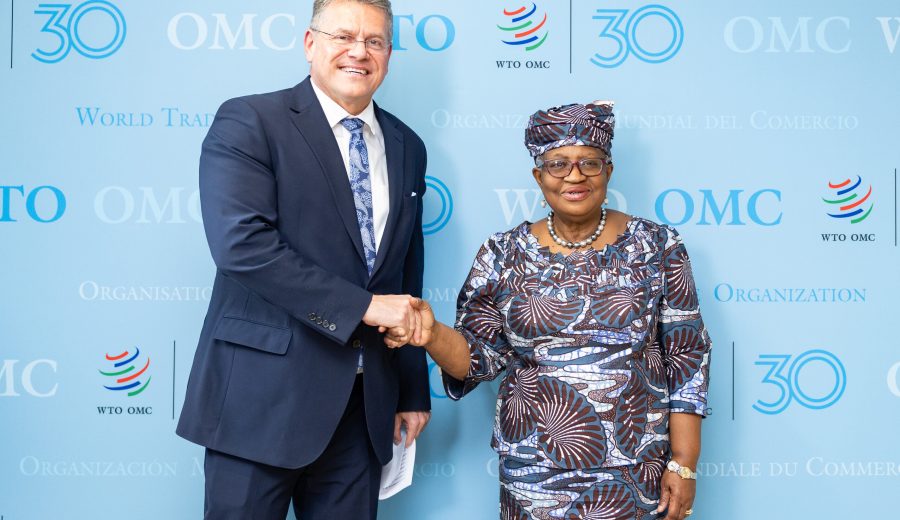
Image: EU Trade Commissioner Maroš Šefčovič with WTO Director-General Ngozi Okonjo-Iweala, January 2025 (not the Beijing talks). Photo by Pierre Albouy / European Union via Wikimedia Commons, CC BY 4.0.